The rapid embrace of AI in China, its biggest testing ground, may shape
how AI is used globally
[May 06, 2026] By
CHAN HO-HIM
HONG KONG (AP) — On a recent weekday, around 50 people gathered outside
the headquarters of a Chinese mobile internet company, waiting to get
help with installing an artificial intelligence assistant.
The scene in Beijing, China's capital, was repeated for days at several
events and was also seen in the southern technology hub Shenzhen in
March, as engineers helped crowds trying to set up the popular AI
“agent” OpenClaw on their laptops.
“I’m worried about falling behind in technological developments,” said
Sun Lei, a 41-year-old human resources manager at the Cheetah event. She
said she hoped the tool might help her source and screen resumes across
various recruitment platforms.
More than a year after OpenAI's Chinese rival DeepSeek stunned the world
with its advanced AI model, China has become a testing ground for mass
use of AI tools. AI models built in the United States still dominate in
raw computing firepower, but Chinese people and businesses have rapidly
embraced the technology, facilitating its swift and widespread adoption
in almost every possible field.
As global AI adoption rises quickly at workplaces and in daily lives,
ordinary Chinese are using AI for all sorts of things, from booking and
planning travel, ordering food and hailing rides. Of its 1.4 billion
population, more than 600 million were using generative AI as of
December, a 142% increase from a year earlier, according to a report by
the government-controlled China Internet Network Information Center.

And, with the recent surge in the use of “agentic” AI like OpenClaw
including for many Chinese businesses, the consumption of data by AI
models has also risen. Measured in what computer scientists call tokens,
or units of data such as part of a word, the weekly share used by
Chinese AI models has recently surpassed U.S. models, according to
OpenRouter, an AI “gateway platform” that tracks data and enforces
security across different AI models.
AI adoption positions China as a ‘world leader’
Jason Tong, a 64-year-old retiree in Shanghai who has worked as an IT
engineer, has been using AI chatbots such as Doubao and Kimi for
everyday queries since they were first introduced a few years ago.
He began paying closer attention to his health and in early March joined
a blood glucose monitoring service run by a Shanghai-based company that
uses an AI model to generate tailored health advice. He has found its
personalized, rapid responses helpful.
Widespread adoption of AI applications in everyday life is inevitable,
Tong believes, “Just as carriages were eventually replaced by trains,
this is bound to happen.”
Chinese products incorporating AI such as cars and robots are making
major advancements, from humanoid robots with advanced cognitive
capabilities to AI systems that drivers can use for more complicated
tasks like making a restaurant reservation.
“The (AI) competition is clearly shifting from models to ecosystems,”
said Lizzi Lee, a fellow at the Asia Society Policy Institute’s Center
for China Analysis focused on economics and technology. “Chinese users
are basically acting as real-time testers at scale.”
Chinese technology companies like Tencent, Alibaba and Baidu are also
racing to commercialize AI. Tencent integrated OpenClaw into WeChat,
China's own “super-app” which is primarily a messaging tool but can also
be used to do things like ordering food and making payments. Alibaba is
embedding “agentic” AI into its workflows.

OpenClaw fuels wider use of China AI applications
OpenClaw, originally created by Austrian software developer Peter
Steinberger last year, won quick and enthusiastic use thanks to its
ability to use various tools to complete complicated tasks.
Zhao Yikang, a Chinese college student in Macao, uses OpenClaw in both
his studies and daily life.
He was struck by how low-cost and efficient it is, using it to
automatically generate promotional videos and manage social media
accounts during his internship at a real estate agency in the southern
Chinese city of Zhuhai.
“AI can understand things in a second,” Zhao said. “You just need to act
as a commander and tell it what to do.”
[to top of second column] |
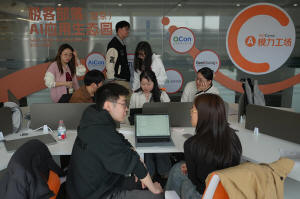
Staff members help their customers install the RedClaw AI software
on their laptops in Beijing on March 22, 2026. (AP Photo/Andy Wong)
 Preparing to start a photo services
business after graduation, Zhao asked AI to build a company website.
Within 10 minutes, it had generated a fully functional site for less
than 5 yuan (70 cents).
At one point, Chinese authorities issued several warnings about
potential security risks over OpenClaw AI “agents” like data leaks
as installations spiked, the broad interest had not faded.
Chinese companies increasingly are setting internal targets for
boosting use of AI to improve efficiency, said Janet Tang, a partner
& managing director focused on technology at consultancy
AlixPartners.
There are “a lot of application scenarios,” said Wang Xiaogang,
co-founder of the Chinese AI software company SenseTime and chairman
of ACE Robotics. “The industry is developing very fast and the
people, they are very open and they’re eager to try the AI in a lot
of scenarios.”
US export controls both help and hinder AI use in China
China has sought to stack the deck in its favor, investing heavily
in nurturing talent and ensuring access to abundant, affordable
electricity for power-hungry AI developments and breakthroughs.
To achieve technology breakthroughs including in AI, Chinese leaders
have pledged an annual average growth of at least 7% in nationwide
spending on research and development in the country’s five-year plan
until 2030. An “AI plus” national blueprint outlines steps to
integrate AI into many areas of life, from healthcare to education.
Judges in Shenzhen processed 50% more cases last year, a court said,
partly with the help of an AI tool assisting judicial processes.
However, limited access to the some of the world’s most advanced
computer chips due to U.S. restrictions remains a bottleneck for
China’s AI advancement.

“Export controls on tools have slowed China’s chipmaking
capabilities, and are the Achilles' heel of many AI labs that need
advanced AI chips,” said Samm Sacks, a senior fellow at New America
focused on Chinese technology policies.
But the controls also have led to improved coordination of design,
manufacturing and adoption across China’s tech supply chain. “Over
time this dynamic could fuel, not foil, China’s ambitions,” Sacks
said.
China is becoming an AI ‘innovator’
When China's DeepSeek released its long-anticipated V4 AI model
preview last month, one major change was that it’s supported in part
by computer chips made by Chinese tech giant Huawei. That means less
dependence on top U.S. chipmakers such as Nvidia.
A recent report by Stanford University’s Institute for
Human-Centered AI says the U.S.-China gap in top AI models’
performance has “effectively closed.”
U.S. policymakers and top AI firms including Anthropic and OpenAI
have accused Chinese AI startups of stealing U.S. AI technologies.
China says such allegations are groundless.
Lian Jye Su, a chief analyst at the research and advisory group
Omdia, believes any AI gap between the U.S. and China will continue
to narrow, despite U.S. export controls and China’s Great Firewall,
the ruling Communist Party's massive internet filter and censorship
system.
Analysts including Su believe that hurdles such as the Great
Firewall are will likely impacts China's AI use in limited ways,
given that the technology already is being tested, integrated and
scaled up under China's controlled internet environment.
“It won’t be long before China moves from fast follower to parallel
innovator,” he said.
___
AP researcher Shihuan Chen and journalists Dake Kang in Beijing and
Matt O'Brien in Providence, Rhode Island contributed.
All contents © copyright 2026 Associated Press. All rights reserved |