Spring plans meet snow in Denver as a late storm could be the season's
biggest
[May 06, 2026]
By MEAD GRUVER and KATHY McCORMACK
FORT COLLINS, Colo. (AP) — While some Americans were gazing at tulips
and mowing lawns, people in Colorado and Wyoming were getting out their
snow shovels.
A late snowstorm swept over the Rocky Mountains and into the High Plains
on Tuesday, bringing heavy, wet accumulation north of Denver into
southeastern Wyoming.
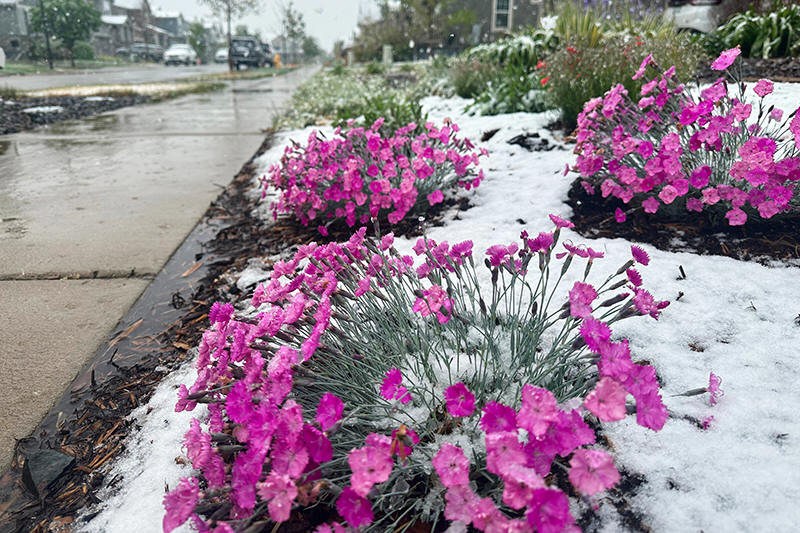
In Fort Collins, Colorado, heavy snow fell throughout the day on ground
that was still too warm for significant accumulation. Slushy snow clung
to leaves, grass and flowers, and homeowners shut off yard sprinklers
lest sub-freezing temperatures damage their plumbing.
Boulder, nestled against the mountains, could get upward of a foot (30
centimeters) of snow. While the Denver area experienced mostly rain on
Tuesday, that turned into snow by early evening. Forecasts predict up to
8 inches (20 centimeters) of snow is possible into Wednesday.
Even as Denver imposed lawn-watering restrictions to address what have
been low mountain snows, the city was facing what may be its biggest
snowfall of the season.
“We just had our driest winter on record,” Kenley Bonner, a
meteorologist in the weather service’s Denver office, said. “We were
kind of joking earlier in the season that winter’s not going to come
until spring, and it did exactly that.”

Big snow and a fast drop in temperature
More accumulation was expected with temperatures plunging overnight and
the heaviest snow continuing into Wednesday morning. Warmer temperatures
are expected to return Thursday, the National Weather Service said.
The state's largest school district, Denver Public Schools, and other
major districts and colleges in the region canceled Wednesday classes
due to severe weather.
Accumulated snow could snap tree branches and knock out power, Bonner
said. Utilities were preparing, with Xcel Energy putting 165 employees
on standby across the state.
Highways remained open Tuesday for the time being. Interstate 80 across
southern Wyoming, including a high-elevation stretch between Cheyenne
and Laramie that closes often, was open but webcams showed heavy
snowfall.
Others along northern Colorado mountain highways also showed
deteriorating conditions.
The ominous forecast did not deter thousands from attending the David
Guetta show at Red Rocks Amphitheatre, though organizers moved the start
time up by an hour in hopes of getting fans home before the worst of the
storm.
Concertgoers bundled up in furry winter coats and beanies while waiting
in line to enter the outdoor venue.
Wait, snow in May?
The forecast is somewhat unusual but not unheard of.
Denver typically sees its last snowfall around April 28, although May
storms do happen. The “Mile High City” recorded half an inch of snow
(1.2 centimeters) on May 21, 2022, while nearby Boulder got 4.5 inches
(11.4 centimeters).

[to top of second column]
|
Wet snow falls on flowers Tuesday, May 5, 2026, in Fort Collins,
Colo. (AP Photo/Mead Gruver)

Historically, Denver has seen at least five May storms with snowfall
over 10 inches (25 centimeters). The biggest, in 1893, dropped 15.5
inches (39.3 centimeters). The city's most recent double-digit snow
was May 25-26, 1950, with 10.7 inches (27 centimeters).
A light dusting on June 2, 1951, was the latest time in the year it
snowed.
The worsening storm caused the Colorado Rockies to reschedule two
games against the New York Mets. But that happens more often than
not during Denver's spring baseball season, including four times in
2015, according to MLB.
May snows are even more common in the Wyoming capital of Cheyenne,
which is almost 1,000 feet (300 meters) higher than Denver and
cooler year-round. Wyoming is also windier than Colorado, pushing
snow into drifts that must be re-plowed if gusts persist.
The storm is welcome during a drought, but not a fix
April was warmer than usual and short on precipitation, with Denver
missing an inch of rain (2.5 centimeters) and 2.8 inches of snow (7
centimeters) last month compared to normal.
For some farmers, who have felt the pressure from Colorado's ongoing
drought, the snow was an opportunity.
Adam Jones, who runs Unsung Family Farms in Longmont, told KMGH-TV
that he had planted carrot seeds days before to take advantage of
the precipitation.
“You can’t get as even distribution with driplines or sprinklers,”
he said. “There’s nothing like starting seeds with snow or water.”
Jones had to move the more weather-sensitive crops inside, however,
with a heater to keep them warm.
But one storm won't solve the West's water problems.

A report from the National Drought Mitigation Center said recent
precipitation helped boost topsoil moisture and reduced irrigation
demands, but hasn't changed a “mostly bleak” water outlook heading
into the summer.
Wildfires also thrive in the dry conditions. Firefighters across the
West have been turning to artificial intelligence and other
technology to catch small fires before they expand.
Storms elsewhere, too
The unsettled weather isn’t limited to the Rockies.
Thunderstorms are expected from northeast Texas into western
Tennessee, with Arkansas facing the greatest risk of large hail,
damaging winds and possible tornadoes, according to the Storm
Prediction Center. Isolated strong storms could also reach parts of
the Northeast.
____
McCormack reported from Concord, New Hampshire. AP reporter Jaimie
Ding contributed from Los Angeles.
All contents © copyright 2026 Associated Press. All rights reserved |