Oil prices sink and stocks leap worldwide on hopes for a reopening of
the Strait of Hormuz
[May 07, 2026] By
STAN CHOE
NEW YORK (AP) — Oil prices sank Wednesday, and stock markets rallied
worldwide with hopes that the United States and Iran are nearing a deal
to allow ships to deliver crude from the Persian Gulf once again to
their customers.
The price for a barrel of Brent crude oil, the international standard,
fell 7.8% to $101.27, down from more than $115 early this week. It
dropped as President Donald Trump said the Strait of Hormuz could be
“OPEN TO ALL” if Iran accepts a reported agreement that the U.S.
president did not detail.
The small strait has caused big trouble for the global economy because
the war with Iran has blocked oil tankers from using it to exit the
Persian Gulf. A reopening could allow oil to flow freely again and
remove upward pressure on inflation that’s driving prices up for all
kinds of products worldwide.
On Wall Street, the S&P 500 climbed 1.5% for its best day in nearly a
month and hit another all-time high. The Dow Jones Industrial Average
jumped 612 points, or 1.2%, and the Nasdaq composite rose 2% to its own
record.
Stock markets abroad had even bigger gains, with indexes leaping 6.5% in
Seoul, 2.9% in Paris and 2.1% in London.
Of course, hopes have risen several times already on Wall Street about a
possible end to the war with Iran, only to get dashed each time. That
could happen again, and oil prices pared some of their steepest losses
from Wednesday morning.
The price for a barrel of Brent briefly dove below $97 before returning
above $100 after Trump threatened to start bombing “at a much higher
level and intensity” if Iran does not accept the agreement.

Wall Street nevertheless latched onto some potentially encouraging
signals. Trump said Tuesday he was pausing his effort to forcefully
reopen the Strait of Hormuz to commercial ships. And China’s foreign
minister called for a comprehensive ceasefire following a meeting with
Iran’s foreign minister. That could be influential because of how
closely tied Iran is to China economically and politically.
In the meantime, big U.S. companies continue to turn in much stronger
profits for the start of 2026 than analysts expected. That’s supporting
the stock market despite all the uncertainties created by the war.
AMD helped lead the market with a surge of 18.6% after it joined the
list of big-name companies topping expectations for both profit and
revenue. CEO Lisa Su said the chip company benefited from continued
growth from artificial-intelligence technology, which is demanding
tremendous amounts of computing power from data centers.
[to top of second column] |

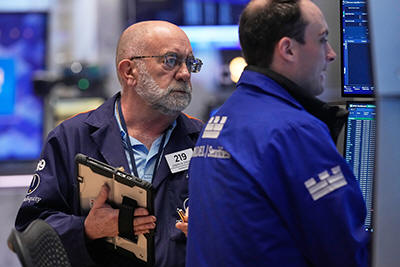
Trader Joseph Stevens, left, works on the floor of the New York
Stock Exchange, Tuesday, May 5, 2026. (AP Photo/Richard Drew)
 AMD also said its revenue growth
could accelerate in the current quarter to roughly 46% from a year
earlier.
Another company enmeshed in the AI industry, Super Micro Computer,
rallied 24.5% after likewise delivering stronger earnings than
analysts expected. Nvidia, the chip company that became the poster
child of the AI boom, rose 5.7% and was the single strongest force
lifting the S&P 500 because of its immense size.
CVS Health climbed 7.6% after delivering better results for the
first quarter than analysts expected and raising its financial
forecasts for the full year. The Walt Disney Co. gained 7.5% after
saying its “Zootopia 2” movie helped draw people to its streaming
business, parks and cruise ships, while delivering a
better-than-expected profit. Uber Technologies drove 8.5% higher
after giving a bookings forecast for the spring that was higher than
analysts expected.
Outside of earnings reports, companies with big fuel bills jumped on
hopes that oil prices will continue to ease. That included gains of
6.8% for United Airlines, 6.8% for Carnival and 8.8% for Royal
Caribbean.
All told, the S&P 500 rose 105.90 points to 7,365.12. The Dow Jones
Industrial Average jumped 612.34 to 49,910.59, and the Nasdaq
composite climbed 512.82 to 25,838.94.
In the bond market, Treasury yields sank as falling oil prices took
pressure off inflation. The yield on the 10-year Treasury dropped to
4.35% from 4.43% late Tuesday. That’s a notable move for the bond
market.
Lower yields can bring down rates for mortgages and other kinds of
loans going to U.S. households and businesses, which in turn can
give the economy a boost. Lower yields also tend to push upward on
prices for stocks and other kinds of investments. The 10-year yield,
though, remains well above its 3.97% level from just before the war.
In stock markets abroad, South Korea’s Kospi jumped above the 7,000
level for the first time to a record thanks to big gains for AI
winners, including Samsung Electronics and SK Hynix.
___
AP Business Writers Yuri Kageyama and Matt Ott contributed.
All contents © copyright 2026 Associated Press. All rights reserved |