Lower-income Americans hit hardest by gas price spike, widening
inequalities, study finds
[May 07, 2026] By
CHRISTOPHER RUGABER
WASHINGTON (AP) — Lower-income Americans sharply reduced their gas
consumption in the month following the Iran war, yet spiking prices
still forced them to spend more at the pump, worsening the economy's
economic disparities, new research released Wednesday showed.
Higher-income households, meanwhile, ratcheted up their spending on gas
while barely reducing their consumption, according to a report from the
Federal Reserve Bank of New York. Middle-income households fell
in-between.
The gaps between how each group reacted were larger than in 2022, when a
similar gas-price shock occurred after the Russian invasion of Ukraine,
the report found. Higher-income households cut back more on their gas
consumption four years ago than in March, while poorer households likely
benefited more from government stimulus programs in 2022. Wealthier
households have seen significant increases in the value of their stock
and real estate holdings since then as well.
The figures suggest the gas-price surge has worsened what many
economists call the “K-shaped economy." The K-shape label refers to
upper-income Americans continuing to do well while lower-income
households fall behind. The disparate outcomes can help explain the
generally gloomy attitude most Americans have toward the economy even as
headline figures, such as the unemployment rate and economic growth,
remain mostly solid.
“We find that households had very different experiences with gasoline
spending,” researchers at the New York Fed wrote. “With the sharp
increases in gasoline prices in March, a K-shaped pattern in gasoline
consumption emerged—showing faster consumption growth for high income
households relative to low-income households.”

The Iran war began Feb. 28, and by the end of March gas prices had risen
about 25%, according to government consumer price data. Overall gas
consumption, according to the New York Fed, fell 3% that month. As of
Tuesday, gas prices have leapt 50% since the war began.
Poorer households, defined as those earning less than $40,000, cut their
gas consumption by 7%, the report found, but still spent 12% more on gas
in March. Higher-income households, defined as those earning $125,000 a
year or above, lifted their spending on gas 19% in March, while reducing
their overall consumption of gas just 1%. The report didn't specify the
middle-income figures.
[to top of second column] |
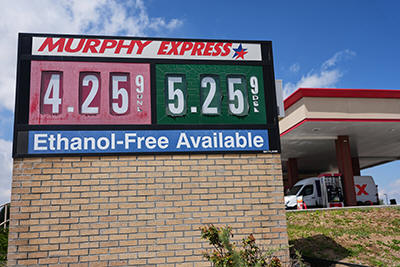
The per-gallon prices for regular unleaded and diesel fuel are
displayed on a sign outside a Murphy Express gasoline station,
Tuesday, April 28, 2026, in Centennial, Colo. (AP Photo/David
Zalubowski)
 The figures suggest lower-income
Americans have cut back on driving, perhaps by carpooling, taking
public transportation, or combining errands into fewer trips, while
richer Americans have had to make few, if any, changes.
The New York Fed report estimates that total spending at gas
stations jumped 15% in March from the previous month. If sustained,
that extra spending on gas will siphon money away from other areas,
reducing overall inflation-adjusted spending and slowing the
economy. So far, there are only limited signs that is happening.
Americans do spend less on gas than in previous decades as cars have
become more efficient.
Consumer spending, adjusted for price changes, ticked up 0.2% in
March, slightly below February's 0.3% gain, the government said last
week.
Still, there is evidence that for many lower-income people, the
spike in gas prices is a big drag on their finances. A separate
report from the Bank of America Institute, released last week, found
that among the poorest one-third of households, one-tenth now spend
10% of their incomes on gas. The figure is far above the average for
higher-income households, who spend just 2.7% of their incomes on
gas.
Data from the Institute, which compiles reports from the anonymous
accounts of its customers, also showed that more expensive gas has
pulled some spending away from discretionary items, defined as those
outside groceries, gas, and utilities. The annual growth in poorer
households' discretionary spending slowed in March from February,
while it rose for middle- and upper-income households.
All contents © copyright 2026 Associated Press. All rights reserved
 |