Johnson, municipal leaders statewide clash with Pritzker over local
funding cuts
[May 07, 2026]
By Sean Reed | The Center Square
(The Center Square) – Mayors and municipalities across Illinois have
called on Gov. JB Pritzker to reverse course on local government state
funding decreases.
Chicago Mayor Brandon Johnson appeared at the State Capitol alongside
other Chicago-area mayors late Wednesday, dropping in on the legislature
during a busy part of the legislative season.
The Local Government Distributive Fund – as its name suggests – provides
state funding to municipalities statewide and was originally intended to
be allocated at 10% of all state income tax revenue.
In the many years since creation, the LGDF has seen a significant
decrease to only 6.47%, which many local government leaders say has
created significant hardship in balancing their municipal budgets.
As mayor of the largest city in the state, Johnson said the decrease in
funding proposed by Pritzker for the coming year would slash an
additional $12 million in funding to the city of Chicago, and a combined
$60 million statewide.
“These cuts inhibit our ability to increase accessibility on our public
transit systems, make the investments we need to build safe communities,
and build the affordable housing that we need,” Johnson said.
State Rep. Anthony DeLuca, D-Chicago Heights, who is the longtime chair
of the Cities and Villages House Committee – and a former mayor – said
it's time to return to the original 10% rate.

“Over the last 10 years, municipal governments have contributed greatly
to the Illinois budget. They have sacrificed needed dollars for our
first responders while watching the state spending increase. Municipal
governments have subsidized the state budget since LGDF was originally
cut by an amount over $10 billion. It's time to make it right,” DeLuca
said.
DeLuca also proposed an immediate change that could further bring costs
down for local governments: a slashing of a 1.5% fee the Illinois
Department of Revenue collects on some municipal taxes.
[to top of second column]
|
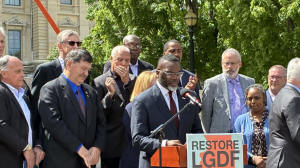
Chicago Mayor Brandon Johnson addresses reporters at a press
conference about the Local Government Distributive Fund on the steps
of the Illinois State Capitol in Springfield. Photo: Sean Reed / The
Center Square

State Rep. Jennifer Sanalitro, R-Carol Stream, reflected the
concerns of municipal leadership in a statement Tuesday.
“The bottom line is that the governor wanting to cut these LGDF
funds from local governments will make it harder for communities to
manage costs and potentially force them to raise property taxes as a
result,” Sanalitro said.
The coalition of 275 municipalities from across the state is diverse
in it’s make-up, including Republicans and Democrats from rural,
suburban and urban areas. Another prominent member of the group is
Broadview Mayor Katrina Thompson.
Broadview is host to the single Immigration and Customs Enforcement
detention facility in state, and Thompson’s village saw unrest as
ICE and Border Patrol carried out operation Midway Blitz during the
Fall last year.
Johnson noted what he thinks the role of local government ought to
be in such a time.
“Local municipalities have had to bear the brunt of the federal
attacks. And it's imperative in this moment that we remain united,
no matter what section of the state that you live in, that we are
not harming working people,” Johnson said.
Thompson said a cut to LGDF – along with costs to the village from
last year’s events – will force her and other municipal leaders to
choose between essential local government services for funding.
“We have already observed over $700,000 in cost from operation
Midway Blitz, which includes significant losses to our local
businesses,” Thompson said. “These are not luxuries in communities
like ours, they are necessities. Decisions made without us are still
being paid for by you. This is just not fiscally irresponsible, it’s
inequitable.” |