Polls open in UK local elections seen as a verdict on Keir Starmer's
leadership
[May 07, 2026]
By JILL LAWLESS
LONDON (AP) — British voters cast ballots Thursday in local and regional
elections that could shake up the country's politics and deliver a heavy
blow to embattled Prime Minister Keir Starmer.
Starmer’s center-left Labour Party is bracing for big losses in polls
that will choose about 5,000 local councilors and a handful of mayors
across England, as well as semiautonomous parliaments in Scotland and
Wales.
Polls opened at 7 a.m. and will close at 10 p.m. (2100 GMT). Some local
authorities will count ballots overnight, but the bulk of the results
are likely to be declared on Friday afternoon.
Local elections usually focus on issues like garbage collection,
graffiti and potholes, but Starmer’s opponents have painted Thursday's
vote as a midterm referendum on the prime minister.
A rout could trigger moves by restive Labour lawmakers to oust a leader
who led them to power less than two years ago. Even if Starmer survives
for now, many analysts doubt he will lead the party into the next
national election, which must be held by 2029.
Starmer’s popularity has plunged after repeated missteps since he became
prime minister in July 2024. His government has struggled to deliver
promised economic growth, repair tattered public services and ease the
cost of living — tasks made harder by the U.S.-Israeli war with Iran,
which has choked off oil shipments through the Strait of Hormuz.
Starmer has been further hurt by his disastrous decision to appoint
Peter Mandelson, a scandal-tarnished friend of Jeffrey Epstein, as
Britain’s ambassador to Washington.

Labour is defending about 2,500 seats on English local councils, and
party members are apprehensive it may lose many of them.
Starmer has already survived a crisis in February, when some Labour
lawmakers, including the party’s leader in Scotland, urged him to quit
over the Mandelson appointment.
Far-right Reform UK expected to win big
Luke Tryl of pollster More in Common said the local elections are likely
to see “the total collapse of the traditional two-party system” that was
dominated for decades by the Labour and Conservative parties.
The big winner is expected to be hard-right party Reform UK, led by
Nigel Farage, which is aiming for working-class, former Labour
strongholds in England’s north and on London’s outer edges with its
anti-establishment, anti-immigration message. The Green Party is also
likely to gain hundreds of council seats in urban centers and university
towns.
[to top of second column]
|
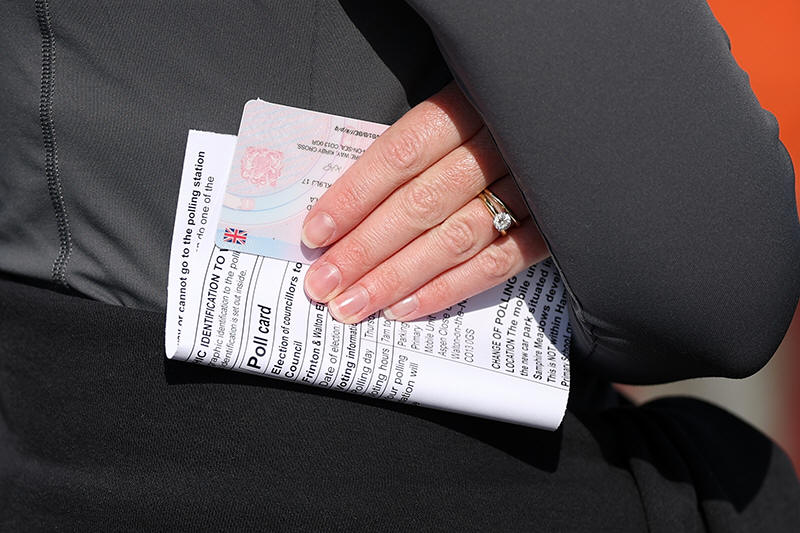
A voter holds a polling card as she queues at a polling station in
Walton on the Naze, England, Thursday, May 7, 2026 to cast her vote
in the UK local elections.(AP Photo/Richard Pelham)
The main opposition Conservative Party is also expected to lose
ground, with the centrist Liberal Democrats making some gains.
Starmer didn’t even mention the Conservatives in his final
preelection message, framing it as a choice between “progress and a
better future” under Labour and “the anger and division offered up
by Reform or empty promises from the Greens.”
Farage said on the eve of the election that a strong result for
Reform would mean Starmer is “gone by the middle of summer.”
Both Reform UK and the Greens have grown rapidly in the last year or
two, and are facing increased scrutiny as a result. Farage is facing
questions over a 5 million pound ($6.8 million) donation from a
cryptocurrency billionaire that he accepted in 2024, but did not
declare. He says it was a personal gift.
The environmentalist Greens, who have stressed their pro-Palestinian
credentials under self-described “eco populist” leader Zack
Polanski, have fired several candidates for antisemitic social media
posts.
Reform also is eyeing breakthroughs in Scotland and Wales, though
pro-independence nationalists the Scottish National Party and Plaid
Cymru are likely to form governments in Edinburgh and Cardiff.
“Labour’s going to lose to Reform in some places, Greens in others,
and here and there they’ll lose one or two seats to the Liberal
Democrats and the Conservatives as well,” said Tony Travers, a
professor of government at the London School of Economics. “They’re
fighting on four fronts in England — five in Wales and Scotland.”
All contents © copyright 2026 Associated Press. All rights reserved
 |