UAE reports drone and missile attack as Iran war ceasefire is challenged
[May 08, 2026]
By ADAM SCHRECK and AUDREY McAVOY
DUBAI, United Arab Emirates (AP) — The Iran war’s shaky ceasefire was
further strained on Friday as the United Arab Emirates responded to a
missile and drone attack hours after the U.S. said it thwarted attacks
on three Navy ships in the Strait of Hormuz and retaliated against
Iranian military facilities.
There were no immediate reports of damage in the UAE.
Iran and the U.S. are trading blows as their negotiators are seeking a
deal to end the fighting, but so far they’ve avoided a return to all-out
fighting. It's not clear how close the two sides are to deal on issues
like Iran's nuclear program, which the U.S. and Israel vowed to halt
when they launched the war on Feb. 28, or the Strait of Hormuz, a vital
waterway that Iran has all but closed in a bid to pressure the global
economy.
On Thursday, Tehran said it was examining the latest U.S. proposals for
ending the war delivered to it via Pakistan, which is serving as a
mediator.
Trump played down the exchange of fire between Iran and the U.S. Navy on
Thursday. In a phone call with a reporter for ABC, Trump called the
retaliatory strikes against Iran “just a love tap.” He insisted the
ceasefire is holding and a deal could come “any day,” but reiterated
threats of bombing if Tehran does not accept a deal that allows for
resumption of oil and natural gas shipments disrupted by the conflict.
“They have to understand: If it doesn’t get signed, they’re going to
have a lot of pain,” he told reporters in Washington.
Iranian state media said the country’s forces exchanged fire with “the
enemy” on Qeshm Island in Strait of Hormuz. It also reported loud noises
and continuous defensive fire in western Tehran late Thursday night.
The ceasefire between the U.S. and Iran has largely held since April 8.
In-person talks between the two countries, hosted by Pakistan last
month, failed to reach an agreement to end the war that began Feb. 28
when the U.S. and Israel launched strikes against Iran.

US military says it's not seeking escalation
The UAE's defense ministry advised residents not to approach, photograph
or touch “any debris or fragments that have fallen as a result of
successful air interceptions.”
Hours earlier, the U.S. military said it had intercepted Iranian attacks
on three Navy ships in the Strait of Hormuz Thursday night and “targeted
Iranian military facilities responsible for attacking U.S. forces.”
U.S. Central Command said in a social media post that U.S. forces
intercepted “unprovoked Iranian attacks” and responded with self-defense
strikes.
The U.S. military said no ships were hit. It said it doesn’t seek
escalation but “remains positioned and ready to protect American
forces.”
President Donald Trump told reporters that the ceasefire was holding
despite the violence.
Pakistani Foreign Minister Ishaq Dar spoke by phone Thursday with his
Iranian counterpart, Abbas Araghchi, the Pakistani Foreign Ministry
said.
“We expect an agreement sooner rather than later,” Pakistani Foreign
Ministry spokesperson Tahir Andrabi said. “We hope the parties will
reach a peaceful and sustainable solution that will contribute not only
to peace in our region but to international peace as well.”
He declined to give a timeline.
Pakistani Prime Minister Shehbaz Sharif, speaking in televised remarks,
said Islamabad remained in “continuous contact with Iran and the United
States, day and night, to stop the war and extend the ceasefire.”
[to top of second column]
|
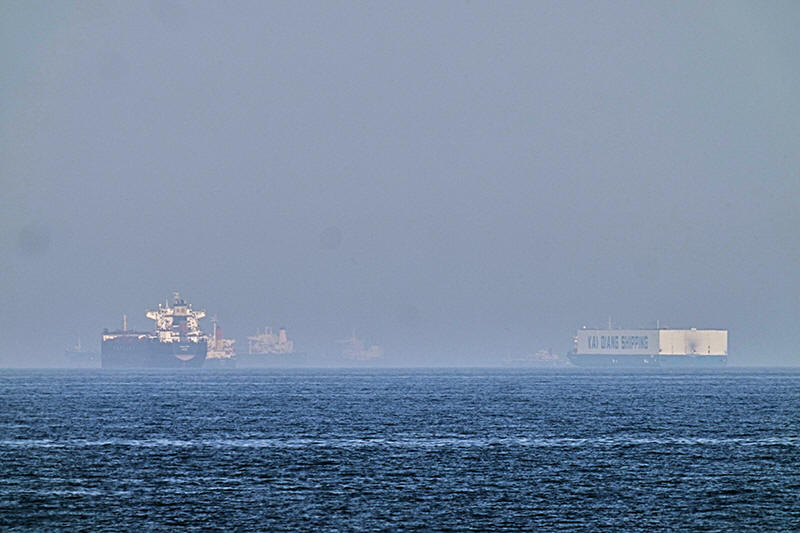
A tanker, left, and a car carrier are anchored at sea in the Gulf of
Oman near the Strait of Hormuz, as seen from the coast near Khor
Fakkan, United Arab Emirates, Friday, May 1, 2026.(AP Photo/Fatima
Shbair)

Meanwhile, direct talks between Israel and Lebanon were scheduled to
resume next week in Washington, according to a U.S. official who
spoke on condition of anonymity to discuss plans for the closed-door
meetings. The official said talks will be held May 14 and 15.
Iran creates agency to control passage at Hormuz
Earlier on Thursday, a shipping data company reported that Iran has
created a government agency to vet and tax vessels seeking passage
through the crucial strait.
The Iranian effort to formalize control over the channel raised new
concerns about international shipping, with hundreds of commercial
vessels bottled up in the Persian Gulf and unable to reach the open
sea. Still, hope that the two-month conflict could soon be over
buoyed international markets.
The report by shipping data firm Lloyd’s List Intelligence that Iran
has established a new government agency to approve transit and
collect tolls from shipping in the strait raised concerns over the
freedom of navigation on which global trade depends.
The agency, called the Persian Gulf Strait Authority, is
“positioning itself as the only valid authority to grant permission
to ships transiting the strait,” Lloyd’s reported in an online
briefing Thursday. Lloyd’s said the authority had emailed it an
application form for ships seeking passage.
On Friday, an oil tanker that passed through the Strait of Hormuz in
mid-April arrived off South Korea's coast for its 1 million barrels
of crude to be unloaded at the HD Hyundai Oilbank refinery. South
Korea, which last year imported more than 60% of its crude through
the strait, has capped prices of gasoline and other petroleum
products as the war raises fears of an energy crisis.
Iran has effectively closed the strait, a vital waterway for the
shipment of oil, gas, fertilizer and other petroleum products, while
the U.S. is blockading Iranian ports. The disruptions have sent fuel
prices skyrocketing and rattled the global economy.
The new Iranian agency formalizes a system Iran has used to let
ships through the strait and charge tolls during the war. Iran aims
to control which ships pass and, for at least some vessels, impose a
tax on their cargo.

Maritime law experts say Iran’s demands to vet or tax vessels
violate international law. The United Nations Convention on the Law
of the Sea calls for countries to permit peaceful passage through
their territorial waters. The U.S. has threatened to impose
sanctions on companies that pay tolls to Iran.
The U.S. and its Gulf allies are pushing for the U.N. Security
Council to support a resolution that condemns Iran’s chokehold on
the strait and threatens sanctions. A prior resolution calling for
reopening the strait was vetoed by Iran's allies Russia and China.
___
McAvoy reported from Honolulu.
All contents © copyright 2026 Associated Press. All rights reserved |