Tennessee enacts new US House map carving up majority-Black district in
Memphis
[May 08, 2026]
By TRAVIS LOLLER, KIM CHANDLER, JEFFREY COLLINS and DAVID
A. LIEB
NASHVILLE, Tenn. (AP) — Amid raucous protests Thursday, Republicans in
Tennessee enacted a new U.S. House map that carves up a majority-Black
district in Memphis, reshaping it to the GOP’s advantage as part of
President Donald Trump’s strategy to hold on to a slim majority in the
November midterm elections.
The final Senate vote unfolded as demonstrators chanted loudly in the
galleries and hallways. Democratic state Sen. Charlane Oliver stood on
her desk in the Senate chamber, holding a banner denouncing the
redistricting as a “Jim Crow” effort, then clapping and dancing. Other
Democratic senators linked arms in the front of the chamber. Republican
leadership quickly adjourned the special session, sending the new map on
to Republican Gov. Bill Lee, who promptly signed it into law.
Protesters in the galleries also had disrupted the Republican-led House
as it voted for the new map — yelling, chanting and blowing air horns.
In the hallways, other shouting protesters were held back by Tennessee
state troopers.
Not long after the new map became law, the NAACP Tennessee State
Conference sued in state court asserting that the mid-decade
redistricting is illegal.
Tennessee is the first state to pass new congressional districts since a
U.S. Supreme Court ruling last week significantly weakened federal
Voting Rights Act protections for minorities. But more Southern states
could follow. Republicans in Louisiana, Alabama and South Carolina also
have taken steps toward redistricting.
The Supreme Court ruled that Louisiana relied too heavily on race when
creating a second Black-majority House district as it attempted to
comply with federal law. The high court’s decision altered a decades-old
understanding of the law, giving Republicans grounds to try to eliminate
majority-Black districts that have elected Democrats.

Louisiana has postponed its congressional primary to give state
lawmakers time to craft a new House map. Legislation awaiting a final
vote Friday in Alabama also would upend the state’s congressional
primaries if courts allow changes to its U.S. House districts. In South
Carolina, meanwhile, Republican state House members released a proposed
new congressional map designed to give them a clean sweep of the seats.
The states are the latest to join an already fierce national
redistricting battle. Tennessee is the ninth state to redraw its
congressional districts since Trump prodded Texas Republicans to do so
last year. From that spate of redistricting, Republicans think they
could gain as many as 14 seats while Democrats think they could gain up
to 10. But some competitive races mean the parties may not get
everything they sought in the November elections.
Tennessee Republicans act despite protests
As a first step to adopting new House districts, Tennessee lawmakers
gave final approval Thursday to legislation that repealed a state law
prohibiting mid-decade redistricting. Another new law will reopen
candidate qualifying until May 15 to allow time for new people to enter
the U.S. House primaries and existing candidates to switch districts or
drop out.
The new House map breaks up Tennessee’s lone Democratic-held district,
centered on the majority-Black city of Memphis, creating a ripple effect
of alterations to districts throughout the western and central parts of
the state. The geographically compact 9th District that includes Memphis
— currently represented by Steve Cohen, who is white — will now stretch
a couple hundred miles eastward before reaching north toward the
Nashville suburbs.
Unlike in Louisiana — where lawmakers had crafted a second
majority-Black district to try to comply with the Voting Rights Act —
Memphis has long been the base of its own congressional district.
Republican House Speaker Cameron Sexton said the new districts were
drawn based on population and politics, not racial data.
But Democrats dismissed such assertions.
“These maps are racist tools of white supremacy at the behest of the
most powerful white supremacist in the United States of America, Donald
J. Trump,” said state Rep. Justin Pearson, a Black Democrat from Memphis
who is running for the U.S. House.

[to top of second column]
|
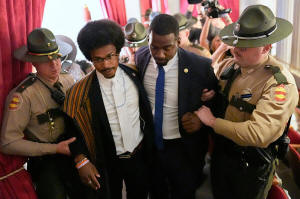
Rep. Justin J. Pearson, D-Memphis, second from left, walks with his
brother KeShaun Pearson, as he is arrested and removed from the
House gallery during a special session of the state legislature to
redraw U.S. Congressional voting maps Thursday, May 7, 2026, in
Nashville, Tenn. (AP Photo/George Walker IV)

Republican state Sen. John Stevens defended the new districts he
sponsored by noting that Democrats in Illinois, Massachusetts and
other states also had drawn congressional districts to their
advantage.
“This bill represents Tennessee’s attempt to maximize our partisan
advantage,” he said.
It does so at the expense of both Memphis residents and democracy,
said Sen. London Lamar, a Democrat from Memphis.
“You cannot take a majority Black city, fracture its voting power
and then tell us race has nothing to do with it,” she said.
Democrats noted that the state Supreme Court in April 2022 rejected
a challenge to the current congressional map, finding it was too
close to the election to make changes. This year, there’s even less
time before the Aug. 6 primary, raising the potential of confusion
for both candidates and voters, Democrats said.
A plan for a new primary advances in Alabama
Audience members watching an Alabama legislative committee Thursday
erupted in shouts of “shame” after Republican lawmakers advanced
legislation to authorize special primaries if the state can put a
new congressional map in place for the November midterms.
Alabama has asked federal judges to lift an order requiring the
state to have a second district where Black voters are the majority
or close to it. That district gave rise to the election of Rep.
Shomari Figures, a Black Democrat, in 2024.
Republicans instead want to put in place a map lawmakers drew in
2023 — which was rejected by a federal court — that could allow them
to reclaim Figures’ district. Black residents currently make up
about 48% of the district’s voting-age population. That would drop
to about 39% under the 2023 map. Republicans hope the federal courts
will see the case differently in the wake of the Supreme Court’s
Louisiana decision.
If a court grants Alabama’s request, the legislation under
consideration would ignore the May 19 primary results for
congressional seats and direct the governor to schedule a new
primary under the revised districts. The House passed the
legislation on a party-line vote Wednesday. A final Senate vote is
expected Friday.
Addressing a Senate committee on Thursday, Figures said his concern
isn’t for himself but for the people who fought for decades “to have
a voice in what government looks like.”

A proposed new House map is unveiled in South Carolina
A proposed new U.S. House map was distributed Thursday on the South
Carolina House floor, where members huddled around desks to review
it.
The proposal would take Democratic U.S. Rep. Jim Clyburn out of the
6th District he has represented since 1992. His district currently
is made up of nearly 50% Black voters and provided a greater than
60% vote for Democrat Kamala Harris in 2024 presidential election.
The proposal would split it into four different districts.
The proposed map also would split the Democratic stronghold of
Columbia and its redder suburbs into four different districts.
The South Carolina House on Wednesday approved a resolution giving
lawmakers permission to return after the May 14 end of their regular
work to continue consideration of a redistricting plan. But that
also would require a two-thirds vote of the Senate.
The state’s primary elections are June 9.
___
Chandler reported from Montgomery, Alabama; Collins from Columbia,
South Carolina; and Lieb from Jefferson City, Missouri. Associated
Press reporter Kristin M. Hall contributed.
All contents © copyright 2026 Associated Press. All rights reserved |