Federal court rules against new global tariffs Trump imposed after loss
at the Supreme Court
[May 08, 2026]
WASHINGTON (AP) — A federal court ruled Thursday against the new global
tariffs that President Donald Trump imposed after a stinging loss at the
Supreme Court.
A split three-judge panel of the Court of International Trade in New
York found the 10% global tariffs were illegal after small businesses
sued.
The court ruled 2-1 that Trump overstepped the tariff power that
Congress had allowed the president under the law. The tariffs are
“invalid″ and “unauthorized by law,” the majority wrote.
The third judge on the panel found the law allows the president more
leeway on tariffs.
If the administration appeals Thursday’s decision, as expected, it would
first turn to the U.S. Court of Appeals for the Federal Circuit, based
in Washington, and then, potentially, the Supreme Court.
At issue are temporary 10% worldwide tariffs the Trump administration
imposed after the Supreme Court in February struck down even broader
double-digit tariffs the president had imposed last year on almost every
country on Earth. The new tariffs, invoked under Section 122 of the
Trade Act of 1974, were set to expire July 24.

The court’s decision directly blocked the collection of tariffs from
three plaintiffs — the state of Washington and two businesses, spice
company Burlap & Barrel and toy company Basic Fun! “It’s not clear’’
whether other businesses would have to continue to pay the tariffs, said
Jeffrey Schwab, director of litigation at the libertarian Liberty
Justice Center, which represented the two companies.
“We fought back today and we won, and we’re extremely excited,” Jay
Foreman, CEO of Basic Fun!, told reporters Thursday.
The ruling marked another legal setback for the Trump administration,
which has attempted to shield the U.S. economy behind a wall of import
taxes. Last year, Trump invoked the 1977 International Emergency
Economic Powers Act (IEEPA) to declare the nation's longstanding trade
deficit a national emergency, justifying sweeping global tariffs.
[to top of second column]
|
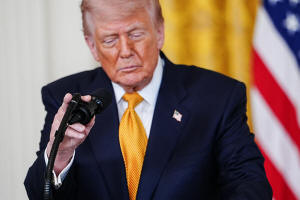
President Donald Trump adjusts his microphone while speaking during
an event for military mothers in the East Room of the White House,
Wednesday, May 6, 2026, in Washington. (AP Photo/Julia Demaree
Nikhinson)

The Supreme Court ruled Feb. 28 that IEEPA did not authorize the
tariffs. The U.S. Constitution gives Congress the power to establish
taxes, including tariffs, though lawmakers can delegate tariff power
to the president.
Dave Townsend, a trade lawyer at Dorsey & Whitney, said the ruling
will open the door for more companies to request that the tariffs be
thrown out and that any payments they've made be refunded.
“Other importers likely will now ask for a broader remedy that
applies to more companies,” Townsend said, though he cautioned the
case could also reach the Supreme Court.
Trump is already taking steps to replace the tariffs that were
struck down by the Supreme Court in January. The administration is
conducting two investigations that could end in more tariffs.
The Office of the U.S. Trade Representative is looking into whether
16 U.S. trading partners — including China, the European Union and
Japan — are overproducing goods, driving down prices and putting
U.S. manufacturers at a disadvantage. It is also investigating
whether 60 economies — from Nigeria to Norway and accounting for 99%
of U.S. imports — do enough to prohibit the trade in products
created by forced labor.
All contents © copyright 2026 Associated Press. All rights reserved
 |