Senate advances bill to expel students who commit sexual violence at
school
[May 09, 2026]
By Ben Szalinski
SPRINGFIELD — The Illinois Senate advanced a plan Thursday that would
ensure students who commit sexually violent crimes can be expelled from
school.
The chamber voted 48-3, with two voting present, to pass Senate Bill 939
sponsored by Sen. Steve McClure, R-Springfield, which would require
students who initiate sexual assault to be expelled for at least one
year, or at least six months for initiating nonconsensual sexual acts.
The bill would apply to incidents that happen at school, school property
such as buses, and school-related events.
The bill was filed last year after an incident in Taylorville where a
10-year-old girl was allegedly sexually assaulted by a 14-year-old male
student on the bus, who then chased the girl from the bus stop and raped
her, according to the girl’s mother. She obtained an order of
protection, and the student was removed from the school for the rest of
the semester but later returned.
The girl’s family sued the Taylorville School District and bus company
last year over violations of federal Title IX rights, negligence and
emotional distress.
“This bill is really important because it’s going to be needed and it’s
going to help survivors of sexual violence who are having a hard time as
it is after one of these situations, let alone having to go to school
and see the person who did that to you right there all the time,”
McClure said.
He said similar incidents have happened in other districts, including an
assault on a 4-year-old girl by a 15-year-old boy in western Illinois.
The issue, McClure said, is that state law lacks clear guidelines on
what schools should do with sexual assault situations.
“Most schools do the right thing, but in a lot of cases I continue
hearing about, the school is not doing the right thing and that is why
this bill is necessary,” McClure said.

According to the bill, students may be removed from their school but
would still be eligible to attend alternative learning centers.
Superintendents would also have power to modify punishments on a
case-by-case basis and must consider a student’s ability to understand
their actions. And any disability they might have would also have to be
considered when schools assess what direction to go with the situation.
[to top of second column]
|

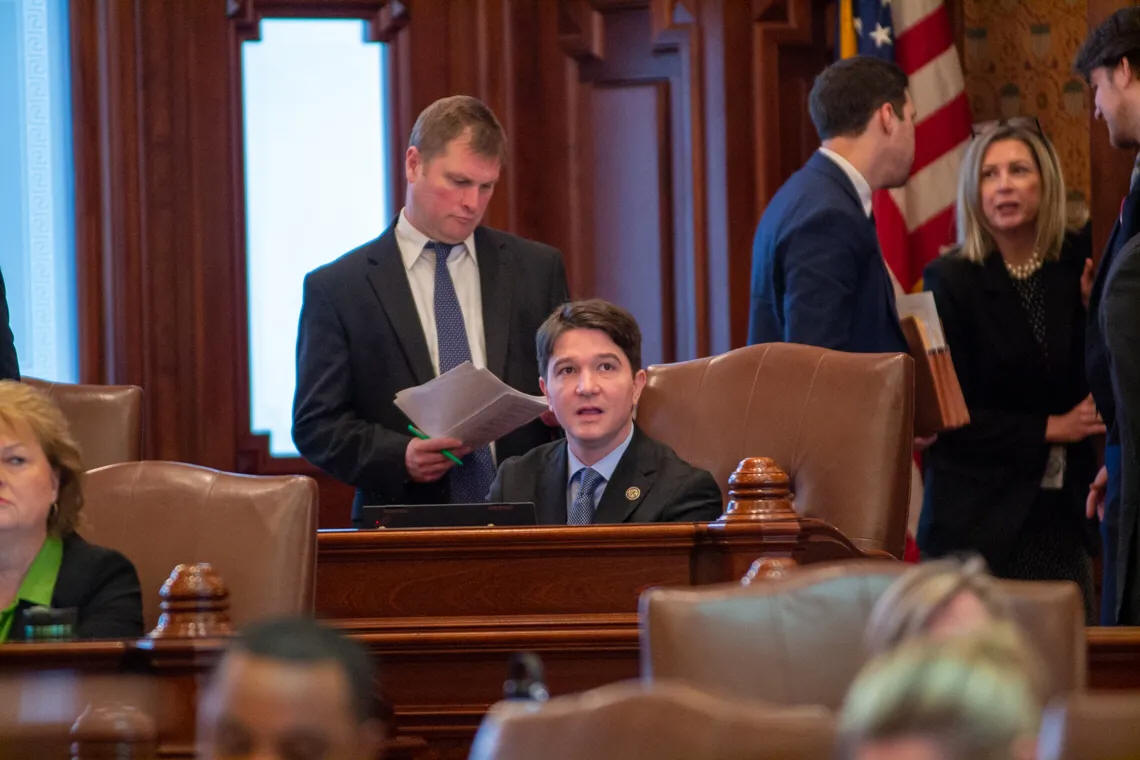
Sen. Steve McClure, R-Springfield, listens to debate in the Illinois
Senate on May 30, 2025. (Capitol News Illinois photo by Jerry
Nowicki)

“We want both sides to get help here, and we want to get the student on
the right path,” McClure said.
Opposition to the bill
Democratic Sens. Mike Simmons, D-Chicago, Rachel Ventura, D-Joliet, and
Karina Villa, D-West Chicago, voted against the bill.
“Right now, schools are allowed to expel students,” Villa said. “In fact
in this case that was talked about that drove this legislation, the
child did end up getting expelled. There’s no need to continue to find
punitive ways to attack our children. Instead, let’s take the cases
case-by-case. There’s no need for this bill.”
Ventura said she is concerned two consenting students could get caught
up in the law.
“My concern with the bill is by mandating school boards automatically
expel students not because of the situation but because of fear of not
following a state mandate,” Ventura said.
McClure responded only nonconsensual incidents would be punished under
the bill and that his legislation only adds a type of scenario where a
student could be expelled and does not change any other parts of state
law that govern expulsion processes. Accused students would still be
entitled to a hearing.
The bill now heads to the House, where Rep. C.D. Davidsmeyer,
R-Murrayville, sponsored a similar measure earlier this spring that was
unanimously advanced out of committee, but did not receive a vote in the
chamber before an April deadline.
Capitol News Illinois is
a nonprofit, nonpartisan news service that distributes state government
coverage to hundreds of news outlets statewide. It is funded primarily
by the Illinois Press Foundation and the Robert R. McCormick Foundation. |