Judge delays decision on special prosecutor for ‘Operation Midway Blitz’
to review new developments
[May 12, 2026]
By Hannah Meisel
CHICAGO — The legal battle over how federal immigration agents can be
investigated and charged by local prosecutors — namely Cook County
State’s Attorney Eileen O’Neill Burke — won’t be resolved for a little
while longer as a Cook County judge on Monday pushed off her scheduled
ruling on whether to appoint a special prosecutor to oversee such cases.
As she began Monday morning’s hearing, Cook County Judge Erica Reddick
noted that since she heard arguments over the special prosecutor
petition last month, there had been a few related developments.
“Spoiler alert: There will not be a ruling today,” Reddick said.
First, a state panel appointed by Gov. JB Pritzker published a final
report April 30 memorializing dozens of clashes between federal agents
and both undocumented immigrants and U.S. citizens during the Trump
administration’s Chicago-focused “Operation Midway Blitz” mass
deportation campaign this past fall.
That same day, the Illinois State Police opened an investigation into
the fatal shooting of Silverio Villegas González by an immigration
officer in September. When the investigation is complete, the ISP plans
to turn it over it to the state’s attorney’s office, which a Burke
spokesperson confirmed will “play a supportive role in their
investigation.”

Lawyers for the coalition of more than 400 petitioners, including
elected officials and community leaders, behind the push for a special
prosecutor want the dual developments to be included in the records the
judge is weighing.
However, the judge lightly admonished Locke Bowman, one of the attorneys
for the coalition, after he told her he couldn’t promise that he
wouldn’t want the record supplemented again.
Reddick said she wasn’t precluding that possibility, “but please
understand: This must come to an end.”
After a Friday deadline for Bowman and his colleagues’ latest legal
filing, the judge will rule on May 21.
This week marks two months since the coalition filed its petition for a
special prosecutor, ramping up an already contentious public pressure
campaign for Burke’s office to investigate and charge federal
immigration agents.
The state’s attorney has maintained her office has limited legal
authority to do so without a request from law enforcement, which she has
not yet received. She’s also repeatedly pointed to federal agents’
relative immunity from state prosecution under the U.S. Constitution’s
supremacy clause and Illinois Supreme Court precedent as reasons to
tread carefully so as not to risk any future case falling apart on
appeal.
But in February, as the pressure to prosecute grew louder, Burke’s
office put together guidelines for handling any future investigations of
federal agents. The protocol, which was written with guidance from
Illinois Attorney General Kwame Raoul, stipulates the state’s attorney’s
Law Enforcement Review Unit can help investigate once a law enforcement
agency “believes that there is sufficient evidence to support felony
charging and is seeking felony review.”

[to top of second column]
|
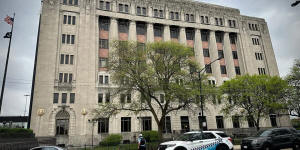
The Cook County Courthouse in Chicago. (Capitol News Illinois photo
by Hannah Meisel)

‘It’s not a hypothetical’
On Monday, Reddick quizzed Assistant State’s Attorney Yvette Loizon on
why the protocol only mentioned the possible investigation of use of
force, and not nonviolent crimes like conspiracy and perjury. Both of
those hypothetical charges were specifically named in the March 12
petition for a special prosecutor, though the judge objected to Loizon’s
use of the word “hypothetical” in answering her question about whether
the state’s attorney’s office would limit the scope of its
investigations.
“It’s not a hypothetical,” Reddick said, interrupting Loizon, adding
that if a law enforcement agency’s investigation finds facts supporting
conspiracy or perjury charges, the state’s attorney’s office would then
be faced with the question of whether to take it up.
After a tense back-and-forth, Loizon assured the judge that the state’s
attorney’s office would dedicate resources to pursue such allegations if
they turn up, though she said it would be unlikely they’d be alleged in
a vacuum without also being connected to use of force charges.
In a statement after the hearing, a spokesperson for Burke’s office
reiterated that the state’s attorney “has repeatedly condemned the
tactics used by the Trump administration and during Operation Midway
Blitz.” Critics of the state’s attorney have accused her of being slow
to action so as not to risk relationships within the Trump
administration and funding for key priorities like gun violence, which
they say is tantamount to the kind of conflict of interest that should
trigger a special prosecutor appointment.
But Burke maintains that her concern is not seeing cases overturned on
appeal, thus undermining efforts to investigate and prosecute federal
agents’ alleged abuses.

“As we have argued in court, the CCSAO (Cook County State’s Attorney’s
Office) must follow the law and the facts to protect the integrity of
our prosecutions and ensure that any resulting conviction will stand,”
Burke spokesperson Elyssa Cherney said, referencing a 2017 Illinois
Supreme Court ruling limiting local prosecutors’ ability to open
investigations without law enforcement. “The petition seeking a special
prosecutor is frivolous, contains baseless allegations and gross
misrepresentations of the law.”
State Rep. Norma Hernandez, D-Melrose Park, however, said Monday that it
looks very different from the outside, especially in immigrant-heavy
communities like those she represents in the near-west suburbs of
Chicago.
“Our community should not have to organize this hard simply for our
voices to be heard,” she told reporters outside Reddick’s courtroom.
“The negligence and inaction of Cook County State Attorney Eileen Burke
has only deepened that pain. When prosecutors refuse to act or
investigate with urgency, they send a dangerous message to families:
That justice depends on who you are and what community you come from.”
Capitol News Illinois is
a nonprofit, nonpartisan news service that distributes state government
coverage to hundreds of news outlets statewide. It is funded primarily
by the Illinois Press Foundation and the Robert R. McCormick Foundation. |