By changing women's lives, the pill changed the nation
[May 13, 2026]
By LAURA UNGAR
The pill helped give birth to modern America.
Known by one simple word, the revolutionary oral contraceptive —
approved by the U.S. Food and Drug Administration 66 years ago — didn’t
just prevent innumerable pregnancies. It gave women new freedom,
changing family life and society forever.
“Its introduction in the 1960s afforded U.S. women this unprecedented
control over their childbearing and subsequent life trajectories,” says
Suzanne Bell of Johns Hopkins Bloomberg School of Public Health.
The pill disentangled sex from procreation. Women no longer needed a
man's cooperation to control their fertility.
The pill’s greatest champion was a woman. Margaret Sanger, who founded
the precursor to Planned Parenthood Federation of America, helped
spearhead its development with financial support from her friend,
philanthropist Katharine Dexter McCormick. Sanger said, “No woman can
call herself free until she can choose consciously whether she will or
will not be a mother.”
Biologists Gregory Pincus and Min Chueh Chang and OB-GYN Dr. John Rock
were instrumental in the pill’s development. It uses synthetic
progesterone and estrogen hormones to prevent pregnancy, mainly by
stopping ovulation but also by thickening cervical mucus and making it
hard for sperm to enter the uterus. When used perfectly, it prevents
pregnancy 99% of the time.
Within two years of its initial distribution, more than a million
American women were taking it. Monumental social change followed.
Researchers have linked the pill to later marriages and greater
educational attainment and labor force participation among women. It
also played a part in the sexual revolution of the 1960s and ’70s.

[to top of second column]
|
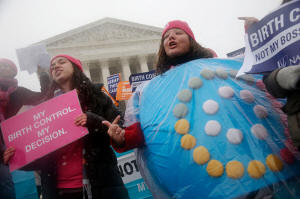
Margot Riphagen of New Orleans, La., wears a birth control pill
costume during a protest in front of the U.S. Supreme Court in
Washington, March 25, 2015. (AP Photo/Charles Dharapak, File)
 The pill spurred backlash, too. In
the 1960s, Pope Paul VI condemned it and many states outlawed
contraceptives. Married women were exempted from state prohibitions
in 1965, but the ban for single women persisted in some states for
years.
More recently, after the Supreme Court’s decision ending the
constitutional right to abortion, some worry the right to use
contraception is also under threat.
“With any device or procedure that gives women more reproductive or
sexual autonomy, there are always groups that resist and push back,”
says Bell, pointing to the recent push for women to have more
children.
But on the whole, women aren’t heeding that message. U.S. fertility
rates have reached a historic low, and the pill remains extremely
popular. Today, it’s the most common form of reversible birth
control in America, used by more than 8 million people — and still
shaping the lives of individuals and the nation.
All contents © copyright 2026 Associated Press. All rights reserved |