Trump's redistricting push fizzles in South Carolina Senate but wins in
Missouri's top court
[May 13, 2026]
By DAVID A. LIEB, JEFFREY COLLINS, JACK BROOK and KIM
CHANDLER
President Donald Trump’s push to redraw the nation’s U.S. House
districts received mixed results Tuesday as South Carolina senators
defied his desires but Missouri’s top court upheld a new map that could
help Republicans win an additional seat in the November midterm
elections.
Rather than waning, a national redistricting battle that began 10 months
ago has intensified — inflamed by a recent U.S. Supreme Court ruling
that weakened the federal Voting Rights Act and provided grounds for
states to try to eliminate voting districts with large minority
populations.
Republican lawmakers in Louisiana are wrestling with how politically
aggressive to be when redrawing House districts after the U.S. Supreme
Court invalidated a majority-Black district as an illegal racial
gerrymander.
The ripples of the Louisiana ruling already have led to new U.S. House
districts in Tennessee and have extended to Alabama, where Republican
Gov. Kay Ivey announced an Aug. 11 special primary for four of the
state’s seven congressional districts. That came after the U.S. Supreme
Court on Monday overturned an order mandating use of a map with two
largely Black districts. The state plans to switch to a map passed in
2023 that has only one majority-Black district, giving Republicans a
chance to win an additional seat.
Republicans think they could gain as many as 14 seats from new House
maps enacted so far in Texas, Missouri, North Carolina, Ohio, Florida
and Tennessee. Democrats, meanwhile, think they could gain six seats
from new maps in California and Utah. The Virginia Supreme Court last
week struck down a redistricting effort that could have yielded four
more winnable seats for Democrats.

Missouri court upholds split of Kansas City
Missouri was the second Republican state, after Texas, to redraw its
congressional districts at Trump’s urging last year.
Tuesday's two unanimous state Supreme Court decisions, delivered just
hours after arguments, “are a complete victory for Missouri and for the
people's elected representatives,” Republican Attorney General Catherine
Hanaway said in a statement.
The rulings sided “against voters in every respect,” the ACLU and
Campaign Legal Center, which represented suing voters, said in a joint
statement. “This state — and our democracy — are worse off for this
outcome.”
Attorneys challenging Missouri's new map had focused on changes to a
Kansas City-based district long represented by Democratic U.S. Rep.
Emanuel Cleaver, who previously was the city’s first Black mayor.
The new map takes a compact urban district that covered 20 miles (32
kilometers) and two counties and stretches it 200 miles (322 kilometers)
over 15 counties, distorting it “into a sprawling behemoth that cuts
clear across the state to unite territories that share nothing in
common,” said Abha Khanna, a partner in the Elias Law Group, a
Democratic firm.
But the Supreme Court upheld a March decision by a lower court, which
found the map as a whole satisfied the compactness requirement even
though the Kansas City district looks less compact. No Missouri court
has ever struck down a congressional map for not being compact, said
attorney John Gore, who defended the districts on behalf of the
Republican Party.
A second case heard by the high court centered on whether the new map
took effect in December, as asserted by Hanaway and Republican Secretary
of State Denny Hoskins, or whether it should have been suspended when
referendum signatures were submitted.

To suspend the map before validating the signatures would let activists
temporarily undercut laws by submitting boxes of fraudulent signatures,
Missouri Solicitor General Lou Capozzi argued.
But to not immediately suspend the map “would dilute the referendum
right, if not destroy it altogether,” said attorney Jonathan Hawley,
arguing for voters who sued.
[to top of second column]
|
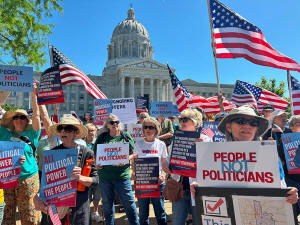
Protesters against a Missouri congressional redistricting plan
gather outside the Missouri Capitol on Tuesday, May 12, 2026, in
Jefferson City, Mo. (AP Photo/David A. Lieb)

The Supreme Court agreed with Republican officials, who contend the new
districts can be suspended only after Hoskins determines the petition
meets constitutional requirements and has enough valid signatures.
Hoskins has until Aug. 4, the day of Missouri’s primary elections, to
make that determination.
South Carolina senator sees risk in redistricting
Trump urged South Carolina to redraw its congressional districts ahead
of the November elections in an attempt to help Republicans win another
seat.
A House committee endorsed a map Tuesday that could eliminate the
state's only Democratic-held seat, and the chamber voted previously to
let lawmakers return after their regular work ends Thursday to further
consider redistricting.
But the Senate had to give permission too. The 29-17 vote failed, coming
just two votes short of the two-thirds needed, as five Republicans
joined all Democrats in opposition.
Republican Senate Majority Leader Shane Massey said he expects
redistricting to come up again in some way before the June 9 primary.
Trump had said on social media that he was closely watching the
redistricting vote, urging South Carolina senators to “be bold and
courageous” and to delay the congressional primaries so new districts
can be drawn.
Although Republicans have a supermajority in the chamber, some GOP
senators weren’t sure the proposed map would guarantee the party could
unseat longtime Democratic U.S. Rep. Jim Clyburn. They also said it
could push enough Democrats into other districts to backfire, resulting
in a 5-2 or even a 4-3 Republican split.
Massey acknowledged the pressure from Trump but said he doesn’t like
being asked to bend to someone’s will instead of doing what’s best for
his state.
“I got too much Southern in my blood,” Massey said. “I’ve got too much
resistance in my heritage.”

Louisiana teen recounts family's fight
A state Senate committee was considering how to reshape congressional
districts — currently represented by four Republicans and two Democrats
— in response to the Supreme Court ruling.
Republican-backed options aimed to eliminate either one or both of those
Democratic seats.
But Democrats backed a map that still would allow for two majority-Black
districts centered on Baton Rouge and New Orleans. They argued that
would comply with the Supreme Court’s ruling while retaining fairness.
As a hearing stretched late into Tuesday night, Josiah Hardy, a high
school sophomore, told lawmakers that his great-grandfather fought for
civil rights and equal representation in Louisiana when Black voters
were disenfranchised.
“Why are we still fighting the same fight decades later,” Hardy said.
“My great-grandfather believed democracy is stronger when more people
are included, not excluded. Further generations should not have to keep
fighting the same battles for fairness and voting rights that leaders
before us have already fought.”
___
Brook reported from Baton Rouge, Louisiana, Chandler from Montgomery,
Alabama, Collins from Columbia, South Carolina, and Lieb from Jefferson
City, Missouri.
All contents © copyright 2026 Associated Press. All rights reserved |