Ship operator and employee are charged in crash that caused the deadly
collapse of Baltimore bridge
[May 13, 2026]
By MICHAEL KUNZELMAN and ED WHITE
BALTIMORE (AP) — Prosecutors announced criminal charges Tuesday in the
deadly 2024 collapse of Baltimore’s Francis Scott Key Bridge, accusing a
Singapore-based ship operator of intentionally relying on an improper
fuel pump that contributed to the ruinous crash and then lying about it
to investigators.
Acting Attorney General Todd Blanche called it a “preventable tragedy of
enormous consequence.”
The indictment names Synergy Marine Pte Ltd., based in Singapore, and
Synergy Maritime Pte Ltd., based in Chennai, India. Radhakrishnan
Karthik Nair, 47, an Indian national who was technical superintendent
for the Dali container ship, was also charged.
Synergy Marine expressed disappointment and accused the U.S. Justice
Department of turning an accident into a crime.
“This was a maritime casualty that should be assessed through the full
factual, technical and regulatory record, rather than through selective
mischaracterizations in a criminal indictment. ... Synergy will
vigorously defend itself against these inaccurate allegations," the
company said.
Nair's lawyer, David Gerger, had a similar response, saying his client
“thinks about this accident every day, but he certainly did not cause
it.”
Disaster began with a loose wire
The Dali, bound for Sri Lanka, lost power twice in a four-minute span as
it moved to sea from the Port of Baltimore, causing it to crash into the
Key Bridge in the early hours of March 26, 2024. Investigators say a
loose wire in a switchboard likely caused the first power loss that led
to its steering failure.

After regaining power, the ship found itself in trouble again. The Dali
turned to a certain pump to supply fuel to two generators but the pump
was not designed to automatically restart after the first blackout, so a
second blackout occurred, the indictment says.
If the Dali had used the proper fuel pumps, according to the indictment,
the vessel would have regained power in time to safely get under the
bridge. Instead, it crashed into a supporting column of the bridge,
killing six construction workers who had been filling potholes.
“As alleged, the bridge was struck and collapsed because those who were
responsible for the ship’s operation deliberately cut corners at the
expense of safety,” said Jimmy Paul, head of the FBI’s Baltimore office.
The government alleges that the same problem occurred with same type of
pump on two of the Dali's sister ships.
Grand jury returns 47-page indictment
The companies and Nair are charged with conspiracy, misconduct causing
death, failing to immediately inform the U.S. Coast Guard of a hazardous
condition, obstructing the National Transportation Safety Board and
making false statements.
The Synergy companies are also charged with misdemeanors for the release
of pollutants into the Patapsco River, including shipping containers and
their contents.
[to top of second column]
|
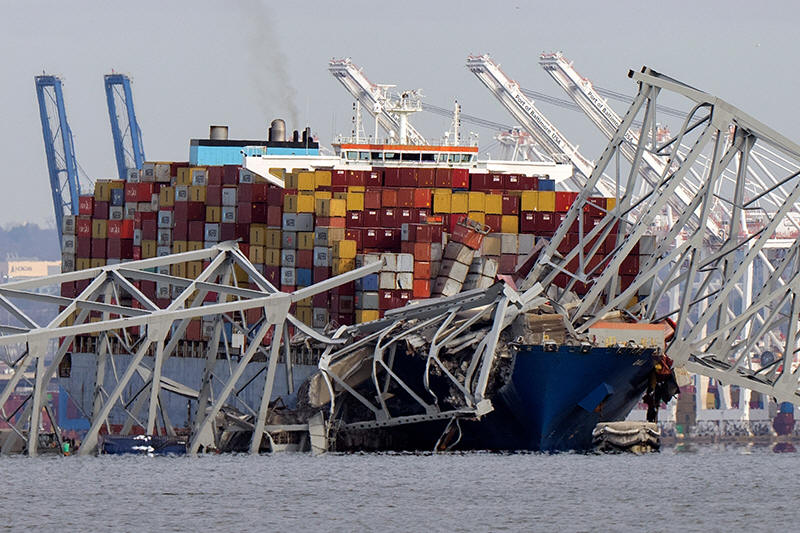
The cargo ship Dali is stuck under part of the Francis Scott Key
Bridge after the ship hit the bridge, March 26, 2024, as seen from
Pasadena, Md. (AP Photo/Mark Schiefelbein, File)

The FBI's investigation focused on the vessel’s operations and
whether the crew knew of critical systems issues before leaving
port. The NTSB found that the two electrical blackouts disabled the
controls of the huge cargo ship before it crashed into the bridge.
The ship had experienced two blackouts in port a day earlier, but
Synergy didn’t investigate or report those as required and provided
false information to the NTSB, the government alleges.
Maryland officials estimate it could cost between $4.3 billion and
$5.2 billion to replace the bridge, which is expected to be open to
traffic in late 2030.
“The altered skyline is a constant reminder of this tragedy,” Paul
said.
But the true cost of the collapse was far greater, according to the
Maryland Attorney General’s Office. It halted shipping at the Port
of Baltimore, disrupted the livelihoods of thousands, rerouted road
traffic through communities already bearing disproportionate burdens
and triggered economic problems statewide.
More legal action
The indictment follows a $2.25 billion settlement between the state
of Maryland, Synergy Marine and Grace Ocean Private Limited, the
Singapore-based ship owner. The deal was announced in April but the
amount was not disclosed until Tuesday.
That lawsuit claimed the crash was the result of negligence,
mismanagement and the reckless operation of a vessel that was not
seaworthy and should never have left port. Plaintiffs included the
owners of cargo aboard the ship and local governments seeking
damages for economic losses. Some portions of the lawsuit remain
unresolved.
Meanwhile, there's civil litigation pending on behalf of people who
died while on the bridge. Trial is scheduled for June 1, though the
indictment could cause a delay.
“The biggest takeaway is: ‘Will we get justice now?’ That's the
common question we get from our clients daily,” said attorney L.
Chris Stewart, who represents four families and a man who survived
the bridge crash.
He described the indictment as a “bombshell.”
The bridge, a longstanding Baltimore landmark, was a vital piece of
transportation infrastructure that allowed drivers to easily bypass
downtown. The original 1.6-mile (2.6-kilometer) steel span took five
years to build and opened to traffic in 1977.
___
White reported from Detroit.
All contents © copyright 2026 Associated Press. All rights reserved |