Michigan teen tobacco use ticks up as prevention funding lags
[May 15, 2026]
By JANELLE D. JAMES/Bridge Michigan
While teen tobacco use in Michigan remains far below historic highs,
data shows it’s beginning to rise again, fueling renewed calls to boost
prevention spending that has fallen far short of federal
recommendations.
Tobacco use among high school students rose to 16.5% in 2023, up from
14% in 2021, according to the most recent data from the Michigan
Department of Health and Human Services.
E-cigarettes were the most common form of tobacco used by Michigan high
schoolers, including 11% of males and 19% of females, and use of both
cigarettes and chewing tobacco products also rose slightly.
Health advocates are highlighting those figures as they call for more
spending on efforts to prevent tobacco use, which the state says remains
the largest contributor to preventable death in Michigan.
“This is something that has been a problem for teens for decades. We
know that cigarette smoking and tobacco use of other types lead to
health problems down the road,” said Dr. David Ledgerwood, a clinical
psychologist and professor at Wayne State University. “Cigarette smoking
is still the leading preventable cause of death in the United States.”
Michigan is one of 10 states that spend less than 5% of the tobacco
prevention funding levels recommended by the US Centers for Disease
Control and Prevention.

Gov. Gretchen Whitmer’s proposed budget would increase prevention
spending by $8.9 million to a total of $16 million next year by creating
a new tax on e-cigarettes, otherwise known as vapes, and alternative
nicotine products, such as Zyn pouches.
That would still be less than 15% of the $110.6 million in spending the
CDC recommends for Michigan, and neither House nor Senate lawmakers have
included those new taxes in separately approved state budget bills.
Experts say any increase in youth tobacco use is concerning, given the
long-term health implications.
“When people are young and develop a habit of smoking or using
e-cigarettes or using other nicotine products, it can very well lead to
… dependence on nicotine,” said Dr. David Ledgerwood, a clinical
psychologist and professor at Wayne State University.
“Introducing a drug like nicotine, or alcohol, or cannabis or any other
drug can interfere with the natural development of the adolescent
brain.”
Michigan currently generates about $733 million in tobacco tax revenue
each year. Most of that goes to a Medicaid Benefits Trust Fund and the
state’s School Aid Fund, which is used to support K-12 schools. Whitmer
is proposing to raise the cigarette tax from $2 to $3 per pack as part
of a broader plan to bolster Medicaid funding.
The state also receives hundreds of millions of dollars a year in
tobacco industry lawsuit settlement dollars but generally spends that on
health initiatives, not prevention or cessation programs.
Prevention efforts
Michigan’s current youth tobacco prevention program is operated with
$7.5 million in state and federal funding and supports youth cessation
programs like My Life My Quit and outreach efforts aimed at reducing
tobacco use among young people, according to Lynn Sutfin, a state health
department spokesperson.
Schools play a major role in prevention. Nearly 90% of Michigan public
school districts had a “category four” tobacco prohibition policy,
including e-cigarettes, on school grounds and at school-sponsored events
off campus, according to the state health department.
Tobacco use among high schoolers had been steadily declining until 2015,
when the state reported a sharp jump attributed to e-cigarettes.

As of 2023, about 35% of Michigan high schoolers said they’d tried
e-cigarettes at least once, up from 33% in 2021. By comparison, 16% said
they’d tried cigarettes at some point, up from 13% two years prior.
“Flavored products and nicotine patches serve as the gateway to hook the
next generation of tobacco users,” said Kezia Ofosu Atta, director of
advocacy for the American Lung Association. ”It’s difficult for tobacco
companies to argue that they aren’t targeting the youth with flavors
like bubble gum, watermelon and mango.”
[to top of second column]
|
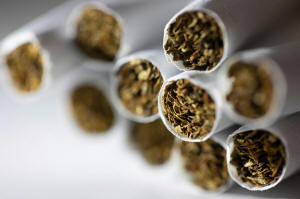
Cigarettes are arranged for a photograph in New York on Dec. 17,
2019. (AP Photo/Patrick Sison, File)

Michigan isn’t alone. Roughly 1 in 5 high school seniors in the US use
tobacco, including 16% who use e-cigarettes, according to the Campaign
for Tobacco-Free Kids, an organization focused on preventing child
deaths caused by tobacco use.
The state banned billboard advertising for tobacco products on all roads
and highways and in 2019, Gov. Whitmer ordered the Michigan Department
of Transportation to enforce the existing law to prohibit the
advertisement of vape products as well but that effort did not lead to a
state law.
Teens continue to report frequent exposure to tobacco advertising in
everyday settings. The majority of students see tobacco advertisements
at the convenience store, gas station or when they’re watching movies or
using the internet.
“Marketing is a huge part of this conversation. We know that these
products are marketed directly to our kids, especially when we look at
(how) these products have evolved over the last five years,” said Jodi
L. Radke, regional director of the Campaign for Tobacco-Free Kids.
“Oftentimes, our teens who are experimenting with these products believe
that they are just flavored vapor or flavored water,” Radke said.
“Nicotine is physiologically just as addictive as heroin. Some of these
newer products that have come to market … have the equivalent of 200
cigarettes worth of nicotine.”
Billboard advertising for cannabis is permitted in Michigan, where
marijuana use among teenagers and adolescents has become more prevalent.
In the past 30 days, roughly 7% of eighth graders, 16% of 10th graders,
and 26% of 12th graders used cannabis, according to the MDHHS. Within
that same time frame, nearly 40% of high school students have reported
trying marijuana and 22% had used it.
Minor sales
State and federal law prohibit adults under the age of 21 from buying
tobacco, a change Michigan also codified in state law.

But Michigan is one of eight states that do not require retailers to
obtain a license to sell tobacco products, which advocates like Radke
say makes it easier for teenagers to purchase tobacco here.
“(Smoking) is not a normal thing to do at our age but it’s normalized by
the people that we’re around,” said Arianna Banford, 18 and a senior at
Osborn High School. “People can smoke right in front of you because it’s
normalized and they don’t feel any type of shame or think there’s
anything wrong with it.”
The state does conduct annual, random, unannounced inspections to
measure its progress in reducing youth retail access to tobacco
products, vapor products and alternative nicotine products.
Still, roughly a quarter of Michigan retailers failed underage and
undercover compliance checks conducted last year by the US Food and Drug
Administration, according to federal data. In 2025, 499 Michigan
retailers received warning letters for first-time violations, and
another 231 were fined.
Some stores check IDs for vape pens, but “there are stores that don’t —
and everyone knows the stores that don’t,” Banford said. “… So they tell
a friend who tells a friend.
Groups like the American Lung Association are backing Whitmer’s proposal
for a 57% wholesale tax on vapes and nicotine products as part of the
2027 fiscal budget, which would help fund tobacco prevention efforts.
The governor’s proposal to raise the cigarette tax from $2 to $3 per
pack would raise an estimated $232 million for Medicaid, not tobacco
prevention. But advocates say the tax increase – which would be the
state’s first in 22 years – could deter tobacco use.
Neither proposal seems likely to advance in Lansing, given opposition
from state House Speaker Matt Hall, R-Richland Township.
“We’re not going to do any of that,” Hall said after Whitmer unveiled
her executive budget and tax proposals in February. “There will be no
tax increases in this budget when we do this deal.”
All contents © copyright 2026 Associated Press. All rights reserved |