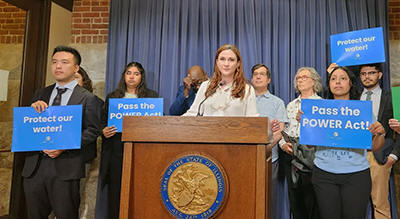
Advocates, accusing governor of ‘lack of engagement,’ urge passage of
data center regulations by end of May
[May 15, 2026]
By Nikoel Hytrek and UIS Public Affairs Reporting (PAR)
SPRINGFIELD — Environmental advocates continue to pressure lawmakers to
require more transparency about data centers’ water and energy use as
the legislative session creeps toward the finish line.
The POWER Act is the primary vehicle for regulations that address
concerns about the effects data centers have on communities, but it
hasn’t seen any action beyond subject matter hearings since it was
introduced in February.
With less than three weeks left before lawmakers are slated to adjourn,
however, it’s unclear whether the wide-ranging bill will come together
and whether Gov. JB Pritzker will throw his support behind any specific
regulatory proposal.
“We are confused and concerned by the Governor’s lack of engagement on
the issue of data centers this spring legislative session,” Kady
McFadden, lead lobbyist on behalf of the Illinois Clean Jobs Coalition
that has been behind several recent energy reforms, said in a statement.
Pritzker mentioned data centers in his February State of the State
address, calling for PJM Interconnection, the electric grid operator
that covers all or part 13 states from Illinois to the East Coast, to
require data center developers to pay for and provide their own energy.
He also proposed a two-year pause on state tax credits for new data
centers to compensate for rising demand and higher prices. Illinois has
provided tax incentives for data centers since Pritzker signed
bipartisan legislation in 2019. According to the state’s 2024 report, at
least 27 data centers had received incentives totaling $983 million in
estimated lifetime tax breaks and benefits.

But the advocates behind the bill say he’s been silent since, even as a
vast array of stakeholders indicate they have at least some interest in
regulation.
“The Governor’s Office continues to monitor and take note of all
legislation that requires additional state resources,” a spokesperson
said in an emailed statement. “As bills make their way to the second
chamber, agencies and Governor’s Office staff will continue to educate
members and budgeteers about the fiscal impact of bills.”
It’s not uncommon, however, for lawmakers to wait until the last minute
to pass major legislation, including energy policy.
“Illinois has the opportunity to set real guardrails before even more
projects move forward,” said Tyshianna Bankhead, executive director of
Faith Coalition for the Common Good based in Springfield, at a House
committee meeting on Tuesday.
The urgency comes from the increased interest of data centers to develop
in Illinois. A representative from Commonwealth Edison said the northern
Illinois territory has almost 100 large-load projects in the queue.
Since February, data center proposals have been approved in Sangamon
County, Joliet and Yorkville.
“This is not something that we can solve one community at a time,” Jen
Walling, executive director of the Illinois Environmental Council, said
at a Wednesday news conference. “This is a statewide issue, and it
demands a statewide solution.”
Bipartisan support for regulation?
Advocates say they don’t know why the bill has stalled, because
Democrats and Republicans have aired concerns about water use, energy
prices and the lack of transparency around proposed developments. As
with all legislation with the scope of the POWER Act, however, the devil
is in the details.
Walling pointed toward a Republican representative’s bill to regulate
data centers and said she was encouraged by the conversation that
happened in the Tuesday committee.
“I think that that hearing just showed a large level of support for
moving forward and doing something, and how interested people are and
how much all lawmakers are hearing from their constituents,” Walling
said.

Rep. Jed Davis, R-Yorkville, filed House Bill 5755 on April 27, which
would require municipalities to provide public notice and hearings for
proposed data centers. It would also allow residents to gather
signatures to trigger a referendum vote on proposed projects.
He said the bill was inspired by constituents who felt Yorkville didn’t
listen to them before approving several data center projects.
“I’m really hearing the voice of my constituents back home and how they
feel silenced,” he said. “And, through this piece of legislation, I’m
trying to give them fresh breath, give them a voice again, to empower
them to have change locally.”
Davis told Capitol News Illinois he’s “right on the fence” as to whether
he’d vote for the POWER Act, and he’s heard similar from some of his
Republican colleagues. He said constituents have emailed him since “day
one,” asking him to support the POWER Act.
Republicans have called for regulations on data centers, but they don’t
want restrictions to interfere with data centers’ economic benefits and
many dislike the requirement that new data centers get their energy from
renewable sources.
What would the POWER Act do
Despite several recent committee hearings on data centers, lawmakers
this week commented on how the bill feels like it’s still in its early
stages. Many members of the House Energy and Environment Committee said
Tuesday they were learning details about the bill for the first time.
[to top of second column]
|
Jen Walling, the executive director of the Illinois Environmental
Council, speaks about the POWER Act at a May 13, 2026, news
conference. (Capitol News Illinois photo by Nikoel Hytrek)

“Clearly, there’s a lot of conversation that needs to happen around the
bill,” said Rep. Carol Ammons, chair of the committee. “I’ll just put on
the record that my major concern and protection area will certainly be
the Mahomet (Aquifer), which is sole source, and utilization of water is
a huge, huge problem in the either existing data centers or those coming
online.”
The POWER Act would prohibit nondisclosure agreements between
governmental units and data centers and would require data center
developers to create community benefits agreements in the places they’re
located.
It would also require public water-use reports, environmental impact
assessments, and would make data center developers build their own
renewable energy generation to power the facilities.
The bill is meant to address concerns about the millions of gallons of
water data centers can use and the power strain they’ll put on an
already struggling grid.
The ComEd territory in northern Illinois, for example, has enough
large-load energy projects in its queue to more than double the amount
of energy demand in the territory by 2040.
Even the data center industry has indicated its open to regulation — at
least nominally.
Brad Tietz, the Midwest policy director for the Data Center Coalition,
acknowledged that data centers have impacts on communities but said data
center companies can be useful too, especially as technology for water
and energy use evolve.
“We’ve been asking throughout the session now for formal stakeholder
negotiations to begin,” he said. “While we do have concerns with the
POWER Act, a number of the issues are not insurmountable, and we’d love
a chance to talk through this.”
Tietz said the data center industry would like to change proposals
requiring data centers to provide their own renewable energy and water
use reports to make them voluntary instead of mandatory — a proposition
that’s unacceptable to environmental advocates.
Similarly, Joe Duffy with Climate Jobs Illinois, said his organization
supports the goals of the POWER Act and is open to negotiating with
other stakeholders, but it has concerns about whether the renewable
generation projects required in the bill will be held to union labor
standards.

Climate Jobs Illinois also opposes a pause on the data center tax
credit.
“Without it, there’s no guarantee that these projects benefit Illinois
workers or Illinois communities,” Duffy said.
McFadden said the Clean Jobs Coalition has spoken with labor interests
about the bill, but they have not been able to sit down with the Data
Center Coalition.
Calls for transparency
Across Illinois, proposed data centers have drawn hundreds of
Illinoisans to city council meetings and town halls demanding more
information about how data centers will impact their communities. Many
have called out the frequent use of nondisclosure agreements between
data center companies and municipalities and limited time for public
input.
In some cases, like in Naperville and Pekin, the outcry has been able to
halt projects, but several communities have moved ahead despite
opposition from residents.
“When it comes to data centers, communities are struggling to get basic
information, let alone meaningful involvement,” Bankhead said at a House
committee meeting on Tuesday.
The Sangamon County Board approved a data center in April on a 17-10
vote after limited public comment. Bankhead said the board did not
openly discuss the project.
“Information was difficult to access, and decisions seemed to move
faster than the public process should, and many residents were left
feeling like they were reacting to the process instead of being
included,” she continued.
Joliet residents voiced similar concerns about the Joliet Technology
Center, a planned 795-acre data center project that was approved in
March on an 8-1 vote.
“City officials were quiet or contemptuous, information was inconsistent
and delayed, and technical analyses were either incomplete or
unavailable to the public,” Noah Martinez, a member of Joliet Residents
for Responsible Growth, said at a Monday news conference in Joliet.
Capitol News Illinois is
a nonprofit, nonpartisan news service that distributes state government
coverage to hundreds of news outlets statewide. It is funded primarily
by the Illinois Press Foundation and the Robert R. McCormick Foundation.
 |