Argentina’s beef consumption falls to lowest level in 20 years as prices
soar
[May 16, 2026] By
CLARA PREVE
BUENOS AIRES, Argentina (AP) — At 6 a.m., in the Mataderos neighborhood
of Buenos Aires, workers unload sides of beef from a truck outside a
butcher shop as customers line up for wholesale purchases. Inside,
73-year-old owner Jorge García and his staff prepare meat orders before
dawn.
Among the stacks of beef boxes and red meat cuts hanging from metal
hooks, chicken and pork are increasingly present.
Red meat consumption in Argentina — historically one of the world’s
biggest consumers of beef — has fallen to its lowest level in two
decades amid economic austerity measures imposed by libertarian
President Javier Milei.
As of April 2026, annual per capita beef consumption fell to 44.5
kilograms (98 pounds), down from 49.5 kilograms (109 pounds) during the
same month a year earlier, according to the Agricultural Foundation for
Argentina’s Development. In 2006, it was 63.4 kilos (139 pounds) per
person.
“People are switching to cheaper proteins. They’re eating pork, they’re
eating chicken,” said García.
Analysts attribute the decline to soaring beef prices, lower cattle
supply and weakened household purchasing power. The opening of
Argentina’s beef market to international trade has also pushed domestic
prices closer to global levels.
“Beef moved into a completely different purchasing-power category.
Workers’ wages fell far behind,” said Juampi Quintero, 25, a meat
distributor who estimated consumption among his clients has fallen by
more than half.

Less money for beef
Since coming into office in December 2023 with an annual inflation at
211%, Milei promised to eliminate what he called “the cancer of
inflation” through an adjustment plan that included cuts equivalent to
nearly one-third of public spending, symbolized by the image of a chain
saw.
The government succeeded in reversing the fiscal deficit and achieving a
budget surplus — a rare result in Argentina’s recent history — but the
social cost of the austerity measures has drawn criticism.
Within months, Milei’s administration eliminated 13 ministries, laid off
about 30,000 public employees, halted public works projects and reduced
funding for key areas such as education, healthcare and science, while
also cutting subsidies for basic services such as electricity, gas,
water and transportation.
“That affects household income because families now have to pay more for
services that were previously subsidized by the state,” said economist
Camilo Tiscornia. “As a result, they have less disposable income and
must give up certain more expensive goods, such as beef.”
At the same time, household incomes did not rise at the same pace as
beef prices, helping drive down consumption.
Wages for registered workers increased an average of 1.8% in February,
the latest available data, compared with monthly inflation of 2.9%.
“Before, I had the freedom to buy what I wanted,” said Alberto Brajin, a
61-year-old retiree who runs a streetside barbecue stall in Buenos
Aires.
[to top of second column] |
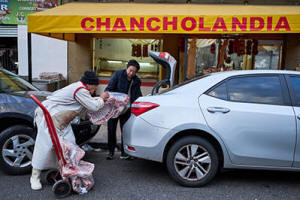
A worker loads pork and beef into a customer's trunk at the
Mataderos meat market in Buenos Aires, Argentina, Thursday, May 14,
2026. (AP Photo/Rodrigo Abd)
 Brajin said he now has to “trade
down” to cheaper proteins such as chicken.
Incomes drop, beef prices surge
Beef prices rose more than 60% over the past year, reaching an
average of 18,500 pesos ($13) per kilogram in Buenos Aires in May,
according to the Argentine Beef Promotion Institute.
In July 2025, Milei’s government reduced export taxes on beef and
poultry and removed production quotas to encourage overseas sales,
reversing part of the restrictions imposed under former President
Alberto Fernández to curb rising domestic prices. The easing of
export regulations came just as Argentina's beef production dropped
by more than 10 percent due to floods and droughts, according to
CICCRA, the nonprofit organization that represents Argentina’s beef
producers.
Argentina’s government said this week that beef exports rose 54% in
the first quarter compared with a year earlier, totaling nearly
200,000 tons worth more than $1 billion. The increase followed a
U.S. decision earlier this year to expand Argentina’s tariff-free
beef quota amid American cattle shortages.
With the market opening up, producers began selling beef — once
affordable across much of Argentina’s social spectrum — at prices
closer to international levels.
“Previously, all meats had similar prices, which encouraged high
beef consumption that did not reflect its real production costs,”
agricultural consultant Iván Ordóñez explained.
Shop owners learn to adapt
As beef becomes increasingly expensive for many Argentine families,
chicken and pork are gaining ground as cheaper alternatives.
“We’ve chosen to buy pork and chicken because beef is too
expensive,” said shop owner Ruth Simon.
Chicken costs an average of 4,900 pesos ($3.50) per kilogram, while
pork ribs cost around 8,900 pesos ($6.30).
García, the butcher shop owner, said he began selling chicken and
pork less than a year ago after noticing changes in customers’
eating habits.
“You have to adapt,” he said. “We can’t just sit around crying. No
crying. We have to work. We have to keep our dignity. We have to
fight.”
All contents © copyright 2026 Associated Press. All rights reserved
 |