School choice option at standstill as legislators weigh benefits,
political fallout
[May 16, 2026]
By Marisa Guerra Echeverria and Medill Illinois News
Bureau
CHICAGO — Diverse interest groups — from public school activists and
downstate voters to state officials and school boards — have pushed Gov.
JB Pritzker to finally make a decision about the Trump administration’s
Education Freedom Tax Credit.
Yet, there has been mostly silence from the Governor’s Mansion as
Pritzker considers opting into the controversial school choice tax
credit, an initiative that has also stalled in a bipartisan state Senate
Bill 3776 due to scarce conversations with colleagues, according to
chief sponsor, Sen. Adriane Johnson, D-Buffalo Grove.
The tax credit, passed under the One Big Beautiful Bill Act in 2025, is
a dollar-for-dollar non-refundable federal tax credit for donations of
up to $1,700 a year to authorized scholarship-granting organizations.
Scholarships under the tax credit do not have a cap and are decided by
the donor organizations.
The organizations then distribute scholarships to eligible families,
whose income must be below 300% of their area’s median income, leaving a
wide eligibility range. Families can then decide to spend their
scholarships on expenses for private, public and charter schools,
including private school tuition, tutoring and uniforms, according to a
January 2026 fact sheet published by the U.S. departments of Education
and Treasury.
As a federal initiative, any taxpayer can take advantage of the tax
credit — but students can only receive the scholarships if their
governor or legislatures opt them in.
So far, 31 states have planned to opt into the program, most led by
Republican governors, according to a tracker from Education Week.
The Treasury Department and IRS have yet to promulgate federal
regulations to implement the program, causing some states to pause
before deciding.
In a statement on May 8, a spokesperson for the governor’s office
confirmed the governor’s team is reviewing the federal tax credit.
“We will evaluate the issue through a lens focused on affordability for
working families and what best supports Illinois students, families, and
public schools,” the spokesperson wrote in an email to CNI.

As the states await federal guidelines, Pritzker and state legislators
in Illinois are measuring the costs, benefits and political calculus
behind the decision to opt into the program.
A ‘voucher’ in disguise?
Public school advocates have rallied against the tax credit, arguing it
is a voucher program, in which the state directly funds students’
private school tuition. They argue that the tax credit will ultimately
siphon funds away from public schools to pay for private education.
Proponents of the tax credit, on the other hand, make the distinction
that private funds power the scholarships, and that the initiative does
not interfere with local or state tax dollars funding public education.
Paul Bruno, assistant professor of education policy, organization and
leadership at the University of Illinois Urbana-Champaign, maintains
that the debate is “a distinction without a difference.”
“What we call it is mostly people trying to score rhetorical points and
doesn’t actually make a big difference from a normal person point of
view,” Bruno said.
In addition, Cassie Creswell, executive director and president of
Illinois Families for Public Schools, argues that public schools will
face increased disenrollment and higher fixed costs as a result, posing
a key risk for already-underfunded schools.
The sentiment is shared on the House side by Rep. Carol Ammons,
D-Urbana, who said in a statement to CNI that opting into the tax credit
may also “incentivize privatization over investment in public
education.”
“Our responsibility is to strengthen the public systems that serve the
vast majority of students across this state,” Ammons wrote. “Policies
that create parallel systems of funding risk deepening inequities rather
than addressing them.”
However, Bruno points out that funding outcomes largely depend on school
districts’ and local governments’ response to declining enrollment, a
crisis that Illinois public schools already face.
He said that decreased enrollment could actually incentivize greater
per-student-spending, which has steadily increased since fiscal year
2020 despite declining enrollment dating back to 2018, according to the
2024-2025 Illinois Report Card.
House Republican Leader Tony McCombie, R-Savanna, who has sponsored
corresponding legislation to opt into the federal tax credit in the
House, maintains that regardless of funding debates, legislators must
recognize that “traditional public schools cannot be the only option
available to families,” especially those in underserved communities.
While initially skeptical of the tax credit without federal guidelines,
Johnson said its potential use to supplement public education for
lower-income families was what tipped the scales for her.
“So it isn’t like it’s enough money to then take you from another
school, you know, from your school,” Johnson said. “It’s just really to
augment whatever the funding you get as a student and some to pay for
additional services and programs if your family doesn’t have the
resources.”
Some education nonprofits have found themselves caught in the middle of
the tax credit debate, forced to weigh the potential benefits of
expanded tutoring access against the threat it may create for public
schools.

[to top of second column]
|
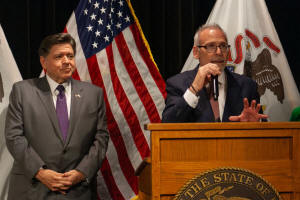
Gov. JB Pritzker and Illinois Superintendent of Education Dr. Tony
Sanders speak at an event at the Governor’s Mansion in March 2026.
(Capitol News Illinois photo by Jenna Schweikert)

Jessica Handy, executive director of Stand for Children Illinois,
describes the group as an “anti-private school voucher” organization
that still supports “high quality and equitable” school choice,
particularly charter schools.
However, as a part of the Illinois Early Literacy Coalition, which
supports greater funding for literacy tutoring programs, Handy said
Stand feels “torn” on the matter.
“We all care really deeply about public education,” Handy said. “We all
care really about equitable access and opportunity. And I think there’s
just a lot of variables about what this program would mean for both of
those.”
Legislators remain wary
One of the central concerns behind the federal tax credit include the
extent to which it will benefit public schools, and whether the
institutions it benefits will be open to students of all protected
groups.
In many rural areas, for example, there are no private schools that
would be eligible for the tax credit.
The argument against funding private schools arose from Illinois’
now-defunct state tax credit, Invest in Kids, which ended in 2023.
According to Cresswell, a majority of private schools that benefited
from the program discriminated on the basis of at least one protected
status, most frequently discriminating against students with
disabilities.
“It funded discrimination, it hurt education equity, and we certainly
don’t want to see that replicated on an even bigger scale with even less
oversight, less accountability, less transparency on how these dollars
are being spent,” Cresswell said.
While some have proposed for legislators to set state-level guidelines
for the federal tax credit, Cresswell said it’s “basically legally
impossible” to enforce, especially if discriminatory practices are due
to schools’ religious beliefs.
To Johnson, the long-running discrimination debate reinforces the need
for flexible school choice for parents among public, private and
religious schools.
“(Critics) forgot that they, too, have choice. It could be a private
school, but it doesn’t have to be a religious-based school,” Johnson
said.
What comes next?
Support in the legislature for the federal tax credit so far has almost
exclusively come from Republicans in the House, with House Bills 4098
and 4099. for Johnson and her Senate bill co-sponsor, Sen. David
Koehler, D-Peoria, are the only Democratic sponsors in either chamber.
The bills remain at a legislative standstill, with the House bills stuck
in the Rules Committee since October and the Senate bill languishing in
Assignments since February. To Sen. Chris Balkema, R-Channahon, it
simply means the Democratic leadership team is not excited by the
measure, partly due to added political pressure.
Johnson attributes some of the struggle to what she called
“misinformation” about the tax credit defunding public schools, and that
the next step would be to “educate” her colleagues and the public to
garner support for the bill.

Pritzker’s caution in weighing in on the federal tax credit has incurred
both criticism and praise at the current stage of the political debate.
Johnson added she supports the decision to be “prudent” in awaiting
federal regulations, but argues that they can signal their support of
the program to Illinoisans by advancing the bill “with caution.”
Leslie Hiner, vice president of legal policy at EdChoice, attributes
Pritzker’s hesitance to the political clout of state teachers unions in
upcoming elections. She claims the decision to opt in would be a
“no-brainer” if politics weren’t involved.
Bruno, on the other hand, contends that the tensions in the decision
exist beyond the elections, as he sees a large constituency in Illinois
will be upset if their students can’t access scholarship money while
other states will under the program.
“Taxpayers in Illinois already pay more to the federal government than
they get in benefits,” Bruno said. “You can think of a program like this
as potentially doing something similar and making that even more
extreme.”
Balkema heralds the tax credit program as a rare gift from the federal
government. He called on Democrats and skeptics of the Trump
administration to support the legislation and to not allow “unhappiness
with a personality get in the way of doing the right thing.”
“Why would we, Illinois, not take advantage of that and provide tax
relief for people that are having to write these checks to property tax
bills, and then also for their child’s education that they could get
reimbursed for?” Balkema said.
Marisa Guerra Echeverria an undergraduate student in
journalism and political science with Northwestern University’s
Medill School of Journalism, Media, Integrated Marketing
Communications, and a fellow in its Medill Illinois News Bureau
working in partnership with Capitol News Illinois.
Capitol News Illinois is
a nonprofit, nonpartisan news service that distributes state
government coverage to hundreds of news outlets statewide. It is
funded primarily by the Illinois Press Foundation and the Robert R.
McCormick Foundation. |