Iran's top diplomat says a lack of trust is impeding talks to end war
with the US
[May 16, 2026]
By SHEIKH SAALIQ and ADAM SCHRECK
NEW DELHI (AP) — Iran ’s foreign minister said a lack of trust is the
biggest obstacle in negotiations to end the war with the U.S., saying
Friday that Tehran would be open to diplomatic help, particularly from
China, to help ease tensions.
Iranian Foreign Minister Abbas Araghchi said contradictory messages have
“made us reluctant about the real intentions of Americans.”
“We are in doubt about their seriousness,” he told reporters in New
Delhi, adding that negotiations would move forward if Washington was
ready for a “fair and balanced deal.”
U.S. President Donald Trump earlier this week dismissed Iran's latest
formal proposal as “garbage.” While Iran was said to include some
nuclear concessions, Trump has said he wants to remove highly enriched
uranium from the country and prevent it from developing nuclear weapons.
Iran says its nuclear program is for peaceful purposes.
In separate negotiations in Washington between Israel and Lebanon, both
sides agreed Friday to extend their ceasefire until early June, U.S.
officials said.
With talks between Iran and the U.S. at a standstill during the shaky
ceasefire, tensions remain high and threaten to tip the Middle East back
into open warfare and prolong the worldwide energy crisis sparked by the
conflict.
Iran still has a chokehold on the Strait of Hormuz, a vital waterway
where a fifth of the world’s oil passed through before the war, and
America is blockading Iranian ports.
Trump and Chinese President Xi Jinping, who finished talks on Friday,
agreed the strait needs to be reopened.

China could play a diplomatic role, Iran says
Araghchi said Friday that Iran would welcome diplomatic support from
other countries, particularly from China, citing Beijing’s previous role
in facilitating the restoration of ties between Iran and Saudi Arabia.
Beijing has shown little public interest in U.S. requests to get more
involved, even though Trump told Fox News’ Sean Hannity that Xi had in
their conversations offered to help.
Pakistan said Thursday it was continuing diplomatic efforts to help ease
regional tensions. But it declined to disclose details of the
discussions or say whether the U.S. had formally responded.
“The clock on diplomacy has not stopped. The peace process is working,”
Pakistani Foreign Ministry spokesperson Tahir Andrabi told reporters in
Islamabad.
Iran says uranium is a sticking point
Trump has demanded a major rollback of Iran’s nuclear activities while
Iran says it has a right to enrich uranium.
Israeli Prime Minister Benjamin Netanyahu, who launched the war with
Trump on Feb. 28, also wants Iran’s highly enriched uranium removed from
the country.
Iran’s foreign minister said Friday that the issue of its enriched
uranium stockpile is one of the most difficult subjects in negotiations
with the U.S.
Russia has previously offered to take the stockpile if Iran is willing
to give it up. Araghchi said Russia’s proposal was not currently under
active discussion, but could be revisited.
“When we come to that stage, obviously we will have more consultations
with Russia and see if the Russian offer can help or not,” he said.
Israel and Lebanon extend ceasefire as strikes continue
Israel and Lebanon agreed to extend the expiring Israel-Hezbollah
ceasefire for another 45 days to allow for negotiations on a broader
peace agreement, the U.S. State Department said.
After two days of meetings, the department said it would reconvene the
two sides for discussions on June 2 and 3, while a military track —
between the Israeli and Lebanese armies — by the Pentagon will begin on
May 29. Hezbollah opposes Lebanon’s direct negotiations with Israel and
has not been part of the talks.
[to top of second column]
|
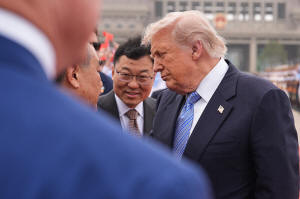
President Donald Trump interacts with China's Foreign Minister Wang
Yi before boarding Air Force One, Friday, May 15, 2026, at Beijing
Capital International Airport in Beijing. (AP Photo/Mark
Schiefelbein)

Israel’s ambassador to the U.S. Yechiel Leiter said the talks were
frank and constructive. “There will be ups and downs, but the
potential for success is great,” he said in a social media post.
“What will be paramount throughout negotiations is the security of
our citizens and our soldiers.”
The ongoing ceasefire hasn’t stopped Israel and Hezbollah from
trading strikes.
The Israeli military said Friday it hit Hezbollah sites in southern
Lebanon after reporting hostile aircraft alerts and launches from
across the border. Lebanon’s health ministry said three paramedics
were killed in a strike near the city of Harouf. Other strikes
around the coastal city of Tyre wounded nearly 40 people, destroyed
a health center and damaged the neighboring Hiram Hospital, wounding
six medical workers, the ministry said.
Chinese-owned ship taken into Iranian waters
A Chinese-owned ship anchored off the United Arab Emirates was
seized this week and taken toward Iranian waters.
Chinese private security company Sinoguards said it had “been
informed through relevant channels" that the vessel Hui Chuan, which
it was operating as an offshore work platform, was taken into
Iranian waters for documentation and compliance inspection by the
authorities.
The company's emailed statement said there was no indication of any
injuries on the ship and that it was cooperating.
Honduras, where the ship was flagged, said the ship had 17 crew
including people from Nepal, Myanmar, Vietnam and Sri Lanka.
The seizure happened as a senior Iranian official reiterated his
country’s claim of control over the Strait of Hormuz and another
said it had a right to seize oil tankers connected to the U.S.
The U.S. seized vessels in the Gulf of Oman last month and on Friday
the foreign minister of Pakistan said it had secured the return of
11 Pakistani nationals and 20 Iranian citizens who were aboard those
vessels. “All individuals are in good health and high spirits,” said
the foreign minister, Ishaq Dar, said.
UAE speeds up construction of oil pipeline
The United Arab Emirates is speeding up the completion of a new
pipeline that will allow the Gulf federation to export more oil
without routing it through the Strait of Hormuz.
Sheikh Khaled bin Mohammed bin Zayed Al Nahyan, the crown prince of
Abu Dhabi, directed state oil company ADNOC to accelerate work on
the pipeline, the Abu Dhabi Media Office said Friday.
The oil company already runs a pipeline designed to carry 1.5
million barrels a day from its oil fields to the port of Fujairah on
the Gulf of Oman.
The new pipeline, expected to double the company’s export capacity
through that port, will become operational next year, the media
office said.
___
Schreck reported from Dubai, United Arab Emirates. Associated Press
reporters Munir Ahmed in Islamabad; Koral Saeed in Abu Snan, Israel;
Matthew Lee in Washington; and Mae Anderson in New York contributed.
All contents © copyright 2026 Associated Press. All rights reserved
 |