US-Mexico border wall construction is desecrating sacred sites,
Indigenous leaders say
[May 18, 2026]
By JULIE WATSON and MORGAN LEE
TECATE, Mexico (AP) — White sage burning, Norma Meza Calles gathers
guests at a Mexican wellness resort into a semicircle facing Kuuchamaa
Mountain and asks everyone to close their eyes and feel its presence.
“This is sacred to us like a church for you all. The mountain is our
healer, our psychologist,” said Meza Calles, a Kumeyaay Nation tribal
leader who explains that in its creation story a shaman transformed into
the mountain. "Here is where we gather strength to live in this
difficult world.”
Then she calls for a moment of reflection. But the silence is pierced by
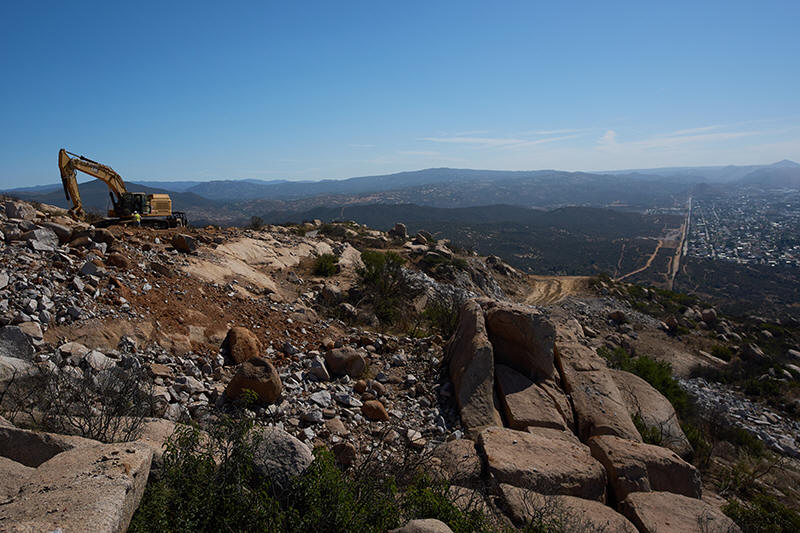
the crushing of rock. U.S. federal contractors have been blasting and
bulldozing Kuuchamaa, which straddles both countries, to make way for
new sections of wall along the U.S.-Mexico border.
Indigenous leaders say that in the Trump administration's rush to build
border walls, contractors are desecrating Native American sacred places
and cultural sites at an unprecedented pace, more than 170 years after
the international boundary split the territories of dozens of tribes.
Federal crews set off blasts on sacred mountain
Barrier construction has ramped up along the 1,954-mile
(3,145-kilometer) border even as illegal crossings have plummeted to
historic lows. Much of it began this year after the U.S. Department of
Homeland Security waived cultural and environmental laws.
In California, explosions on Kuuchamaa send rocks hurtling down its
Mexico side.

“We feel that in our DNA,” said Emily Burgueno, a California member of
the Kumeyaay Nation, adding that “body” and “land” are the same word in
the Kumeyaay language. Some tribal leaders met with DHS officials to
urge them to protect Kuuchamaa and are looking into legal action.
“No one ever consented or supported the use of dynamite on the
mountain,” Burgueno said.
The nation consists of more than a dozen tribes in California and
Mexico’s Baja California.
In Arizona, DHS contractors last month carved through a massive
1,000-year-old fish-shaped geoglyph called “Las Playas Intaglio." The
rare drawing, etched into the desert floor much like Peru’s Nazca Lines,
was created on a lava field in what is now the Cabeza Prieta National
Wildlife Refuge.
The Tohono O’odham Nation said it had pointed out the site on its
ancestral land for contractors to avoid.
“This was a devastating and entirely avoidable loss,” Tohono O'odham
Chairman Verlon Jose said in an April 30 statement. “There is nothing
more important than our history, which is what makes us who we are as
O’odham. The site was also an irreplaceable piece of the United States’
history, one none of us can ever get back.”
U.S. Customs and Border Protection said in a statement that a contractor
“inadvertently disturbed” the site west of Ajo, Arizona, on April 23,
but it vowed to protect the remaining portion. CBP Commissioner Rodney
Scott is talking to tribal leaders to determine next steps.
Members of the Inter-Tribal Association of Arizona, which represents 21
tribes, traveled to Washington last month to lobby against a 20-foot
(6-meter) secondary wall being built along that section of the border,
as well as a primary 30-foot (9-meter) bollard wall planned on Tohono
O’odham tribal lands. They met with Homeland Security Secretary
Markwayne Mullin, a Cherokee Nation member, who listened but made clear
his intent is to build more border walls as fast as possible, the Tohono
O’odham Nation said in a statement.

Hundreds of miles are under contract
The Trump administration says the barriers are necessary to keep people
and drugs from entering the U.S. illegally. It wants walls to cover at
least 1,400 miles (2,250 kilometers) of the border.
Trump’s “ big, beautiful bill ” devoted over $46 billion to the effort.
CBP has awarded contracts or begun construction on over 600 miles (966
kilometers) of new border wall, with companion surveillance technology.
A double wall is planned or under construction along another 370 miles
(596 kilometers).
In Arizona, where the Patagonia Mountains descend to the border, heavy
machinery crawls along freshly graded roads to extend a double wall that
could block a wildlife corridor for endangered ocelots and jaguars.
Jaguars have long coexisted with the Tohono O'odham, who consider the
species “spiritual guardians," Austin Nunez, a tribal leader, said in a
2025 lawsuit that unsuccessfully challenged the DHS waivers.
[to top of second column]
|
Construction crews work on a new border wall segment on Kuuchamaa
Mountain, Friday, April 24, 2026, seen from Tecate, Mexico. (AP
Photo/Gregory Bull)

In Sunland Park, on New Mexico's border with Mexico, crews this year
set off blasts on Mount Cristo Rey, a pilgrimage site topped with a
limestone crucifix.
CBP is seeking to seize a strip of the mountain owned by the Roman
Catholic Church for wall construction. The Diocese of Las Cruces
asked a judge this month to deny the land transfer as an affront to
religious liberties and the “faithful who seek to commune with God
on Mount Cristo Rey."
In western Texas, the federal government in February notified
ranchers on the Rio Grande east of Big Bend National Park of its
interest in their land that contains canyonland pictographs and
petroglyphs, said Raymond Skiles, a retired Big Bend National Park
ranger.
“There are pictographs, paintings of shaman figures and various
things that we don’t know how to interpret,” said Skiles, describing
the drawings on his family's ranchlands.
After community backlash, CBP's online planning map showed the
30-foot-wall plans were scrapped for surveillance technology,
patrols and some vehicle barriers. A segment in the national park
and neighboring Big Bend Ranch State Park would rely on technology
alone.
CBP says it recognizes the importance of natural and cultural
resources and is working to minimize the construction’s impact,
including leaving drainage gates open in wildlife corridors for
animal passage. Illegal border crossings have littered, polluted and
trampled sensitive habitat, the agency says.
CBP also says 535 miles (860 kilometers) of remote, rugged border
terrain will solely rely on detection technology.
Many tribes would prefer that to walls.
Desecrating Native American sites is a felony
Tribes along the border “are all experiencing the same tragic
desecration of our cultural and sacred sites,” said Burgueno, chair
of the Kumeyaay Diegueño Land Conservancy, a nonprofit organization
in California that works to protect Kumeyaay lands. “This is a great
example of the federal government not following federal laws.”

Desecrating a sacred Native American site on U.S. federal or tribal
land is a felony, punishable by imprisonment and fines. In 1992, the
National Park Service listed Kuuchamaa Mountain, also called Tecate
Peak, in the National Register of Historic Places, giving it limited
protection. It noted that “discarding or disturbing the mountain’s
natural state would be sacrilegious.”
Rising 3,885 feet (1,184 meters) above sea level, Kuuchamaa has also
captivated non-Native people.
Sarah Livia Brightwood Szekely said her father, Edmond Szekely, felt
the mountain's healing energy when he arrived in Tecate, Mexico, as
a Hungarian Jewish refugee during World War II, and started the
renowned wellness resort, Rancho La Puerta, which she now runs.
“There are all of these people that have a deep relationship with
the mountain,” she said.
Meza Calles leads walks at Rancho La Puerta to teach guests about
Kuuchamaa.
Traditionally, young men would spend 40 days at its base in a
coming-of-age ceremony before becoming warriors or shamans, she
said. Today's rituals are shorter. People suffering from a death,
debt, divorce or other difficulty seek Kuuchamaa's healing, she
said.
“It's sad they are ruining the mountain," she said. “We'll see how
far they go. Destiny is destiny. But the fight is not over.”
_____
Lee reported from Santa Fe, New Mexico.
All contents © copyright 2026 Associated Press. All rights reserved
 |