Negotiators reach a deal to end strike on North America’s busiest
commuter rail system
[May 19, 2026] By
PHILIP MARCELO and KATHY MCCORMACK
NEW YORK (AP) — Negotiators on Monday reached a deal to end the strike
that stalled service on the Long Island Rail Road, the busiest commuter
rail system in North America.
New York Gov. Kathy Hochul said the deal won't increase fares or taxes
and will give employees fair wages. She said she's not at liberty to
disclose specific details while the new contract terms are considered
and voted on by union members.
“Negotiations are rarely easy, but I have a lot of respect for the
collective bargaining process that unfolded over the last few days,” she
said during a news conference Monday evening.
The deal comes years after the Metropolitan Transportation Authority and
leaders of the five labor unions started bargaining for a new contract.
The unions went on strike at 12:01 a.m. Saturday, stalling service for
roughly 250,000 commuters who use the rail system that connects New York
City to its eastern suburbs every weekday.
Robert Free, LIRR’s president, said that the system’s major commuter
lines will begin running trains by noon Tuesday, with full service to
all branches by the afternoon rush hour.
“Time to get back to work,” he said.
Kevin Sexton, the vice president of the Brotherhood of Locomotive
Engineers and Trainmen, said the unions believe this is a fair deal, but
he wouldn’t disclose any specifics about what the railroad promised its
workers. Union officials said later that more details would be shared
soon with rank and file members.
“We are looking forward to our members getting back to work doing what
they do best, which is serving the region,” Sexton said at a news
conference.
The unions, representing about half the train system’s workforce, had
demanded raises they said were needed to help workers keep up with
inflation and rising living costs. The MTA argued that the unions’
initial demands would lead to fare increases.
Gerard Bringmann, chair of the rider advocacy group Long Island Rail
Road Commuter Council, said he’d reserve judgement until he sees more
details about the deal and how it might impact future fare hikes.
“This will be a relief to our daily riders who experienced a very
difficult day today getting to work and home,” he said.
The LIRR urged riders to work from home again Tuesday if possible.
Deal was years in the making
Unionized workers had picketed in front of major LIRR hubs, chanting
slogans and holding up signs that read: “No contract. No work,” and
“Equal work. Equal pay.”
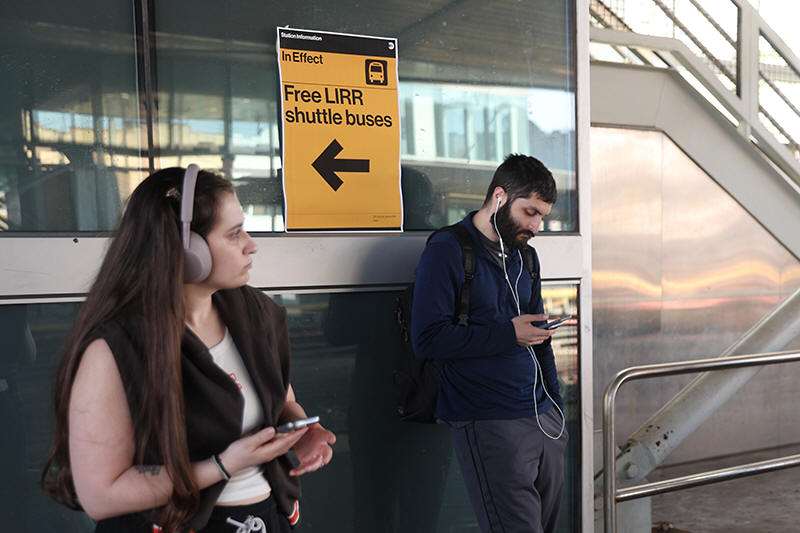
The MTA, which runs the railroad, offered free but limited shuttle buses
during the morning and evening rush hours starting Monday, leaving most
commuters to navigate the gauntlet of car, bus and subway routes. Hochul
had urged LIRR riders to work from home, if possible.
Union officials and the MTA negotiated Sunday afternoon into the early
morning hours Monday after prodding from the National Mediation Board,
which is the federal agency that governs labor relations for railroads
and airlines.
[to top of second column] |
Signs for free Long Island Rail Road shuttle buses hang at the
Howard Beach–JFK Airport station as Long Island Rail Road workers
enter the third day of their strike, Monday, May 18, 2026, in New
York. (AP Photo/Heather Khalifa)
The two sides had been negotiating a
new contract since 2023. The Trump administration got involved in
September after the unions asked for the appointment of a panel of
experts. The move temporarily averted a strike, but the two sides
still couldn’t reach a deal after months passed.
The LIRR serves hundreds of thousands of commuters who live along a
118-mile-long (190-kilometer-long) land mass that includes Brooklyn
and Queens in New York City and the Hamptons, a summertime
playground for the rich and famous near its eastern tip.
Most of its riders live outside New York City in two Long Island
counties populated by nearly 3 million people.
Before this latest walkout, LIRR workers last went on strike in
1994.
Ridership lighter, but impact still felt
Ridership was lighter than expected on the free but limited shuttle
buses the MTA provided from a handful of locations on Long Island to
New York City subway stations.
During the morning commute, more than 2,000 people took advantage of
the shuttle service, the agency said. It had prepared for about
13,000 riders.
Hallie Kessler, a 24-year old speech therapist, had expected her
usual one-hour commute home from a public school in the New York
City borough of Queens to double in length because of the strike.
Instead, it tripled. And rather than just one LIRR train, she took
two trains and then a shuttle bus.
“I’m tired. I’m ready for a nap,” Kessler said as she stepped off
the bus at the Hicksville LIRR station where she parked her car.
“Not thrilled about having to do it again tomorrow.”
The first impacts of the walkout were felt over the weekend as
baseball fans had to find other ways to get to Citi Field in Queens
to see the New York Mets take on their crosstown rivals the New York
Yankees.
Hochul said the deal ensures the same fate won’t befall basketball
fans looking to catch the New York Knicks continue their playoff run
on Tuesday. Madison Square Garden, where the Knicks play their home
games, is located directly above the railroad’s Penn Station hub in
Manhattan.
“Knicks fans will be able to take the train to MSG tomorrow in time
for game one of the Eastern Conference Finals," she said.
___
McCormack reported from Concord, New Hampshire. Associated Press
writers Ted Shaffrey and Joseph Frederick in New York, Hallie Golden
in Seattle and Josh Funk in Omaha, Nebraska, contributed.
All contents © copyright 2026 Associated Press. All rights reserved |