Indonesia tightens state control over exports of vital commodities
[May 20, 2026] By
EDNA TARIGAN and ANTON L. DELGADO
JAKARTA, Indonesia (AP) — Indonesia is tightening state control over its
globally important natural resources, with new regulations requiring
that state-owned enterprises handle exports of key commodities like palm
oil, coal and iron alloys.
President Prabowo Subianto told parliament on Wednesday that Indonesia
had lost as much as $908 billion because its commodities were
undervalued when they were exported. Increasing control will bring more
money into government coffers, he said, describing the underreporting of
exports to reduce taxes as “fraud or deception.”
“The primary objective of this policy is to strengthen oversight and
monitoring — and to combat under-invoicing, transfer pricing and the
diversion of export proceeds,” Prabowo said.
As the world’s largest exporter of thermal coal and palm oil, Indonesia
is a global powerhouse in terms of commodities. The Southeast Asian
nation of roughly 287 million also has the world’s largest known
reserves of nickel, a critical mineral that China and the United States
are competing to control.
State-owned enterprises now handle only a modest portion of Indonesia's
exports of such commodities, experts say.
Greater state control will give Indonesia greater “bargaining power” in
future negotiations with superpowers keen on securing access to the
country’s vast resources, said Dinita Setyawati of the energy think tank
Ember.

The new centralized commodities system could also help Indonesia address
long-standing environmental issues caused by the overexploitation of its
natural resources, she said, but that will depend on how policies are
implemented.
“There’s going to be a question of trust,” Setyawati said. “Most
notoriously, corruption needs to be watched to make sure that everything
goes according to what it should be.”
Over the past few months, the government has cracked down on
unauthorized mining operations. It has been pushing to develop domestic
refining of commodities like coal and nickel, in 2020 outlawing exports
of raw nickel ore.
[to top of second column] |
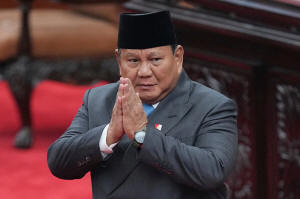
Indonesia's President Prabowo Subianto gestures before delivering
his address during a House of Representatives plenary session in
Jakarta, Indonesia, Wednesday, May 20, 2026. (AP Photo/Achmad
Ibrahim)
 Prabowo's announcement this week is
by far the government's biggest move to directly control the
nation's commodities, said Putra Adhiguna of the Energy Shift
Institute, a Jakarta-based think tank.
He said the policy will boost state revenues and help make up for
shortfalls caused by higher subsidies provided to protect consumers
from higher fuel prices caused by the energy shock from the Iran
war. That could have a significant impact on the economy.
Indonesia's central bank raised its key interest rate by 0.5
percentage point to 5.25% on Wednesday, mainly to counter a
weakening in the country's currency, the rupiah.
The export control plan's first phase is expected to run from June
to August, when private companies will turn over their import and
export transactions to state-owned enterprises. State-owned
companies are expected to manage all trade transactions between
foreign buyers and domestic sellers by September.
“This policy will optimize tax revenue and government revenue, as
well as the management and sale of our natural resources," Prabowo
said. He continued that "we do not want our revenue to be the lowest
simply because we lack the courage to manage what belongs to us,
what belongs to the Indonesian people.”
___
Delgado reported from Bangkok.
All contents © copyright 2026 Associated Press. All rights reserved
 |