A mop, a broom and a calmer mind. Why some find mental health benefits
in everyday tasks
[May 20, 2026]
By KATHERINE ROTH
NEW YORK (AP) — It's spring cleaning season, and for some people that
can mean drudgery or anxiety.
But experts from Zen monks to psychologists say there are mental health
benefits to be found in such manual chores as sweeping, mopping and
clearing away clutter. These tasks can encourage mindfulness or permit
the mind to wander, all while producing a concrete sense of achievement
in accomplishing the basic tasks of daily life.
As one famous Zen saying goes:
“Before enlightenment, chop wood, carry water. After enlightenment, chop
wood, carry water.”
What the monks know
Zen apprentices, or “unsui” monks, spend much of their time cleaning and
tidying.
“We sweep dust to remove worldly desires. We scrub dirt to free
ourselves of attachments," Shoukei Matsumoto, a Buddhist monk living in
Kyoto, Japan, wrote in his book “A Monk’s Guide to a Clean House and
Mind.” “The time we spend carefully cleaning out every nook and cranny
of the temple grounds is extremely fulfilling.”
Holly Schiff, a clinical psychologist based in Greenwich, Connecticut,
confirms that the process of cleaning can be calming and almost
meditative.
“I definitely think there is a link between mental health and the act of
cleaning," she said.
“Repetitive, physical activities like cleaning can be regulating for the
nervous system because they’re predictable, structured and give a clear
sense of completion,” she says. That gives people a feeling of control
and grounding.

Plus, you can immediately see the result of what you've done, "which can
be satisfying in a way that many cognitive or emotional tasks aren’t,”
she says.
For those who dread cleaning and find it daunting, it can help to focus
on the process rather than on a to-do list.
Some tips for a more mindful approach to cleaning:
Slow down and change your focus
“For people who tend to see cleaning as drudgery, I think the shift is
less about forcing yourself to enjoy it and more about changing how you
engage with it,” says Schiff.
Don't try to rush through it. Pay attention to the physical movement or
its rhythm, or to things like the temperature of the water.
“If you slow it down and focus on the sensory aspects of it, it can
start to function more like a mindfulness exercise," Schiff says.
[to top of second column]
|

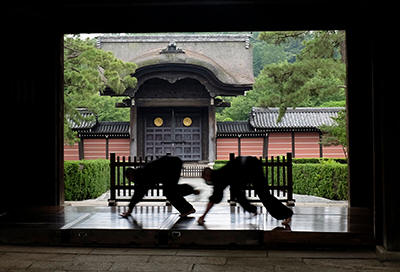
Monks polish the wooden corridor of the walkway that connects
between temple buildings at Soji-ji in Yokohama, Japan on July 5,
2016. (AP Photo/Kiichiro Sato, File)
 Let your mind rest
For some, cleaning can provide an opportunity to free your mind.
“By gently tending to your habitat, you allow your mind to naturally
settle into a peaceful, unforced clarity,” says Matsumoto.
Expand your perspective
Matsumoto says cleaning is a way of caring for yourself and the
world.
“In our practice, we don’t see cleaning as a chore to control the
environment. Instead, we view it as ‘Habitat Care,’” he explains.
“Just as our bodies maintain a dynamic equilibrium to stay healthy,
cleaning is an extension of that biological process into the space
we inhabit. When we clean, we are not just fixing a room; we are
tending to our expanded self. It is a way of caring for the
relationship between us and the world."
Let go of perfection
Rather than needing a perfect result, says Matsumoto, try to embrace
incompletion without being anxious.
“Peace is found not in the final ‘tidy state,’" he says, "but in the
humble, ongoing act of emptying the space and our minds.”
There's no such thing as perfection.
“In nature, everything is constantly changing — leaves fall the
moment you finish sweeping," he says.
Narrow the scope of the task
Sometimes, the feeling of being overwhelmed isn't about the task
itself, but what it represents. That could be time pressure,
self-judgment or other anxieties, for instance, says Schiff.
"Break the task down into very small, defined actions to reduce that
barrier,” she suggests. “Just choose one surface, one task or one
room for starters.”
“A lot of the overwhelm comes from anticipating the entire task
rather than just engaging with that first step,” she says.
Cleaning as sharing the love
“In a clean space, even if the person who cleaned it is not there,
we can feel their consideration and awareness,” says Matsumoto.
“This awareness creates a sense of peace and safety, similar to why
sacred spaces like temples feel different from the busy streets."
All contents © copyright 2026 Associated Press. All rights reserved |