Community grieves the 3 men killed while defending San Diego mosque
[May 20, 2026]
By JAIMIE DING, TY ONEIL and SAFIYAH RIDDLE
LOS ANGELES (AP) — The three people killed by two teen shooters at a San
Diego mosque were beloved pillars of the community, and died while
saving roughly 140 children who were in the building at the time of the
attack, authorities said Tuesday.
All three men were shot while trying to delay and distract the two
gunmen who barged into the Islamic Center of San Diego on Monday, San
Diego Police Chief Scott Wahl said.
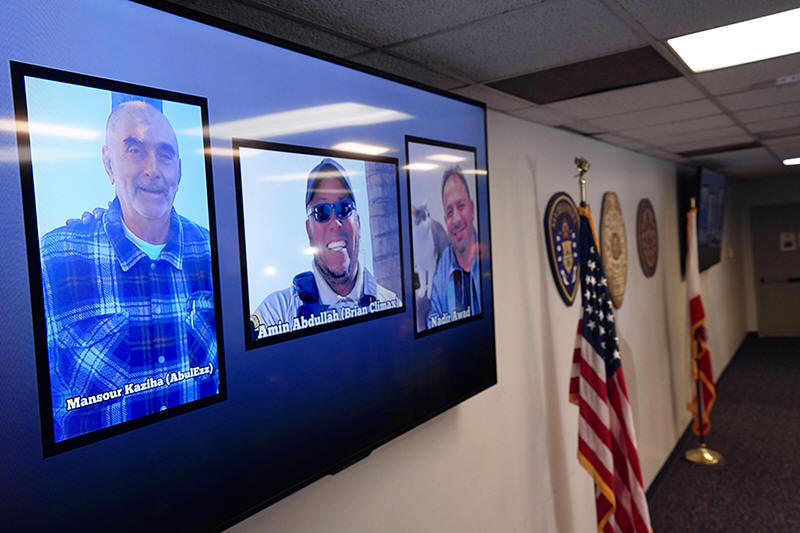
The Imam of the Islamic Center of San Diego, Taha Hassane, identified
the three victims as Amin Abdullah, 51, Nadir Awad, 57, and Mansour
Kaziha, 78, who was known as Abu Ezz.
“We call them our brothers in the community. We call them our martyrs
and our heroes,” Hassane said.
The three men saved lives
Authorities described how the shooting unfolded based on security camera
footage at the mosque, which is the largest in San Diego and attracts
thousands of people from across the region during major holidays. In
addition to having prayer five times a day, it also provides dinners and
breakfasts during the Ramadan fasting period, hosts a school for Arabic
and Islamic studies, and has a store inside.
When the two shooters, ages 17 and 18, entered, they passed Abdullah,
seemingly without notice, Wahl said. Abdullah, who was a security guard
for the mosque for about a decade, quickly confronted them and exchanged
gunfire.
At the same time, he grabbed his radio and warned everyone to go into
lockdown. As the shooters made their way into the lobby, they wounded
him as he kept firing, forcing them back outside into the mosque’s
parking lot. There, he was fatally shot.

The shooters went back inside and searched through rooms that were
emptied during the lockdown, Wahl said. The gunmen then went back out to
the parking lot where Kaziha and Awad confronted them. Kaziha was able
to call 911 before the gunmen fatally shot both men outside.
“All three of our victims did not die in vain. Without distracting the
attention, without delaying the actions of these two individuals,
without question, there would have been many more fatalities,” Wahl
said.
A warm and welcoming presence
Amid an outpouring of condolences from Muslim leaders and
politicians around the country, people in the tight-knit community say
they are struggling to imagine the Islamic Center without the three men
— who were widely regarded as central figures who made the mosque feel
like home.
Abdullah greeted all visitors to the mosque with a smile and the
traditional Muslim greeting in Arabic of “as-salamu alaikum,” or “peace
be upon you,” according to Mahmood Ahmadi, a longtime attendee. Another
friend, Shaykh Uthman Ibn Farooq, said Abdullah was there nearly every
single day and was dedicated to his wife and eight kids.
His daughter Hawaa Abdullah, surrounded by family members at a Tuesday
news conference, said her father was loving and supportive, a “best
friend” and a role model. He took his job protecting the community so
seriously he sometimes wouldn't eat during his shifts, she said.
“He wanted to save his food until after he left the job because he was
afraid that if he were on his break, something bad will happen,” she
said.
Abdullah was raised Christian and described in a 2019 YouTube video his
journey discovering the Islamic faith after graduating high school.
Farooq said he met Abdullah shortly after he became a Muslim in the
1990s. Most recently, they had gone on a pilgrimage trip to Mecca
together.
[to top of second column]
|
Photos of the three victims at the Islamic Center of San Diego are
displayed after a news conference in San Diego, Calif., Tuesday, May
19, 2026. (AP Photo/Ty ONeil)

Khalid Alexander converted to Islam around the same time as Abdullah
roughly 30 years ago. The two men lived in a different San Diego
mosque together at the time, where they helped each other imagine
how to make meaningful, stable lives. Over the years, Alexander said
that he has watched Abdullah take pride in his ability to care for
his community as a security guard.
“That was his dream job,” Alexander said.
Alexander said that he and Abdullah sometimes discussed concerns
about rising “anti-Muslim, anti-Black, anti-immigrant” sentiments on
television. Often, those sentiments came directly to the San Diego
mosque through hate mail, which prompted the hiring of security
guards like Abdullah and installation of cameras, Hassane said.
Alexander said Abdullah “was keenly aware of the dangers of his job
— and that’s exactly why he chose to do it.”
Father figure in the center
Kaziha, known as Abu Ezz, was an integral part of the mosque since
it was built in the 1980s, and has served the community “non-stop”
since then, Hassane said.
Hassane and others knew Kaziha as the first person to call when
something went wrong.
“He was the handyman. He was the cook. He was the caretaker. He was
the storekeeper. He was everything,” he said.
Yasser Kaziha, Mansour Kaziha’s son, described his father as not
only a pillar of the community, but “a pillar of our household.”
“He taught us to expect hardships and push through them to fill our
individual purposes just like he did,” Yasser Kaziha said during a
vigil Tuesday evening.
Alexander has known Mansour Kaziha since before Alexander converted
to Islam, and still remembers the first time in the mid-1990s when
he was welcomed into Kaziha's home. Decades later, Alexander said it
was hard to imagine the center without him.
“He was like, kind of like the father of that space,” Alexander
said.

Running toward gunfire
Awad lived across the street from the Islamic Center and attended
prayers “every single day,” Hassane said.
When he heard gunfire, Awad he ran toward the building, where his
wife is a teacher at the school.
“He left his home, trying to go and do something to help,” Hassane
said during the vigil.
The three men's actions, Alexander said, embodied the virtues of
Islamic community in San Diego.
“They really represented everything that’s beautiful about Islam and
everything that is beautiful about Muslims,” Alexander said.
All contents © copyright 2026 Associated Press. All rights reserved |