Backlash to Trump's $1.8B settlement fund delays GOP immigration bill
[May 22, 2026]
By KEVIN FREKING, MARY CLARE JALONICK and LISA MASCARO
WASHINGTON (AP) — Senate Republicans abruptly left Washington on
Thursday without voting on a roughly $70 billion bill to fund
immigration enforcement agencies, frustrated with the White House and at
an impasse over whether to try to block a new $1.776 billion settlement
fund to compensate Trump allies who believe they have been politically
prosecuted.
Republicans had already abandoned part of the bill that provided $1
billion in security money for the White House complex and President
Donald Trump’s ballroom amid backlash from members of their own party.
But the settlement announced by the Justice Department this week
prompted even more questions, spurring a push to limit the taxpayer
dollars that some feared could go to Trump supporters who harmed law
enforcement officers in the Jan. 6, 2021, attack on the Capitol.
A tense meeting with acting Attorney General Todd Blanche on Thursday
morning to discuss the settlement only heightened the frustration among
senators. Soon after it ended, Republican leaders announced that they
would not vote on the immigration enforcement measure until they
returned from a Memorial Day recess the week of June 1, which was
Trump's self-imposed deadline for them to pass it.
Blanche “had an appreciation for the depth of feeling” among GOP
senators, Senate Majority Leader John Thune said afterward as a growing
number of them spoke out against the idea.
Kentucky Sen. Mitch McConnell, the former GOP leader, called the
settlement “utterly stupid, morally wrong.”

“The nation’s top law enforcement official is asking for a slush fund to
pay people who assault cops?” McConnell said in a statement afterward.
The last-minute scramble on the bill came as Democrats have criticized
Republicans for trying to fund Trump’s ballroom when voters are
concerned about affordability issues — and as some GOP lawmakers have
grown increasingly frustrated with Trump.
Several GOP senators have spoken out against the Justice Department
settlement announced this week, and many were upset by the president’s
Tuesday endorsement of Texas Attorney General Ken Paxton in next week’s
primary runoff against Sen. John Cornyn.
Growing tensions with the White House derail bill
Both sides have acknowledged the tensions. Thune said Thursday that the
White House should have consulted Congress before it announced the
settlement, which he said made “everything way harder than it should
be.” Trump's endorsement of Cornyn's opponent also complicated matters,
he said.
“I think it’s hard to divorce anything that happens here from what’s
happening in the political atmosphere around us," Thune told reporters.
"There is a political component to everything we do around here.”
Trump unloaded on senators in a social media post Wednesday, urging
Republicans to fire the Senate parliamentarian, Elizabeth MacDonough,
who said over the weekend that parts of the $1 billion White House
security proposal did not qualify for the ICE and Border Patrol bill.
Trump also renewed his long-standing calls for the Senate to pass the
SAVE Act, a Republican bill that would require voters to prove U.S.
citizenship, and to end the Senate filibuster.
Republicans need to “get smart and tough,” Trump said, or “you’ll all be
looking for a job much sooner than you thought possible!”

While they have been loyal to Trump on most issues, Senate Republicans
have resisted his repeated calls over the years to kill the filibuster,
which creates a 60-vote threshold for most bills in the Senate.
Asked Thursday at the White House if he was losing control of the
Senate, Trump replied: “I really don’t know. I can tell you — I only do
what’s right.”
Hanging over the growing GOP rift is Trump’s surprise endorsement of
Paxton. That intervention has Republican senators privately fuming that
it could cost them their majority in November as they view the
incumbent, Cornyn, as the stronger candidate.
[to top of second column]
|

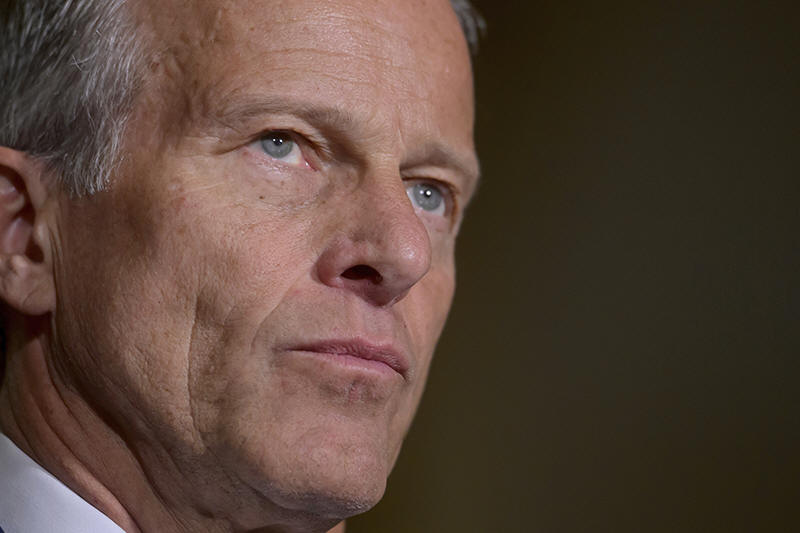
Senate Majority Leader John Thune, R-S.D., speaks during the Senate
Republican policy luncheon news conference at the Capitol, Tuesday,
May 19, 2026, in Washington. (AP Photo/Rod Lamkey, Jr.)

Possible parameters on Trump's settlement fund
The “anti-weaponization” fund, part of a settlement that resolves
Trump’s lawsuit against the IRS over the leak of his tax returns,
unexpectedly became one of the main complications in the bill after
Democrats announced that they would force votes to block it or place
restrictions on it.
Democrats have an opening because Republicans are trying to pass the
immigration enforcement bill through a budget process that allows a
long series of amendment votes. The Democratic amendments would
block the fund outright or ban any payments to Trump supporters who
harmed law enforcement officers on Jan. 6, 2021.
“The only way for Republicans to get out of this box is to stop
backing the slush fund, stop pushing the ballroom, and as soon as we
get back, join Democrats in fighting to lower Americans’ costs on
health care, on housing, on power, on so much else,” Senate
Democratic Leader Chuck Schumer of New York said after senators left
town.
As it became clear that the Democratic amendments could pass,
Republicans began discussing their own last-minute additions to head
that off — an idea that appeared to have support in the GOP
conference but could threaten eventual support of the bill in the
House or make a presidential veto more likely.
“I think there’s reasonable limitations that can be put on it,” said
Sen. Rick Scott, R-Fla., one of Trump's top allies in the Senate.
Secret Service request falters
Under the Secret Service’s request, about $220 million would fund
security improvements related to the ballroom. The rest would go for
a new screening center for visitors, training and other security
measures.

After it became clear that Republicans would abandon that proposal,
Trump told reporters at the White House on Thursday that “I don’t
need money for the ballroom,” which he had originally said would be
paid for with private funds. Still, if Congress doesn’t approve the
request, he said the White House “won’t be a very secure place.”
Sen. Thom Tillis, R-N.C., said the effort to add the security
package to the bill was a “bad idea.” The bill should not have
included the other security improvements, he said, “because it’s
just giving everybody the ‘billion-dollar ballroom.'”
Left in the bill is the money for ICE and Border Patrol, which
Democrats have blocked for months in protest of the administration's
immigration enforcement crackdown.
Democrats demanded changes for the agencies, but negotiations with
the White House yielded little progress. So Republicans are using
the complicated budget maneuver called reconciliation — the same
process that allowed them to pass Trump's tax and spending cuts bill
last year — to fund the agencies through the end of Trump's term
without any Democratic support.
Still, passage requires sign-off from the parliamentarian and unity
from Republicans.
Sen. Mike Rounds, R-S.D., said the Senate's responsibility should be
to focus on funding ICE and Border Patrol.
“When other extraneous things get in the middle of it, it makes it
more difficult," he said.
___
Associated Press writers Collin Binkley, Stephen Groves and Joey
Cappelletti contributed to this report.
All contents © copyright 2026 Associated Press. All rights reserved |