FDA staff blindsided by move allowing more e-cigarettes and nicotine
pouches onto US market
[May 23, 2026]
By MATTHEW PERRONE
WASHINGTON (AP) — Senior officials in the Food and Drug Administration’s
tobacco center were blindsided by a recent decision that opens the door
to allowing more unauthorized electronic cigarettes and nicotine pouches
onto the U.S. market, The Associated Press has learned.
The guidelines, posted days before former FDA Commissioner Marty Makary
resigned, will allow companies to launch certain nicotine-based products
before they've been fully vetted by regulators.
Some FDA officials tasked with enforcing vaping regulations were not
consulted on the changes and only learned of them the night before the
document was published earlier this month, according to two staffers who
spoke to the AP on condition of anonymity to discuss confidential agency
matters. The document's sudden appearance sparked internal confusion
about how the policy came about and who authorized it, the staffers
said.
In recent days, agency officials have convened hourslong meetings
grappling with how to implement the six-page memo, which breaks with
longstanding FDA policy requiring scientific verification of health
benefits for smokers before any new products are introduced.
It’s highly unusual for the FDA to draft new policies without input from
the staffers who oversee them.
“It begs the question of whether the true subject matter experts may
have actually opposed this policy and were ordered to do it anyway,”
said Mitch Zeller, who retired as the FDA’s tobacco director in 2022.
“And that goes to the ability of the public to have trust and faith in
institutions like FDA.”
The vaping guidelines bypassed a federally required period that allows
for public comment and revisions. Instead, the FDA published them as a
finalized policy hours after media reports surfaced that President
Donald Trump had approved a plan to fire Makary. He resigned from the
FDA last week following months of complaints from industry lobbyists
close to the White House.

A Health and Human Services spokesperson did not address the origins of
the guidance in a written statement.
“This approach strengthens protections against youth nicotine addiction
while supporting evidence-based alternatives for adult smokers seeking
to move away from combustible tobacco products,” Andrew Nixon said in a
statement.
Messages seeking comment from Makary were not immediately returned
Friday.
FDA eyes new approach to vaping flavors
Most health researchers agree that e-cigarettes are significantly less
harmful than traditional cigarettes, and the products have been promoted
in the U.K. and other European countries as an alternative for smokers.
In the U.S., the FDA has struggled to police the market for over a
decade. The agency has authorized vaping products from five companies
while rejecting millions of other applications, mainly due to the
presence of fruit, candy and other sweet flavors that were deemed
appealing to kids. And yet, unauthorized vapes are widely available.
But recent changes in Washington and across the U.S. reflect a shifting
landscape.
Underage vaping among U.S. teenagers has fallen to its lowest level in
more than 10 years, following the disruptions of the pandemic and new
state and federal restrictions.
Trump came to power last year after vowing to “save” the vaping
industry. Major tobacco companies, such as Reynolds American and Altria,
have contributed millions to political action committees supporting
Trump and other administration priorities, including Trump's
inauguration and his proposed White House ballroom. Both companies have
invested heavily in e-cigarettes and nicotine pouches, in addition to
cigarettes.
Despite the influence campaign, vaping issues took a backseat at FDA
under Makary. On rare occasions when Makary addressed e-cigarettes, he
voiced skepticism about the data showing declining underage use.
Even as FDA staffers were poised to shift course on flavors, Makary and
other agency leaders intervened.
In February, one of Makary’s deputies blocked an FDA decision that would
have authorized the first fruit-flavored vapes, according to internal
memos later released by the agency. FDA reviewers had determined the
products were unlikely to be used by children when combined with digital
age-verification technology.
The mango- and blueberry-flavored products were finally OK’d during
Makary’s last full week heading the FDA, just days before the agency
posted the new guidelines allowing unauthorized nicotine products.
[to top of second column]
|
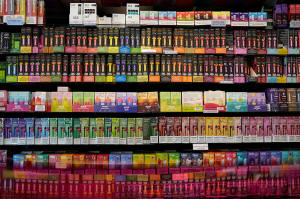
Disposable flavored electronic cigarette devices are displayed
for sale at a store in Pinecrest, Fla., June 26, 2023. (AP
Photo/Rebecca Blackwell, File)
 Under the guidance, the FDA is
supposed to publish a list of e-cigarettes and pouches that are not
yet authorized but will be subject to “enforcement discretion,”
meaning they can be sold without regulators targeting them for
removal. While there is no public list of products that might
qualify, the policy is expected to allow for new flavors that had
previously been blocked by regulators.
“What we’re seeing is a broader opening up and responsiveness to
flavored products by the agency both in terms of a stronger appetite
for authorization but also less appetite to take enforcement action
against flavored products,” said Brian King, former FDA tobacco
director now with the Campaign for Tobacco-Free Kids.
US stores are already packed with illegal flavored vapes
While FDA’s new approach breaks with precedent, it may have little
impact on the flavors already available at gas stations, vape shops
and convenience stores.
The U.S. market has been flooded for years by unauthorized vapes
containing mango, gummy bear, strawberry and dozens of other
flavors.
These disposable e-cigarettes filled the vacuum left by Juul when it
pulled its high-nicotine flavored products from the market, after
they became ubiquitous in U.S. schools beginning around 2017.
Currently, the company only sells FDA-authorized e-cigarettes in
tobacco and menthol flavors.
Juul and other companies now see the chance to directly compete with
disposable Chinese vapes, which by some estimates account for 80% of
U.S. sales.
“The choice we face is not whether flavored vaping products should
be sold in the U.S. They already are,” said Robyn Gougelet, a Juul
vice president. “The choice is whether those products should be
regulated and responsibly marketed — or illegal, untested, and
smuggled into the country.”
Rather than targeting flavors, the FDA said its new enforcement
approach will focus on vapes with specific youth-appealing features,
such as designs that resemble children’s toys.
“The reality is they’re just deluged by illegal products coming
across the border,” said Jonathan Foulds, a tobacco-addiction
specialist at Penn State University. “So they’re making it clear
what should be common sense: ‘We’re going to focus on the worst
actors.’”
New policy may create winners and losers among vaping firms
It’s far from clear whether FDA’s new approach will be embraced by
the vaping industry at large, which includes multinational tobacco
companies alongside hundreds of smaller companies selling imported
devices from China.
As written, the guidance suggests only e-cigarettes that are under
“scientific review” will qualify to launch without FDA
authorization. Only a small number of applications typically reach
that stage, which requires detailed health data on smokers who
switch to the new product, King noted.
“This is certainly going to benefit the larger tobacco companies,
which have the resources to get far enough into the application
review process and thus won’t be prioritized for enforcement,” King
said.

Lobbyists for smaller companies say it’s too early to tell whether
the policy will be help or hinder their clients, but they fear being
left behind.
“The big companies would love nothing more than to see their largest
swath of competitors out of the marketplace,” said Tony Abboud of
the Vapor Technology Association.
___
The Associated Press Health and Science Department receives support
from the Howard Hughes Medical Institute’s Science and Educational
Media Group and the Robert Wood Johnson Foundation. The AP is solely
responsible for all content.
All contents © copyright 2026 Associated Press. All rights reserved |