Officials lift evacuation orders for some California residents living
near a damaged chemical tank
[May 26, 2026]
By LEAH WILLINGHAM and JAMIE STENGLE
Emergency officials lifted an evacuation order Monday for some of the
people who live near a damaged tank containing a hazardous chemical in
Southern California after temperatures inside the tank fell enough to
eliminate the risk of a catastrophic explosion.
While there's no longer a risk of a major explosion at the GKN Aerospace
Transparency Systems plant in Garden Grove, there's still a chance for a
smaller blast or a fire, Orange County Fire Authority division chief
Craig Covey said during a news conference.
An overnight evaluation of the tank containing 6,000 to 7,000 gallons
(22,700 to 26,500 liters) of methyl methacrylate, which is highly
flammable, showed a reduction of pressure inside the tank thanks to a
crack that was discovered Sunday. About two-thirds — roughly 34,000 — of
the evacuated residents can go home as a result, Covey said.
“It’s not over yet. We still have work to do,” Covey said. “We still
have to mitigate a fire and very small explosion concern, and also a
spill potential.”
Officials began ordering residents of Garden Grove, near Los Angeles, to
evacuate their homes on Thursday after the tank overheated, and by the
weekend about 50,000 residents had been told to leave.
Officials said they needed to cool the tank to prevent a toxic leak or
explosion. The tank’s interior had cooled to 93 degrees F (33.9 degrees
C), Covey said Monday, down from 100 degrees (37.7 degrees C) a day
earlier.
Orange County Health Director Regina Chinsio-Kwong said she wanted to
reassure everyone who is returning home that they can feel safe.
Exposure to methyl methacrylate can cause serious respiratory problems,
neurological problems and irritation to the skin, eyes and throat,
according to the federal Environmental Protection Agency.

“There was no contamination. There were no fumes. There were not vapors
that came from this incident,” she said at the news conference. “There
was not a leak. So it should be, you should feel comfortable going home
even if you’re across the street from that new zone line.”
Environmental risks remain
The tank might eventually cool enough for crews to safely stabilize and
drain the remaining material without triggering a spark or ignition,
said Andrew Whelton, a Purdue University engineering professor who has
studied environmental contamination.
Whelton cautioned there is still some risk of an explosion while the
chemical inside the tank remains hot and reactive. He said temperatures
need to fall closer to ambient levels — roughly 60 to 70 degrees
Fahrenheit (15.6 to 21.1 degrees C) — before conditions are considered
significantly safer.
As the interior temperature of the tank increased, methyl methacrylate —
which is used to make plastics — converted from liquid to gas, ramping
up the pressure and risk of explosion, Whelton said.
Some of the methyl methacrylate may already have hardened into a stable
plastic similar to plexiglass, reducing the risk inside the tank, he
said.
Orange County Supervisor Janet Nguyen said the South Coast Air Quality
Management District will be monitoring the air for several months and
the EPA will be checking the sewer and storm drains.
County health officials have said the chemical is easy to smell and
people may notice it over a large area without being harmed.
Relief among residents after hearing the latest update
Authorities have not defined what a catastrophic explosion might mean,
but said Monday the worst-case scenario is off the table.

[to top of second column]
|
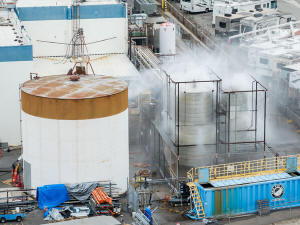
Water is sprayed on a damaged tank at GKN Aerospace in Garden Grove,
Calif., on Sunday, May 24, 2026, after the tank containing a
chemical used to make plastic parts overheated Thursday. (AP
Photo/Ethan Swope)

Kim Yen, a retiree who had to evacuate her Garden Grove home, said she
has been closely following the news and is relieved to learn that the
worst has passed.
“I am happy and many of us are happy but, still, we are still on our
evacuation,” she said.
Yen, who lives two blocks from the plant, said she’s ready to return
home but first wants to be sure it’s safe. And, she said, she’s been
worried about the emergency crews.
“They are really our heroes,” Yen said.
The parking lot was full Monday at a large park in Fountain Valley, just
southwest of Garden Grove, as people sought refuge in an ad hoc shelter
there or pitched tents outside. Other people gathered in the park to
enjoy Memorial Day.
GKN is a British company that supplies aircraft manufacturers
GKN Aerospace Transparency Systems, which owns the plant, is a British
company that makes cockpit windows, canopies and windshields for
military and commercial aircraft.
GKN Aerospace technical specialists and the Orange County Fire Authority
removed external insulation material from the tank to help cool its
contents, according to a GKN Aerospace statement released Monday.
“We apologize for the ongoing disruption this incident is causing and
our priority remains its safe resolution, so that residents can return
to their homes as quickly as possible,” the statement said.
GKN Aerospace says on its website that it employs about 16,000 people
across 32 manufacturing sites in 12 countries and supplies technologies
and components used by major commercial and military aircraft
manufacturers worldwide.
It remained unknown when the operation would reopen.
GKN Aerospace agreed in 2025 to pay state regulators more than $900,000
to settle violations involving recordkeeping, permitting issues and
nitrogen oxide emissions, according to a report on the South Coast Air
Quality Management District website.
Aircraft manufacturing vulnerable to supply chain disruptions
Disruptions at facilities producing specialized aircraft components can
be difficult for the global aerospace industry to absorb because supply
chains are highly concentrated and already strained, said Richard
Aboulafia, managing director of the aerospace consulting firm
AeroDynamic Advisory.

Aboulafia said aerospace manufacturing differs from many other
industries because aircraft production rates are relatively low, leaving
only a small number of suppliers for many specialized parts and systems.
“There’s just not a lot of margin in the system,” he said.
___
Willingham reported from Boston. Stengle reported from Dallas.
Associated Press journalist Ethan Swope in Garden Grove, California,
contributed to this report.
All contents © copyright 2026 Associated Press. All rights reserved |