Southern California officials lift all evacuation orders for residents
near damaged chemical tank
[May 27, 2026]
By AMY TAXIN, CHRISTOPHER WEBER and MARTHA BELLISLE
GARDEN GROVE, Calif. (AP) — Southern California officials lifted the
final evacuation orders Tuesday night for residents who live near a
damaged chemical tank, allowing 16,000 people to return home.
The crisis that began Thursday had forced 50,000 people to evacuate in
and around the Orange County city of Garden Grove. A crack that formed
by chance on the tank relieved pressure and helped avert a catastrophic
explosion, allowing most evacuees to return home over the Memorial Day
weekend. Authorities announced they were lifting the final orders after
the temperature on the tank remained stable for four hours without
intervention from sprinklers.
“All residents will go home,” Orange County Fire Authority Division
Chief Craig Covey said during a meeting that grew raucous at times as
residents questioned why the chemical was allowed in a densely populated
area and urged city officials to hold the company that operates the tank
accountable.
The tank contains methyl methacrylate, which is highly flammable. Health
officials have assured residents that no contamination or fumes were
released, and that they will keep monitoring the air for several months
and checking the sewer and storm drains. Exposure to the chemical can
cause serious respiratory problems, neurological issues and irritation
to the skin, eyes and throat, according to the federal Environmental
Protection Agency.
The tank at GKN Aerospace Transparency Systems, which makes cockpit
windows, canopies and windshields, contains 6,000 to 7,000 gallons
(22,700 to 26,500 liters) of the chemical.

Separately, an implosion of a chemical tank Tuesday at a pulp and paper
mill in Washington state killed one worker and left nine others
accounted for, with authorities saying they were working on recovery
efforts. Nine others were injured.
Residents call for accountability
Angry residents spoke at the city council meeting after the crisis
interrupted Memorial Day plans, graduation ceremonies and daily life in
central Orange County, which is made up of a cluster of cities including
Garden Grove.
Karen Nguyen, a 29-year-old Garden Grove resident, said she will be able
to go home now that the evacuation order is being lifted but is
concerned about what the chemical might do to her three cats, which
already have health issues. She told the city council she wants stricter
regulations to ensure nothing like this happens again, and she doesn’t
want to see these plants in her community.
“They’re not welcome in our neighborhood,” she said.
Bobbi-Lee Smart said she was evacuated from her home in nearby Anaheim
but many of her neighbors were too poor to get out. She said this never
should have happened as the company had a record of violations. She
demanded the city take action.
“Please shut them down, please take care of our residents," she said.
Mayor Stephanie Klopfenstein pledged to hold the company accountable.
In a statement earlier Tuesday, GKN said it was working closely with
authorities.
[to top of second column]
|
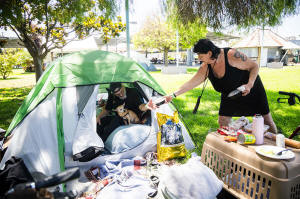
Jan De Jonge and fiancé Sher Stuckman set up a tent with their
belonging and pet outside the Elks Lodge in Garden Grove, Calif., on
Monday, May 25, 2026. (AP Photo/Ethan Swope)

“We apologize for the ongoing disruption this incident is causing,
and our priority remains the safety of our neighbors and our
community,” the statement said.
GKN agreed to pay state regulators more than $900,000 in 2025 to
settle violations involving recordkeeping, permitting issues and
nitrogen oxide emissions, according to a report on the South Coast
Air Quality Management District website.
Authorities scrambled to minimize risk
Crews at the California plant had worked to ensure two nearby tanks
were neutralized and would not be affected by the compromised tank,
Orange County Fire Capt. Brian Yau said.
The tank overheated because a valve on the cooling system failed
that kept it at 50 degrees, (10 degrees Celsius), Covey said.
Crews sprayed water on the tank until the interior temperature
stabilized to 92 F (33.3 C), down from 100 F (37.7 C) over the
weekend, the fire department said earlier Tuesday. A sprinkler
system was used to douse the tank, and the company said its
technical specialists and firefighters removed insulation from the
tank to help cool it.
Officials will remain to continue monitoring, he said.
So far testing has found no contamination, officials said.
Orange County Health Director Regina Chinsio-Kwong tried to reassure
people returning home over the holiday weekend, saying "you should
feel comfortable going home even if you’re across the street from
that new zone line.”
Isabel Mendez, 34, said she broke out in a rash on her face and had
tingling lips and a sore throat while she was getting ready to leave
after an evacuation order was issued Thursday. Her symptoms
disappeared a few hours later, she said. She was among the last
people allowed back to her home, which is a mobile home close to the
site of the leak.
The South Coast Air Quality Management District will monitor the air
for several months and the EPA will be checking sewer and storm
drains for spills, Orange County Supervisor Janet Nguyen said.
The California crisis is reminiscent of a 2014 chemical spill in
Charleston, West Virginia when storage tanks failed. The disaster
inspired a new state law requiring more inspections and
registrations of aboveground storage tanks.
All contents © copyright 2026 Associated Press. All rights reserved
 |