Voters back abortion rights and reject Trump's redistricting in state
ballot measures
[November 04, 2026]
By DAVID A. LIEB
WASHINGTON (AP) — Abortion-rights advocates notched victories in several
states Tuesday, and voters delivered a double dose of disapproval to
President Donald Trump’s redistricting efforts as they decided 145
ballot questions in more than three dozen states.
The ballot measures provided a political undercard for a high-profile
midterm election in which Democrats took control of Congress and gained
power in state legislatures and gubernatorial offices.
Some measures put Trump’s priorities to a public test by gauging support
for his attempts to redraw congressional districts, limit transgender
athletes in sports and strengthen voter identification requirements.
Abortion rights prevail in three states
Voters defeated a proposed amendment to Missouri’s constitution that
would have reimposed restrictions on most abortions. The vote Tuesday
essentially reaffirmed voters' decision from two years ago, when they
became the first in the nation to undo an existing abortion ban by
approving an abortion-rights amendment.
The Republican-led Legislature then referred a new, less restrictive
version of an abortion ban to this year’s ballot. The measure would have
allowed abortions only for medical emergencies and fetal anomalies, or
in cases of rape or incest up to 12 weeks of pregnancy. It also would
have amended the constitution to prohibit certain medical procedures for
transgender minors.
Abortion-rights advocates, led by national progressive groups, heavily
outspent abortion foes in a successful campaign to defeat the Missouri
ballot measure.
In Virginia, a voter-approved measure creates a “ fundamental right to
reproductive freedom ” in the state constitution, ensuring that
abortions can occur during the first two trimesters of pregnancy. The
amendment also creates a right to contraception and fertility care,
among other things.
An amendment approved in Nevada creates a fundamental right to abortion
until fetal viability, which is generally considered after 21 weeks of
pregnancy. The amendment won initial voter approval in 2024 but needed a
second vote this year to add it to the constitution.

Since the U.S. Supreme Court overturned a nationwide right to abortion
in 2022, voters in more than one-fifth of the states have passed ballot
measures protecting abortion rights.
But voters in Republican-leaning Idaho on Tuesday defeated a ballot
measure that would have created abortion rights in state law. Current
Idaho law bans abortions unless necessary to save the life of a pregnant
woman, or during the first trimester of pregnancy in cases where rape or
incest has been reported to law enforcement.
Abortion-rights measures failed two years ago in Florida and South
Dakota.
Trump redistricting efforts rejected by voters
Nine states are using new congressional districts in the midterm
elections after a rare spate of mid-decade redistricting encouraged by
Trump.
In Missouri, Republican lawmakers last year adopted new House districts
designed to help the GOP win an additional seat in the Kansas City area.
Opponents then gathered petition signatures to put the map to a public
vote.
The new districts were used in the August primary. But courts
subsequently ruled they could not be used again unless first approved by
voters in a November referendum. Voters put an end to the new map by
rejecting the redistricting legislation on Tuesday.
Meanwhile, voters in Democratic-led Maryland approved a constitutional
amendment that could pave the way for new congressional districts in the
2028 election. Democratic proponents, backed by former President Barack
Obama, had urged a “yes” vote as a way to “stop Trump.”
Some Democrats also want to redistrict in Colorado. But a citizen
initiative on the ballot would prohibit any potential 2028 redistricting
from favoring one political party and require approval from both an
independent commission and the state Supreme Court.
Florida voters approve major property tax break
An amendment passed Tuesday could wipe away a significant amount of
taxes for Florida homeowners — and leave local governments scrambling
for revenue.
The Florida amendment was one of the nation’s most notable property tax
proposals in a year when numerous politicians proposed ways to provide
tax relief to residents burdened by high costs.
Florida currently exempts the first $50,000 of the value of a person’s
permanent residence from many property taxes. That exemption will triple
next year for non-school taxes and rise to $250,000 in 2028.
The measure was referred to the ballot during a special legislative
session called by Republican Gov. Ron DeSantis. Some local officials
warn it could lead to cuts to police and fire departments, public
libraries and parks.
[to top of second column]
|

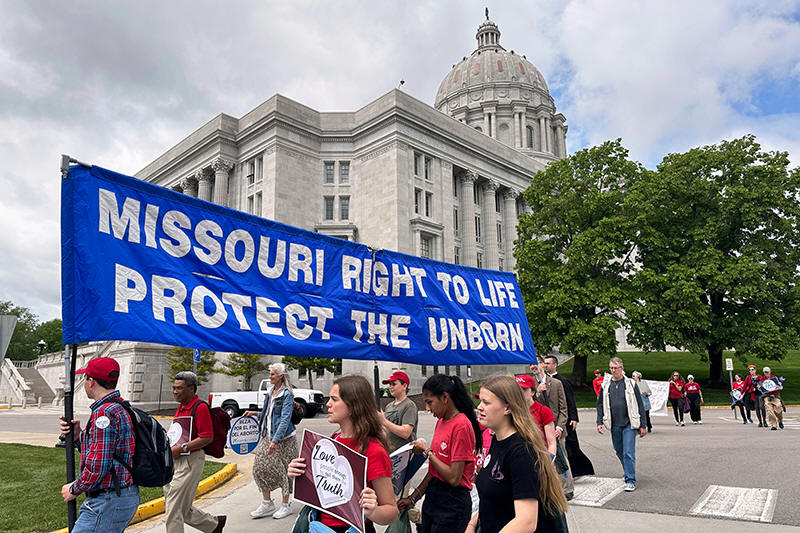
Participants in the Midwest March for Life walk past the Missouri
Capitol on May 1, 2025, in Jefferson City, Mo. (AP Photo/David A.
Lieb, File)

Transgender restrictions pass in some states
Nebraska voters approved an amendment to add existing transgender
medical restrictions to the state constitution. And in Arizona,
voters passed a measure that extends public school sports
restrictions to private schools.
Voters in Colorado and Washington also were considering measures
restricting transgender athletes or medical procedures. That comes
as Trump’s administration has been pushing for restrictions
impacting transgender people, especially youth.
Most Republican-led states already bar transgender women and girls
from female school sports teams. In the Democratic-led states of
Colorado and Washington, the measures were placed on the ballot by
citizen initiatives. A second ballot question in Colorado would ban
some transgender medical treatments for minors.
California and Colorado reject new voter ID mandate
Though Trump’s push for nationwide voter ID mandates remains stalled
in Congress, citizen activists bypassed Democratic-led state
legislatures to place new voter ID requirements on the ballot in
California, Colorado and Nevada.
Opponents in California successfully campaigned against the
amendment by linking it to Trump. The defeated California measure
would have required a government-issued ID to vote in person or the
last four digits of that identification number to vote by mail. The
vast majority of California’s ballots are cast by mail.
Colorado voters also defeated a measure that would have required
people voting by mail to include the last four digits of a
government-issued identification number.
In Ohio and North Carolina, Republican-led legislatures referred
measures to the ballot enhancing existing voter ID requirements by
placing them in the state constitution. The measures passed in both
states. A voter ID amendment also passed in Nevada.
Voters say ‘no’ to higher thresholds for ballot measures
North Dakota and South Dakota voters defeated ballot measures that
would have made it harder to amend the state constitutions by
requiring 60% approval from voters instead of a simple majority. And
Utah voters defeated a measure that would have required a 60%
threshold to pass citizen initiatives that raise taxes.
Meanwhile, Missouri voters passed an amendment that would make it
harder for lawmakers to change voter-approved citizen initiatives by
requiring revisions to get an 80% vote in the state House and
Senate.
Citizen voting measures keep racking up wins
Voters in Arkansas, Kansas, South Dakota and West Virginia approved
constitutional amendments reinforcing current election practices
limiting voting to U.S. citizens. In Alaska, voters approved a
citizen voting ballot question as state law.

Critics argue the measures are largely symbolic and unnecessary,
because voting by noncitizens is rare and already forbidden in
federal elections. But noncitizens are allowed to vote in some local
elections in California, Maryland, Vermont and the District of
Columbia.
Prior to this election, at least 15 states already had adopted
similar measures over the past decade, including all eight states
where they appeared on the ballot in 2024 and in Texas last year.
Arizona measure limits traffic cameras
Voters in Arizona passed a ballot measure limiting the use of
traffic cameras to catch drivers speeding or running red lights. The
Republican-led Legislature referred the measure to voters after
Democratic Gov. Katie Hobbs vetoed a ban on the cameras.
Hobbs said the cameras enhance roadway safety, but opponents contend
they infringe on people’s privacy and point to instances of misuse
by certain law enforcement officers.
The proposal would bar new contracts for traffic camera systems
starting in 2027 and require local governments to hold elections on
whether to continue existing systems.
About half the states, including Arizona, have communities that use
cameras to enforce speeding or traffic signal laws, according to the
Insurance Institute for Highway Safety.
All contents © copyright 2026 Associated Press. All rights reserved |