Seeds, preserved hair in tomb point to oldest signs of cannabis high
2,800 years ago, study suggests
[November 06, 2026]
By JAMEY KEATEN and PHILIPP JENNE
GENEVA (AP) — People may have been getting high off cannabis earlier
than previously thought — at least 2,800 years ago, a new study
suggests.
Archaeologists who led a dig at a monumental tomb in Siberia said they
turned up evidence of the earliest known use of cannabis for
psychoactive purposes.
The findings point to cannabis consumption at least 300 years earlier
than previously known use in neighboring China.
Ancient drug use has long intrigued scholars. The Greek historian
Herodotus wrote about inhabitants of Central Asia smoking cannabis
around 440 B.C., and recent archaeologists have found the seeds in tombs
across its highlands.
The team from Germany, Russia, Sweden and Switzerland said analysis of
hair in the royal tomb where cannabis seeds turned up sheds new light on
the plant's role in ancient societies.
“It’s extremely rare that we have both preserved plant parts and human
soft tissue with the active compounds in it in the same context," said
co-author Gino Caspari, an archaeologist at the University of Bern.
It's not clear whether the cannabis was consumed through inhalation or
ingestion, he said.
The dig took place starting in 2017 at a large burial mound at the
Tunnug 1 site in the Uyuk Valley of southern Siberia, home to one of the
earliest monumental tombs showing material culture of the Scythians —
ancient nomads who migrated from Central Asia to southern Russia and
Ukraine.
The team, deployed “essentially out in the middle of nowhere,” lived in
tents for months and faced a spring-to-autumn season that variously
featured swamps, snowstorms, frosts and swarms of mosquitoes. Herds of
horses ran freely across the grassy steppe.

Larger artifacts on the site include weapons in the burials, horse gear
and animal-style motifs. But the team “struck gold” as it also found
tiny black spots that turned out to be cannabis seeds along with
preserved human hair, Caspari said.
“It’s only so often as an archaeologist that you do get to drug test a
person that’s been dead for almost 3,000 years," he said.
Radiocarbon dating on some of the more than 1,000 seeds helped establish
the time of origin, and “they are not there by accident" but deposited
within the tomb, suggesting that the plant material had significance in
the community, he said.
[to top of second column]
|
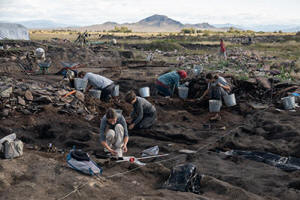
Archeologists dig at an excavation site in the Uyuk Valley of
southern Siberia, Russia, on Aug. 9, 2024. (Gino Caspari, Frozen
Corpses Golden Treasures, T.Wallace & G. Caspari via AP)
 Results were published Thursday in
the journal Science.
Not all independent experts were convinced.
The hair analysis “is scientifically weak” and there’s not enough
evidence to tell whether cannabis was used, wrote Volker Auwaerter,
head of the forensic toxicology section at the University Medical
Center in Freiburg, Germany, in an email.
“For a central part of the study, the article falls far short of
what would have been possible,” Auwaerter said. “This matters
because the hair data carry the abstract’s main claims (cannabis
consumption and use for its psychoactive properties)."
Today, scholars don’t consider ancient accounts trustworthy without
corroborating evidence. Because the cannabis plant has other uses —
seeds are pressed for oil and fibers used for cloth — their presence
alone doesn’t confirm drug use.
Auwaerter, who was not part of the study, said the data didn't
distinguish consumption from external exposure — in other words, the
hair could have picked up traces of weed simply by being buried
together with it. He said a lab test involving forensic toxicology
expertise would have been advisable and easy to arrange.
But Elisa Guerra Doce of the University of Valladolid in Spain, who
has written about use of consciousness-altering substances in
European prehistory, said toxicological hair analysis was not new in
archaeology and has been used to identify consumption of
psychoactive substances. She was not involved in the study.
In an email, she credited the authors for showing, through their
methodology, that “cannabis was not merely deposited as a funerary
offering but was actually consumed by individuals associated with
the burial rite.”
___
Jenne reported from Vienna, Austria.
All contents © copyright 2026 Associated Press. All rights reserved |