After midterm loss, Trump is left to weigh his next move in Iran war
that contributed to GOP debacle
[November 06, 2026]
By AAMER MADHANI, LINLEY SANDERS, SAMY MAGDY and MATTHEW
LEE
WASHINGTON (AP) — As he takes stock of his Republican Party's midterm
drubbing, President Donald Trump now faces the difficult question of
what to do about his unpopular 8-month-old war against Iran.
For weeks, Trump has threatened to return to a full-scale bombardment of
Iran once the U.S. elections were in the rearview mirror if Tehran did
not come to a settlement under terms acceptable to him.
In his first comments on Wednesday after Democrats' resounding election
victory — a wave powered in part by the American electorate's
dissatisfaction with the war — Trump largely agreed with Vice President
JD Vance, who publicly ruminated on the war being a catastrophe for
Republicans.
And in an Oval Office exchange with reporters Thursday, Trump suggested
that the election losses aren't weighing on his calculations.
“If we have to do the rest of the Iran thing, we’re very much locked
in," Trump said.
The strikes, and counterstrikes, have caused tens of billions of dollars
of damage in the region. And the conflict has reached into the
pocketbook of families around the globe with elevated gas prices and
rising costs in just about every sector.
Now, as Trump ponders his next move, the stakes couldn't be higher for
Iran, the Middle East and the global economy writ large.

Trump may be less restrained, but the conflict is now more
complicated
While oil is flowing again from the Strait of Hormuz with the help of
U.S. Navy escorts for international tankers, the conflict has spread to
the Red Sea with Iran-backed Houthi rebels and a Saudi Arabia -led
coalition fighting it out.
The situation in the Red Sea remains particularly volatile. The Houthis
are attacking Yemeni civilians and Saudi infrastructure, and are looking
to bolster ties with militant groups across the Horn of Africa.
The attacks by the Yemen-based Houthis on areas controlled by the
internationally recognized Yemeni government have also worsened a
growing humanitarian crisis.
The threat that the region faces from Iran and its proxy groups, noted a
senior Yemeni government official, “did not change overnight” with the
U.S. elections, urging Washington to avoid hasty decisions. The official
was not authorized to comment publicly and spoke on the basis of
anonymity.
“There’s reason to suspect that Trump may feel less restrained given
that the political damage is done,” said Brian Haggerty, a former senior
analyst at the Central Intelligence Agency who focused on Middle East
security issues. “At the same time, the strategic calculus or the
strategic logic of what you hope to achieve through an escalation of
strikes against Iran is no different today than it was a week ago or a
month ago.”
Trump has at least a few options, analysts say
Haggerty, who now works with Defense Priorities, a Washington think
tank, said Trump could choose to maintain something close to the current
posture, with the U.S. military carrying out what it calls “defensive
strikes” while continuing its naval blockade to restrict the flow of
Iranian oil to the global market.
Another option is striking Iran’s Pickaxe Mountain, a facility linked to
its nuclear program that is buried deep underground in central Iran,
said David Schenker, who served as assistant secretary of state for Near
Eastern affairs in Trump’s first term. Trump has repeatedly suggested he
was considering targeting the site.

Schenker said Trump could then walk away and contend he had done
sufficient damage to Iran's nuclear program — and perhaps try to pursue
a “fig leaf agreement” that restores freedom of navigation to the Strait
of Hormuz, offers Iran some degree of sanctions relief, and punts
additional nuclear talks to the future.
Yet another option would be to follow up on threats Trump made earlier
in the war to launch massive attacks on Iranian infrastructure. “The
Iranians may believe the president is wounded and constrained by
Congress, but the opposite can also be true,” Schenker said.
But such escalation would likely exacerbate the oil and energy price
problem that many voters cited as a reason for supporting Democrats on
Tuesday, Schenker said.
The price for a barrel of Brent crude oil tumbled below $95 on Wednesday
after the election, touching its lowest level in two months, a signal
that markets do not expect major strikes.
Iran, of course, also has a say, analysts note.
“Once you start a fistfight, you can stop throwing punches. That doesn’t
mean the other combatant will stop throwing punches,” said Bradley
Bowman, an analyst at the Foundation for Defense of Democracies. “We can
try to end the war, but what do we do if the Islamic Republic of Iran
continues to attack shipping in the Strait of Hormuz?”
[to top of second column]
|
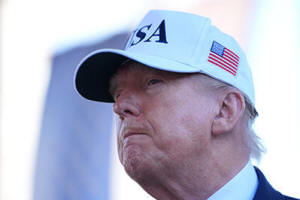
President Donald Trump talks to reporters during a tour of White
House Ballroom construction at the White House, Wednesday, Nov. 4,
2026, in Washington. (AP Photo/Alex Brandon)

Regional officials are on high alert for what Trump does next
Middle East officials had been hanging on Trump’s every word in the
weeks leading up to the U.S. elections, looking for clues on how the
Republican leader was weighing his next steps.
Israeli Prime Minister Benjamin Netanyahu pressed for renewed
strikes on Iran during a call over the weekend with Trump, who would
not commit to taking military action, according to a person who was
briefed on it.
Three Middle Eastern government officials said on Wednesday that
Trump and his administration had seemed to be signaling to Iran that
its leverage would only diminish after the U.S. elections were over.
Administration officials had privately suggested in diplomatic
channels that Trump might be more willing to restart strikes after
Nov. 3 because he'd have little left to lose politically, according
to the officials, who were not authorized to comment publicly and
spoke on the condition of anonymity.
After Tuesday’s electoral shellacking, there was lingering concern
that Trump might be more emboldened to carry out full-scale or new
limited strikes against Iran, the officials said.
A fourth official said the results of the election gave mediators a
measure of optimism about finding a pathway to resolving the
conflict.
Meanwhile, Vance appeared to more forcefully pin the electoral
debacle on the Iran war than his boss Trump, who initially blamed
the GOP's candidates for the big loss.
“The reason we lost,” Vance said of the midterm elections in a
lengthy social media post, “is the war.”
Vance, a potential 2028 presidential contender, had been among the
most skeptical inside the White House on the wisdom of launching the
war but got on board with Trump's decision once he made it.

Voter data shows Iran had an impact but was not the top issue
Several Democratic candidates who scored upsets on Tuesday noted
voter discontent with the Iran war in their victory speeches.
“Wherever I went, I heard the same thing,” said Sen.-elect Josh
Turek of Iowa. “They would say, Josh, I’m struggling just to keep
food on the table, keep a roof above my head, pay my electric bill.
And with this war in Iran, I’m struggling just to keep gas in my
tank.”
About 6 in 10 voters said the U.S. made the “wrong decision” in
taking military action against Iran, according to The AP Voter Poll,
a survey of more than 100,000 voters in the United States.
Most of those voters dissatisfied with the Iran war backed the
Democratic candidate in their local U.S. House race, but the survey
suggested the Iran war was not the top issue for most voters.
Only about one-third of voters said the war in Iran was “crucial” to
shaping how they voted for Congress. That was well below the roughly
half who said that about the cost of living or government
corruption.
Nearly all voters who backed the Democratic candidate in their local
U.S. House race said going to war with Iran was the “wrong
decision,” while roughly 8 in 10 voters who backed the Republican
candidate said it was the “right decision.”
Meanwhile, about 6 in 10 voters nationally said they were “very
concerned” about the cost of gasoline and diesel, the poll showed —
and about two-thirds of that group voted for the Democratic
candidate in their local U.S. House race.
But Trump, for his part, said even in hindsight he'd approach Iran
exactly as he has.
“I can tell you that as far as that war is concerned I would have
done nothing different," the president said.
___
Magdy reported from New York. AP writers Collin Binkley in
Washington, Hannah Fingerhut in Des Moines, Iowa, and Kathleen Foody
in Chicago contributed reporting.
All contents © copyright 2026 Associated Press. All rights reserved
 |