US military carries out new targeted strikes on Iran as Tehran's leaders
weigh mediator's proposals
[November 07, 2026]
BY AAMER MADHANI, SAMY MAGDY and MICHELLE L. PRICE
WASHINGTON (AP) — President Donald Trump said the U.S. military on
Friday carried out new limited strikes on Iran, targeting an Iranian air
defense system.
Iranian state media reported the sound of two explosions in the Suza
area of Qeshm Island, which is in the crucial waterway for oil
shipments.
Trump in an exchange with reporters described the military action as
“minor."
“They knocked out -- they built a little bit of an anti-aircraft device
and we knocked it out in about 15 minutes, maybe five," Trump told
reporters shortly after arriving in West Palm Beach, Florida, on Friday
evening.
Trump did not offer further details about the target. But U.S. officials
have reported that most of Iran’s air defense systems were destroyed or
severely degraded during a June 2025 bombardment by Israel and in the
early stages of the current conflict. U.S. officials have assessed that
Iran would try to rebuild them and other military infrastructure over
time.
The U.S. military also reported carrying out what it described as
defensive strikes on Monday. Explosions were heard on the islands of
Qeshm and Hengam in the strategic Strait of Hormuz, and in the nearby
mainland area of Bandar Abbas.
Friday's strikes are the first since Trump’s Republican Party was dealt
a stunning repudiation in Tuesday’s midterm elections in the U.S.
The electoral setback — Republicans lost both chambers of Congress — was
stoked in part by voter dissatisfaction with Trump’s execution of the
conflict and elevated fuel prices, a byproduct of the war that’s
affected nearly every sector of the global economy.
In the days since Republicans' shellacking at the polls, Trump has
vacillated between threatening to “destroy” Iran and suggesting a
resolution to the war is near.
Qatar presents new proposals to Iranian officials
Earlier Friday, two Middle East government officials said Iran was
reviewing proposals presented by chief mediator Qatar aimed at
addressing differences with the United States about Tehran’s nuclear
program.

But one of the officials stressed that the Iranians, at least at the
moment, remain unwilling to engage in negotiations with the Trump
administration over their atomic activities until the U.S. agrees to
several core conditions that Iran has been demanding be part of any
ceasefire agreement.
Differences with Iran over its nuclear program remain the thorniest
issue and one that Trump insists must be resolved as part of any deal
meant to end the more than 8-month-old war.
Both officials were not authorized to comment publicly on the delicate
negotiations and spoke on the condition of anonymity.
Meanwhile, U.S. Central Command, which oversees U.S. military operations
in the Middle East, announced in a post on X late Friday that the United
States was offering “a reward of up to $20 million and possible
relocation for information about Iran’s nuclear program, including its
facilities, equipment, and associated personnel, such as those in the
scientific community, or the movement of any of the above.”
The post included a link to the State Department’s Rewards for Justice
program.
Iran insists on several concessions before nuclear talks
The White House declined to comment about the Qatari-presented proposals
on Iran's nuclear program, but Trump noted earlier Friday in an exchange
with reporters that mediators' discussions with Iran continue.
“We are talking to Iran. We have been,” said Trump, who insists the U.S.
military remains in control of the conflict with a battered Iran.
Yet, Tehran insists on several concessions from the U.S., which Trump
has declined in the past. Among the core demands Iran says must be met
before engaging in nuclear talks: ending the U.S. blockade on Iran’s
ports, lifting sanctions, unfreezing its assets, issuing compensation
for war damage and ending hostilities throughout the region, including
Israeli operations in Lebanon.
[to top of second column]
|

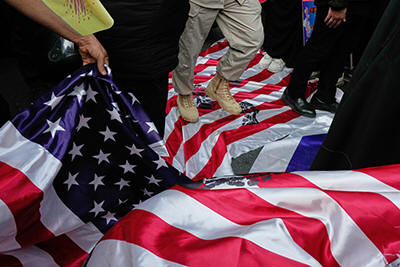
Iranian government supporters step on U.S. and Israeli flags during
the annual rally marking the anniversary of the 1979 U.S. Embassy
takeover, outside the former embassy in Tehran, Iran, Wednesday,
Nov. 4, 2026. (AP Photo/Vahid Salemi)

Qataris and Iranians discuss a bridge deal to get to nuclear
talks
Mediators and Iran have discussed a potential bridge deal aimed at
helping pave the way for further talks on Tehran’s nuclear program,
according to regional officials.
They said the proposal, which was recently presented to the two
sides by Qatari mediators, called for implementing trust-building
measures over the course of two days.
These measures include lifting the U.S. blockade and releasing some
of the billions of dollars in Iranian frozen funds seized over the
years as part of a U.S. campaign to isolate Iran over its nuclear
program. In return, Tehran would allow International Atomic Energy
Agency inspectors at its sites bombed by the U.S. and Israel, the
officials said.
On the second day, Iran would reopen the Strait of Hormuz in line
with a modified agreement that Iran and Oman have reached on the
waterway but has not been approved by the United States, the
officials said. That mechanism would be temporary until a permanent
deal is reached on the strait in cooperation with other Gulf
countries, they said.
Following the implementation of the measures, the U.S. and Iran
would embark on extensive talks addressing Iran’s stockpile of
highly enriched uranium as well as other aspects of its program, the
officials said.
Iran has long maintained that its nuclear program is peaceful.
According to the International Atomic Energy Agency, Iran has 440.9
kilograms (972 pounds) of uranium that is enriched up to 60% purity,
a short, technical step from weapons-grade levels of 90%.
Diplomatic efforts pick up following US election
A flurry of diplomatic phone calls in recent days between leaders in
the Persian Gulf and beyond has been aimed at easing tensions in the
region. Concerns have mounted over the possibility that Trump could
still order the U.S. military to carry out new strikes against Iran.
Defense Secretary Pete Hegseth spoke Friday with his Qatari
counterpart, Sheikh Saoud bin Abdulrahman Al Thani, about
developments, according to the Qatari government.
The Qatari government announced the call between the countries’
defense officials after confirming earlier Friday that Trump and
Qatar’s emir had a separate call to discuss efforts to deescalate
tensions.
Iranian Foreign Minister Abbas Araghchi also held phone calls with
his Iraqi and Tunisian counterparts on Friday to discuss tensions in
the region. Araghchi and Iraqi Foreign Minister Fuad Hussein
discussed Tehran’s vision for resuming negotiations with the U.S.,
according to Iraq’s News Agency.
Egyptian Foreign Minister Badr Abdelatty, who held two calls with
Araghchi this week, said Friday in a post on X that it was critical
that both sides demonstrate “flexibility” to achieve the “compromise
solutions” necessary to prevent the region from sliding into a new
wave of escalation.
Egypt’s top diplomat also held a phone call with his Emirati
counterpart, Abdullah Bin Zayed Al Nahyan, to emphasize the
importance of political negotiations to prevent another military
confrontation that could fuel violence and destruction, according to
a statement by Egypt’s Foreign Ministry.
All contents © copyright 2026 Associated Press. All rights reserved
 |