European flights and broadcasters are targeted with another wave of bomb
threats
[November 07, 2026]
By STANISLAV HODINA, KAREL JANICEK and GEIR MOULSON
PRAGUE (AP) — Officials across Europe reported a fresh slew of bomb
threats against multiple flights on Friday, following a string of hoaxes
that have caused flight diversions this week. Three broadcasters also
received security threats, in a possible sign the menace was spreading
beyond the skies.
No suspicious items have been found and no one has been injured, but the
threats have raised concern because they came on the heels of other
European disruptions — including attacks on supermarket refrigeration
systems and drone incursions.
Overall, the threats have caused minimal disruption to aviation,
according to the European air traffic authority. Eurocontrol said it was
aware of bomb threats against 14 flights on Thursday — only 0.05% of all
of the nearly 26,300 flights across the European network that day — and
seven on Tuesday. The European Union's transportation commissioner,
Apostolos Tzitzikostas, said there were 11 more on Friday.
Even so, airlines have to take every threat seriously because they are
ultimately responsible for the lives of their passengers, said Robert
Jordan, research director at Britain's Royal United Services Institute
think tank.
Jordan told the BBC that there are more ways than ever to make threats
against flights, and secure messaging apps have allowed for greater
anonymity.
“The risk appetite for airlines is always going to be incredibly low,”
he said, noting the great strides that have been made in airport
security in recent years. “It is baked into their safety procedures, and
it’s baked into their security procedures.”

Tzitzikostas said after a meeting with Eurocontrol and the EU’s Aviation
Safety Agency in Brussels that security experts will meet in the Belgian
capital next week to discuss measures needed to deal with the bomb
threats.
“Our priority here is clear. The safety of passengers and the smooth
functioning of European aviation,” he said.
Fighter jets are scrambled
In Hungary, the defense minister said fighter jets escorted three
passenger planes Friday through the country’s airspace within an hour
after each received a bomb threat. Romulusz Ruszin-Szendi said the
escorts were for flights from Brussels to the Bulgarian capital, Sofia,
and from Prague to Cyprus and Romania.
French Prime Minister Sébastien Lecornu’s office said four bomb threats
were made against aircraft flying over France. The planes landed safely
at Paris’ Orly Airport and bomb disposal experts conducted inspections.
The office didn’t specify which flights were affected.
Threats were also made against a Prague-to-Bucharest, Romania, flight
operated by Romanian carrier Tarom, and a Ryanair flight from the
Portuguese capital, Lisbon, to Rome. A WizzAir flight from Prague to
Rome was diverted to Venice after a bomb alert, and passengers were
evacuated after the aircraft landed.
Eurocontrol said Friday it was monitoring the situation and working
closely with airlines, airports, navigation service providers and other
groups across Europe “to mitigate any disruption to air traffic flows.”
Nine of the affected flights were coming or going from Václav Havel
Airport in Prague, airport spokesperson Denisa Hejtmánková said. They
included flights from Denmark, Spain and Britain, and departures to the
Netherlands and Britain, in addition to the ones to Cyprus, Italy and
Romania. Czech police said security measures were taken that had “a
minimal impact on the normal operations at the airport.”
Diverting and inspecting flights is costly, though.
“I think it’s a big problem for aviation that this is happening,"
Torstein Nymoen, a 52-year-old Norwegian traveler, said at the Prague
airport. "It must cost a lot for the companies, the aviation companies.
And I think that it’s sad that some people are doing this.”
In Denmark, police deployed to Copenhagen airport for a second
consecutive day as a precautionary measure over threats directed at air
traffic, and deemed there was no danger to passengers or others at the
airport.
No clear evidence on who is behind the threats
More than two dozen flights were affected by threats earlier in the
week, with some diverted as authorities scrambled to rule out any
danger.
[to top of second column]
|
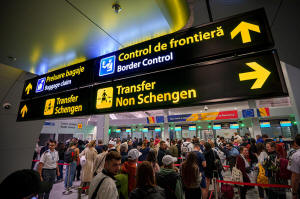
Passengers arriving at the Henri Coanda International Airport pass
under a Schengen Information sign, in Otopeni, near Bucharest,
Romania, on March 31, 2024. (AP Photo/Andreea Alexandru, File)

Fake bomb threats are relatively common but it is unusual to see so
many in such a short period.
It remains unclear who is behind the airline threats, which come at
a time of increased geopolitical tensions and warnings from
authorities that Russia may be ramping up so-called hybrid threats
in Europe.
Italian Premier Giorgia Meloni said Friday that the recent
cyberattacks and bomb threats are cause for concern.
“Today we are not in a position to say whether these events are all
connected,” she said on the sidelines of an event in Verona. “But
they certainly tell us the same thing: that civilian infrastructure
is under attack.”
Authorities haven't attributed the threats to any group or state
actor, and no evidence has emerged linking the hoaxes to a
government. An email containing the threat sent Thursday to airport
authorities in Rome and reviewed by The Associated Press purported
to come from a group describing itself as anti-feminist and claiming
it was targeting a “feminist regime.” Another European airport
received a threat with similar wording, but it was unclear if it
came from the same sender.
Bomb threats are on pilots’ minds and create unnecessary tension,
but crews are prepared to respond professionally, said Paul Reuter,
vice president of the European Cockpit Association. Pilots review
procedures with cabin crews, identify airports where they could
divert and may carry extra fuel, he said.
Reuter called the use of civil aviation for geopolitical disruption
or hoaxes “totally unacceptable.”
Broadcasters also received threats
In Ireland, the Dublin headquarters of national broadcaster RTE was
evacuated Friday because of a bomb threat, and live broadcasts were
replaced with prerecorded programs. Staff returned to the building
after a few hours, once police with sniffer dogs had searched the
area and declared it safe.
Ireland’s police force, An Garda Síochána, said it has been liaising
with Irish media organizations and that the threat will be
investigated.
Irish Prime Minister Micheál Martin said the threats to RTE and
others “just illustrates how relatively simple it can be to cause
disruption and to undermine the normal operation of society through
unconventional activities of this kind, which are designed to cause
fear and anxiety.”
He said there would be a “very significant security operation” in
place next week when Dublin hosts meetings of the European Political
Community and European Union leaders.
Separately, U.K.-based broadcaster Sky said it had also received a
“security threat.” In a statement reported by Sky News channel, it
said that “we are working closely with authorities to ensure our
people and operations remain secure.” Sky News remained on air.

Meanwhile, NOVA TV, a private broadcaster in Bulgaria, said it
received an email Friday threatening it with a bomb. It said the
sender claimed to be behind the threats to European air traffic, and
that the broadcaster implemented its standard safety measures
without any interruptions to its TV and radio broadcasts.
___
Moulson reported from Berlin. These Associated Press reporters also
contributed: Jill Lawless in London; Suman Naishadham in Madrid;
Stephen McGrath in Leamington Spa, England; Jamey Keaton in Geneva;
Giada Zampano in Rome; Veselin Toshkov in Sofia, Bulgaria; Menelaos
Hadjicostis in Nicosia, Cyprus; Sylvie Corbet in Paris; and Mark
Carlson in Brussels.
All contents © copyright 2026 Associated Press. All rights reserved |