As Veterans Affairs expands automation, it commits more errors on
veterans’ claims
[November 10, 2026]
By PHINEAS HOGAN/The Beam
When Randy Leger Diaz left the Marines, he said, his whole body was in
pain.
Following rigorous physical training in the mornings, Leger had spent
his days in uniform working in a warehouse in Okinawa, Japan, where he
was part of the 7th Communication Battalion from 2014 to 2016.
The labor took a toll. After returning to civilian life, Leger said, his
joints would pop and lock, his back, wrist and shoulders ached, sharp
pains shot up and down his legs, he couldn’t sleep and he had stomach
problems.
“They always tell us in the Marines to suck it up,” he said. That worked
in his 20s. But in his 30s, he said, his injuries started to affect his
ability to work.
The Department of Veterans Affairs runs one of the federal government’s
largest disability programs, providing compensation and treatment for
millions of veterans for injuries or conditions connected to their
service.
Leger first filed for benefits in November 2024, seven years after
finishing his service at Parris Island, in South Carolina. The VA denied
him monthly compensation for most of his conditions.
The former Marine said his attorney requested a higher-level review.
After the review, the VA told him it had committed errors collecting
medical evidence – failing its legal “duty-to-assist” veterans in
preparing their claims. Leger eventually received monthly compensation
for some of his rejected claims, he said.
Leger’s experience has become more common as the VA has increasingly
used automation to gather veterans’ records and summarize medical
evidence ahead of claims determinations.

An investigation by the Washington Bureau of The Beam, an accountability
newsroom at Arizona State University’s Howard Center for Investigative
Journalism, found that the VA’s push to use automation more often has
coincided with a surge in errors made while collecting medical records
needed to process veterans’ claims.
The VA introduced a tool called Automated Decision Support in December
2021. As the department expanded its use in the following years,
higher-level reviews have been sending back a growing share of decisions
for reconsideration due to disagreements with the decision or errors in
collecting medical records.
The VA says the tool speeds up processing. But employees have aired
complaints about it to Congress and to veterans advocacy groups,
asserting it routinely fails to extract key details from documents and
misunderstands medical nuances.
The VA denies that automation contributes to errors.
“There is no evidence to suggest the Automated Decision Support tool is
causing errors,” VA press secretary Quinn Slaven told The Beam by email.
The department has long struggled with extended wait times and backlogs
of unprocessed claims. Margarita Devlin, the VA’s principal deputy under
secretary for benefits, testified to the House Committee on Veterans’
Affairs that technology has helped streamline claims processing,
decision accuracy has improved and errors have decreased.
“Our errors, in general, are decreasing and our percentage of accuracy
has been going up,” she testified April 15, 2026, under questioning by
the panel’s senior Democrat, Rep. Mark Takano of California.
However, the VA’s own data on the outcomes of appeals show that errors
have surged in the last five years, along with the expanded use of
Automated Decision Support.
In fiscal year 2021, the VA counted more than 66,000 errors in
collecting evidence for veterans’ claims. The number has climbed in each
subsequent year. In fiscal year 2026, the tally was over 329,000.
“A quick decision is well and good,” Takano told The Beam by email. “But
if we’re moving so quickly that errors are made, or if we’re simply
rushing to denials, veterans are not being served well.”

Faster processing, more errors
In fiscal year 2021, just before the launch of Automated Decision
Support, higher-level reviewers sent back about 23% of claims decisions
to collect more evidence and reconsider. Five years later, in fiscal
year 2026, that rate hit 35%.
Evidence collection errors can stem from automated or human mistakes.
The statistics the VA publishes make no distinction between the two.
Either way, the VA is mandated by law to help veterans prepare
documentation needed to substantiate their claims.
The Automated Decision Support tool does not decide how much
compensation a veteran is entitled to. And it is utilized only on
certain medical conditions.
The VA has expanded the tool to regional offices across the country and
to more conditions. In 2023, it made nearly 300,000 decisions on claims,
according to VA budget documents. By April 2026, the pace was up to
50,000 per month. The VA plans to apply the tool to 90% of all claims by
the end of 2027, according to its latest annual budget request.
When a veteran submits a claim for one of the conditions approved for
automated processing, the tool collects medical records from the VA and
the applicant’s time in service, scans the files for keywords and data
points, and writes a summary.
[to top of second column]
|
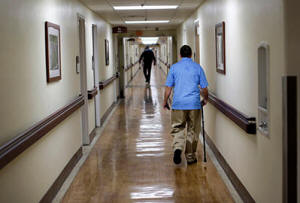
A patient walks down a hallway at the Fayetteville Veterans Affairs
Medical Center in Fayetteville, N.C., March 11, 2015. (AP
Photo/Patrick Semansky, File)
 Before the file reaches a human
benefits rater, Automated Decision Support analyzes the records and
decides if the claim is ready for review. If it determines there
isn’t enough evidence, the tool orders an additional examination to
help a veteran support their claim.
Human raters use the ADS-generated summary as a reference when
deciding the severity of the injury, the degree to which it stems
from military service and the monthly compensation to which the
veteran is entitled.
If a claim is sent to review without a necessary exam, that is a
“duty-to-assist” error– a lapse in the VA’s legal mandate to help
veterans obtain the evidence needed to support their claims.
Such errors are tracked only when a veteran appeals a claim
decision. Many do not, so the scale of the problem could be much
higher than the reported error count indicates.
“There is no evidence”
Slaven, the VA press secretary, attributed the spike in identified
errors to the fact that the number of denials appealed under the
higher-level review process quadrupled from 2020 to 2026. That, he
said, “is why more errors are being found at this stage of the
process.”
The Beam presented Slaven with data showing that the share of
higher-level reviews that send cases back to be reconsidered rose
along with the total number of errors. Slaven did not address those
statistics in a response to detailed questions.
At the April 2026 House hearing, Devlin testified that accuracy
rates have improved. She used a metric called issue-based accuracy,
which scores correctness on each condition in a sample of claims
that included both denials and approvals.
By that metric, the 12-month accuracy rate was close to 94% at the
time of Devlin’s testimony, a notch below the VA’s own target of
96%. Devlin told lawmakers that the score was the highest it had
been in two years.
The VA did not make Devlin available for an interview after repeated
requests nor respond to questions about her testimony.
A Democratic aide on the House Veterans’ Affairs Committee
acknowledged that the number of appeals has gone up but emphasized
that the “number of errors found in Higher Level Reviews or caught
by the Board of Veterans’ Appeals are also increasing.”

“That speaks to a quality deficit” at the Veterans Benefits
Administration, the VA subagency that handles benefits, the staffer
said by email. “That can be directly attributed to the errors
produced by ADS.”
Attorney John Niles, who specializes in veterans appeals, agreed.
“There can be no doubt that VA’s expanding reliance on Automated
Decision Support is a contributing cause of duty-to-assist errors,”
Niles said by email.
The American Legion conducted reviews in 2025 at VA regional offices
in Chicago, Puerto Rico and Louisville, Kentucky.
Employees at those offices reported the automated tool frequently
misses details and fails to extract critical evidence from
documents, according to the reports.
The “limitation frequently results in partial rather than complete
claims being submitted,” the San Juan report reads, which “delays
and contributes to the underdevelopment of claims.”
The Board of Veterans’ Appeals publishes documents explaining its
decisions.
In a 2024 case, the VA proposed slashing a veteran’s disability
compensation for bilateral hearing loss. A review found an automated
system failed to identify relevant evidence within the vet’s record,
and after submitting additional medical records the vet’s disability
rating was increased.
In a 2025 case, the review board found “significant discrepancies”
between an automated summary and a veteran’s actual service
treatment records. The VA had denied a claim for service-related
asthma without providing an asthma exam. The appeals judge deemed
that the VA committed a duty-to-assist error and sent the claim back
to be reconsidered.
Leger, the former Marine, posted screenshots on Reddit showing the
VA informing him of “duty-to-assist” mistakes on his claims.
“Basically every single issue they previously denied or mishandled
now magically has an error attached to it,” he posted on the
VAClaims subreddit on Jan. 7, 2026.
“I don’t even know whether to laugh or be angry anymore.”

___
This story was originally published by The Beam and distributed
through a partnership with The Associated Press. The Beam is an
accountability newsroom inside the Howard Center for Investigative
Journalism at Arizona State University.
All contents © copyright 2026 Associated Press. All rights reserved |