After saying deportation policy was too tough, Trump now says it's 'very
strong,' rejects 'amnesty'
[November 10, 2026]
By REBECCA SANTANA
FOREST HEIGHTS, Md. (AP) — After suggesting he was open to negotiating a
deal with Democrats on an immigration policy that he described as too
tough, President Donald Trump on Monday defended his administration’s
deportation policy and said he was opposed to any immigration deal that
would include “amnesty” for immigrants living in the U.S. illegally.
The comments from Trump came after Homeland Security Secretary Markwayne
Mullin earlier Monday also said that while he has been fielding calls
from Democrats interested in working on immigration policy, he was
adamantly opposed to any deal that would include amnesty.
The midterm elections highlighted voters’ disaffection toward the
administration’s hard-line immigration enforcement activities. But the
comments from both Trump and Mullin reflected the mixed messaging from
the administration in the aftermath of the election and emphasized how
complicated it will be for a new Congress controlled by Democrats to
find any common ground when it comes to the issue of immigration.
Immigration has long been one of the most intractable issues facing
Congress, with any deal that gives people in the country illegally a
pathway to resolve their status often characterized by anti-immigration
critics as amnesty. But advocates have said that longtime immigrants
who've lived in the U.S. for years and worked and raised families here
deserve a way to come out of the shadows and legalize their status.
“There won’t be amnesty,” Trump told reporters at the White House.
“Somebody suggested, will there be amnesty? No, but — they came in. They
knew the law.”
Trump defended his administration’s deportation policy as “very strong.”
Asked if he had spoken with Stephen Miller, his newly promoted chief of
staff who was the architect of his immigration crackdown, about
immigration changes, Trump said no.

“My policy hasn’t changed,” he said, adding that the focus will be on
removing “the worst of the worst.”
In comparison, during an interview that aired Sunday with “60 Minutes,”
Trump said “killers” and “drug dealers” in the country illegally should
be deported, but suggested he was open to the idea of a deal that would
let others stay “if they’re good people working in a landscaping
company, or working in a hotel, or doing something, right? And in some
cases, paying taxes.”
Trump rode back into power with a promise to crack down on immigration.
During the first two years of his second term, arrests of immigrants
surged, including through high-profile operations in large U.S. cities
that sometimes turned violent.
And voters appeared to disapprove of the tactics. Nationally, about 6 in
10 voters said the Trump administration’s actions on immigration
enforcement had “gone too far,” according to The AP Voter Poll, a survey
of more than 100,000 midterm voters. A similar share disapproved of how
Immigration and Customs Enforcement was doing its job.
[to top of second column]
|
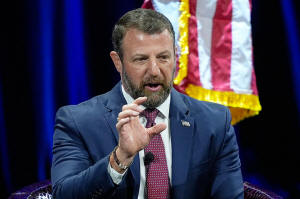
Secretary of Homeland Security Markwayne Mullin, speaks at a forum
to address the evolving challenges and opportunities in drone
security, at the National Harbor in Oxon Hill, Md., Friday, Nov. 6,
2026. (AP Photo/Manuel Balce Ceneta)

Mullin earlier Monday reiterated Trump’s willingness to work with
Democrats on the issue, although he said that he and the president
haven’t yet discussed any concrete immigration policy changes in the
aftermath of the midterm elections.
Speaking to reporters on the sidelines of a conference near
Washington, D.C., Mullin also said he is strongly opposed to any
amnesty for people living in the U.S. illegally.
Mullin, who was a senator and House representative before becoming
Trump’s Homeland Security secretary earlier this year, said after
the election he’s been fielding calls from Democrats that he worked
with in Congress on bipartisan issues.
“I’ve let the president know that those calls are coming in. And the
president has said, you know, let’s start working with them and then
let’s meet at some point. So that’s the extent of the conversation,”
Mullin said. “We haven’t had any conversation just on policy.”
Trump since the election has elevated Miller, raising questions
about how cooperation with Democrats might look so long as
enforcement remains strict. Mullin called Miller in a post on social
media last week an “excellent choice.”
Mullin, who said he worked with Democrats while he was in Congress
including on immigration reform, said he thought a bipartisan
approach was the only way to get anything done. But the secretary
also pushed back decisively against any type of agreement that would
include amnesty for people living illegally in the U.S.
“I was working on immigration reform when I was in the House and
when I was in the Senate. I think the only way you can actually get
it is by a bipartisan approach. But amnesty's never going to be a
solution. We’re never gonna allow amnesty to happen. So that’s a
full stop,” said Mullin.
The Homeland Security secretary raised the issue of DACA — a form of
protection from deportation for children brought to the country
illegally by their parents. He said figuring out a way to legalize
their status would be up to Congress.
“Now, if we wanna have an immigration reform to where we can look at
DACA and figure out a way that these individuals can become maybe
legal permanent citizens or something like this, that’ll be up to
Congress to do that,” Mullin said.
___
Associated Press writer Collin Binkley in Washington contributed to
this report.
All contents © copyright 2026 Associated Press. All rights reserved |