China’s Singles' Day shopping festival struggles to shake off weak
consumer spending
[November 11, 2026] By
CHAN HO-HIM
HONG KONG (AP) — Early signs suggest China ’s biggest online shopping
event is struggling to persuade anxious consumers to spend more, despite
discounts.
The Singles’ Day festival, a major discount campaign comparable to Black
Friday and Cyber Monday in the U.S., centers on Nov. 11. But it begins
weeks earlier and is seen as a barometer of the broader economy.
Retail data platform Syntun said cumulative sales as of Oct. 31 totaled
just over 1 trillion yuan ($154 billion), broadly in line with the same
period last year.
Retailers have increased sales mainly by extending the festival. Total
Singles’ Day sales in 2025 reached a record of almost 1.7 trillion yuan
($254 billion).
Consumer demand in China remains subdued, however, as a prolonged
property downturn and other pressures weigh on confidence.
“Optimism over a recovery in domestic demand has faded,” said Max
Zenglein, Asia Pacific senior economist at The Conference Board.
“Improvements in sentiment have repeatedly proved short-lived.”
E-commerce giants such as Alibaba have turned to artificial intelligence
to encourage frugal shoppers to spend more. Alibaba integrated its Qwen
AI into its Taobao and Tmall platforms to help shoppers place orders and
find products.

Plans offering AI tokens are also being prominently promoted during
Singles’ Day for the first time. This month, a livestream by Li Jiaqi,
dubbed the “Lipstick King” for his huge lipstick sales, sold plans
covering roughly 2 trillion tokens within half an hour, according to
Chinese media.
Singles’ Day originated as “Bachelors’ Day,” a celebration of being
single. The nationwide shopping festival began in 2009 and now targets
everyone.
Consumers feel pinched
While China’s broader economy continues to grow at a relatively robust
pace, expanding 4.6% from a year earlier in January-September, much of
that momentum came from a boom in exports. Retail sales of consumer
goods rose just 1.1% over the same period.
China’s vast domestic market has struggled as a yearslong real estate
downturn has left households feeling less wealthy. Home prices have
fallen roughly 20% or more from their 2021 peak, with smaller cities and
the resale market seeing steeper declines.
Although home prices appear to be stabilizing in larger cities, many
homeowners remain concerned they could fall further, said Andy Rothman,
founder and CEO of the advisory firm Sinology.
In the southern furniture manufacturing hub of Foshan, 24-year-old Gabby
Liang said she was feeling cautious.
“I’ve been buying much less online, especially when it comes to
non-essential items,” she said. “During the Singles’ Day festival last
year, I bought quite a bit of skincare products. But this year I expect
to buy fewer.”
Other shoppers are also reining in spending.
“I’m perhaps not as keen on pursuing famous or high-end brands as I used
to be,” said Beijing resident Kong Min, referring to this year’s
Singles’ Day.
Middle-class Chinese consumers have lost confidence, and many festival
discounts are less generous than they once were, said Shaun Rein,
managing director of China Market Research Group in Shanghai.
More shoppers are experiencing “discount fatigue,” said Yaling Jiang,
founder of market research company ApertureChina. With discounts
available year-round, Singles’ Day may be losing its power to boost
spending, she said.

“Looking at what Singles’ Day originally was: a shopping festival where
people used to expect the largest discounts of the year,” she said.
“That is not true any more after it was extended to multiple platforms,
then to a monthlong thing.”
Liang, who works in furniture sales, said extras such as cameras and
game consoles were off her shopping list this year.
[to top of second column] |
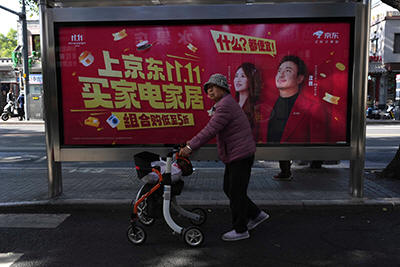
A woman past by an advertisement for the Singles' Day sale promotion
in Beijing, Friday, Oct. 30, 2026. (AP Photo/Ng Han Guan)
 “We’re undergoing a consumption
downgrade,” she said. “Even the amount that we earn has somehow been
downgraded.”
Domestic demand remains weak as exports soar
Business has stalled as Chinese shoppers tighten their belts, Liang
said, despite rising exports to markets such as the Middle East and
Africa.
An oversupply of goods, from cars and TVs to shoes and other
electronics, has intensified competition in China’s crowded domestic
market, pushing manufacturers to expand overseas.
Exports overall surged 35% from a year earlier in October, driven by
high-tech products such as semiconductors and electric vehicles.
China is on track to surpass last year’s record trade surplus of
$1.2 trillion.
Domestic demand for big-ticket items, including cars and some luxury
goods, has been particularly weak.
Passenger car sales in China have fallen for most of this year,
dropping almost 25% in January-September, according to industry
data. The decline partly reflects cuts to government subsidies.
That contrasts sharply with a 71% jump in passenger car exports over
the same period.
Luxury spending has also weakened. LVMH, whose brands include Louis
Vuitton, Dior and Fendi, and Kering, which owns Gucci, Balenciaga
and Saint Laurent, both reported softer demand in China in recent
months.
Chinese leaders have pledged for years to accelerate growth in
domestic demand. But strong exports have reduced the urgency of
introducing policies to stimulate spending at home, analysts said.
“As long as China continues to make progress on its industrial and
technological ambitions, policymakers have little incentive to
fundamentally rebalance the economy toward household demand,”
Zenglein said.

Bright spots remain as status symbols shift
Not all retail categories are struggling. Health, lifestyle and
experiences are increasingly becoming status symbols for Chinese
consumers.
“It’s not a simple case of big-ticket items falling,” said Jacob
Cooke, CEO of Beijing-based consultancy WPIC Marketing +
Technologies. Health-related products are selling relatively well,
he said.
According to WPIC data, online sales of imported fish oil rose
nearly 43% from a year earlier in the 12 months through September.
Sales of other supplements aimed at improving sleep or supporting
joint and bone health grew between 28% and 37%.
Cooke expects some growth in this year’s Singles’ Day sales.
ApertureChina’s Jiang described this year’s defining consumer trend
as “just living life,” with people moving away from grand gestures
and focusing on “the bare necessities and internal fulfillment.”
Many families are holding back as youth unemployment hovers around
18% and income growth lags. Yet China’s household savings remain
vast. With a population of 1.4 billion, the country has enormous
spending potential, even as consumer preferences and spending
patterns shift.
Zenglein, the Conference Board economist, sees growing divergence in
Chinese consumption, with pockets of stronger demand amid subdued
overall sentiment.
“It’s still enough to make a living, but there’s just not much extra
to splurge,” said Liang, the furniture sales worker in Foshan.
All contents © copyright 2026 Associated Press. All rights reserved |