Scrutiny of FAA intensifies after communications meltdown leads to
nationwide grounding
[November 17, 2026]
By JOSH FUNK
The nationwide grounding of flights last week will only intensify
scrutiny of the Federal Aviation Administration, which has been under a
spotlight since a midair collision last year that killed dozens.
The agency has been plagued for decades by underfunding, outdated
technology and staffing shortages. Yet isolated technical problems went
largely unnoticed by the flying public, even as experts saw them as
signs of serious trouble brewing.
The FAA says it is trying to make long-overdue upgrades by the end of
President Donald Trump's second term with $12.5 billion Congress
approved last year. But experts warn that rushing the process could make
things worse.
“What we’re seeing has been decades in the making,” said Mike McCormick,
who used to oversee air traffic control at the agency before becoming a
professor at Embry-Riddle Aeronautical University.
Improving aviation safety has been a focus of the Trump administration
since last year’s midair collision outside the nation's capital killed
67 people. A prolonged government shutdown last year highlighted the
chronic shortage of controllers, while communications disruptions that
affected Newark Liberty International Airport last spring, and again in
September, also raised concerns.
But overhauling the air traffic control system without causing problems
is not easy. The FAA has been struggling to do that for decades, said
Tom Lintner, who worked as an air traffic controller and eventually
became a top official at the agency. Friday was the second time in less
than four years that a technical issue grounded planes nationwide.
“Go back and look at the history of the past 40 years. The track record
does not make you encouraged that the modernization will succeed,” said
Lintner, who is now an aviation safety consultant.

Long overdue overhaul is underway
Congress approved $12.5 billion last year to modernize much of the key
infrastructure that more than 45,000 flights a day rely on to reach
their destinations safely. The funds were earmarked for replacing
outdated technologies such as copper wires, floppy discs and radars
built in the 1980s, but much of that money will also go toward runway
upgrades and other construction projects.
Still, Transportation Secretary Sean Duffy has said that's not nearly
enough money to complete the work. Duffy had already been asking for $30
billion more. But on Friday evening, when the FAA lifted the ground stop
after more than four hours, Duffy increased that request to $50 billion.
That request was met with skepticism by Democrats on the House
Appropriations Committee. On Sunday, they asked why they should approve
more money when the FAA hasn't spent what the agency received last year.
Duffy says the money is committed to various projects, but he can't
spend money for new radars and other gear until they get built, perhaps
sometime next year.
Aviation safety experts wonder whether the rush to complete the
modernization projects by the end of Trump's term contributed to
Friday's problems.
Duffy said the closure of U.S. airspace was needed after a new router
installed in El Dorado, Arkansas, resulted in a cascade of intermittent
communications and radar signals at 17 of the 22 regional air traffic
control centers. These centers direct planes cruising at high altitudes.
The Government Accountability Office warned in September that was a
distinct possibility if the work moved too fast.
Duffy and Trump are quick to blame the Biden administration, but the air
traffic control problems date back to well before the first Trump
administration. Some members of Congress question whether the current
leadership at the FAA can truly deliver better results.
Rick Castaldo, who spent decades at FAA as an electrical engineer, said
he doubts the agency will be able to complete the overhaul because many
of the same people who failed to complete past projects are advising
Duffy and FAA Administrator Bryan Bedford. With Democrats taking control
of Congress in January, politics could make it even more difficult, he
said.
[to top of second column]
|
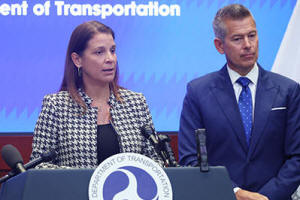
Rebecca Gay, FAA Acting Chief Technology Officer, left, with
Transportation Secretary Sean Duffy, right, speaks during a news
conference at the U.S. Department of Transportation, Saturday, Nov.
14, 2026, in Washington. (AP Photo/Tom Brenner)

“They’re going to start strangling the money,” said Castaldo, who
worries that many projects will be “left half done.”
Problems happen when maintenance and repairs get delayed
In September, the primary and backup communications lines went down at a
key FAA facility in Philadelphia. Similar communications outages also
disrupted flights in Minneapolis and Dallas over the past year.
The last time flights were grounded nationwide was in January 2023. That
episode was caused by a contractor working on a different FAA system
that distributes the Notices to Airmen, or NOTAMs, that pilots consult
before taking to the air to learn about any potential hazards along
their routes. That upgrade had also been deferred for years beforehand.
But sometimes the problems are more mundane such as an air-conditioning
failure that unexpectedly forces a key air traffic control facility to
close while the decades-old building is repaired.
The FAA relies heavily on contractors to help its limited staff of
technicians. But the head of the technicians' union told Congress in
2024 that the agency's own technicians could do more of the upgrades if
enough of them were hired and given a chance. The union said Saturday it
wasn't consulted about the work that caused all the problems on Friday;
Duffy said he didn't bother because the FAA doesn't even own the
network.
A private company called L3Harris owns and maintains the system under
contract with the government. Their technicians were the ones replacing
old copper wires in Arkansas when the system went haywire.
A new router they installed malfunctioned and in short order overwhelmed
a nationwide network of signals vital to air traffic controllers. That
prompted the ground stop because the system was unreliable.
Experts work to determine exactly what went wrong
On Saturday, Duffy said he wasn't sure whether the crew doing the work
made mistakes or if the routers themselves were faulty. The
investigation into what happened is just beginning.
The FAA could have scheduled this work in the middle of the night when
few planes are in the air, but officials believed there was a low chance
of problems because the work was being done in a remote location. After
all, hundreds — perhaps thousands — of miles of copper wire have been
replaced in the past couple years without any problems, said aviation
safety expert John Cox.

"If they followed the same procedure using similar equipment, there’s no
reason to believe this was going to occur,” said Cox, who leads the
Safety Operating Systems consulting firm.
But former FAA executive Mike O'Donnell said the agency shouldn't be
deflecting blame. It has to ensure the safety of the system no matter
who performs the repairs and upgrades.
“Ultimately the FAA is responsible — doesn’t matter whether you hire a
contractor or it’s an FAA employee that did it,” said O'Donnell, who
oversaw airport safety programs and accident investigations for much of
his 17 years at FAA. “They need to take responsibility for it.”
All contents © copyright 2026 Associated Press. All rights reserved |