Trump appeals to state and federal courts to erase hush money conviction
[November 17, 2026]
By MICHAEL R. SISAK
NEW YORK (AP) — A federal appeals court is weighing whether it can — or
should — intervene in President Donald Trump’s hush money case now that
a New York State appellate court has heard arguments in his quest to
erase the historic conviction.
A three-judge panel of the 2nd U.S. Circuit Court of Appeals on Monday
spent more than an hour questioning Trump’s lawyer and a state
prosecutor about the president's latest bid to shift the case from state
court to federal court, where he could seek to have it dismissed on
immunity grounds. There was no immediate decision.
The sides were in court for the second time in 11 days as Trump pursues
a two-pronged legal strategy in an attempt to get the May 2024 verdict
thrown out. Trump was convicted on 34 felony counts of falsifying
business records to obscure a $130,000 payment to adult film performer
Stormy Daniels.
Along with his federal court fight, the Republican president is also
waging a traditional appeal through New York’s state court system, which
included arguments before the mid-level Appellate Division on Nov. 5.
That court has yet to rule.
Regardless of the outcome, Trump will forever be associated with the
case, which went to trial as he was campaigning for his return to the
White House. Trump denies wrongdoing and was given no punishment. Now,
with little over two years left in his presidency, he is steadfast in
trying to rid himself of the dubious distinction of being the first U.S.
president convicted of a crime.
Trump's lawyer says case could go to the Supreme Court
Trump’s lawyer, Robert Giuffra Jr., urged the 2nd Circuit judges on
Monday to issue an order as soon as possible — even before writing their
full decision — to take control of the case and stop the Appellate
Division’s deliberations.

Without federal court intervention, Trump “will likely have to wait
years” for state appellate courts to rule before he can take the matter
to the U.S. Supreme Court, Giuffra said in a letter previewing his
argument.
But Judge John M. Walker Jr., who was appointed to the appeals court by
his cousin, President George H.W. Bush, and Chief Judge Raymond J.
Lohier Jr., who was appointed by President Barack Obama, weren't so
sure.
“How does that work?” Walker asked. “I mean, assuming we were to agree
with you, there’s been an argument in the Appellate Division. Briefs
have been filed in the Appellate Division. Will those briefs be refiled
by everybody here?”
Federal law doesn't spell out precisely how such a move would play out.
Giuffra suggested the case would first go to a federal district court
judge, who would adopt the state court verdict, before going to the 2nd
Circuit for arguments and a decision on dismissal on presidential
immunity grounds. The briefs, he said, would remain the same — albeit
with different covers.
“You’re asking us to embrace an entire procedural mechanism that I don’t
see anywhere authorized by Congress,” Lohier said.
[to top of second column]
|
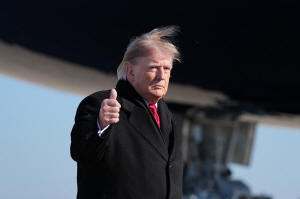
President Donald Trump walks to board Air Force One at Joint Base
Andrews, Md., on his way to attend the 49th ASEAN Summit in Manila,
Monday, Nov. 16, 2026. (AP Photo/Mark Schiefelbein)

“We think it is authorized,” Giuffra said, calling a provision of
the law that allows such post-verdict transfer petitions “a safety
valve that’s intended to protect against exactly the gamesmanship
that’s gone on here.”
A federal judge declined Trump’s transfer bid 3 times
Trump asked the 2nd Circuit to step in after a federal judge in
August ruled against the president for a third time. Judge Alvin K.
Hellerstein, who died last month at 92, wrote in his decision that
“paying hush money to an adult film star or engaging in a cover-up
of an embarrassment are not subsumed in presidential immunity.”
Trump first sought to move the case to federal court weeks after he
was indicted in March 2023. He tried again after his conviction and
the Supreme Court’s July 2024 ruling that presidents and
ex-presidents can’t be prosecuted for official acts and prosecutors
can’t use official acts as evidence that unofficial actions were
illegal.
Giuffra argued to both the state and federal appellate panels that
prosecutors used the type of official acts evidence that was later
barred by the Supreme Court's immunity ruling, including testimony
about his Oval Office conversations, workflow and social media
posts.
Giuffra also took issue with the prosecution’s description of the
hush money payment as an illegal campaign contribution under the
Federal Election Campaign Act, arguing that such allegations belong
in federal court, not state court.
After Trump appealed Hellerstein’s second denial, the 2nd Circuit
ordered the judge to reconsider, finding that he had failed to weigh
“important issues relevant” to the president’s request to move the
case.
That panel, which also included Lohier, said it expressed no view on
how he should rule but instructed Hellerstein to closely review
evidence that Trump claimed was related to official acts and whether
Trump could argue those actions were taken as part of his White
House duties.
Steven Wu, chief of the appeals division at the Manhattan District
Attorney's Office, urged the 2nd Circuit panel to uphold
Hellerstein’s ruling and leave the case in state court. Even if
Trump were to prevail, he argued, the state appeals court would
still be free to rule.
All contents © copyright 2026 Associated Press. All rights reserved
 |