Trump's pick for Navy secretary acknowledges the Iran war is straining
military resources
[November 18, 2026]
By BEN FINLEY, KONSTANTIN TOROPIN and FARNOUSH AMIRI
WASHINGTON (AP) — President Donald Trump's pick to lead the U.S. Navy
acknowledged the strain of the Iran war as senators from both political
parties pressed him at his confirmation hearing Tuesday about the impact
of long ship deployments on sailors, drawdowns to stockpiles of advanced
weapons and resources being shifted away from countering China.
Acting Navy Secretary Hung Cao, a Trump loyalist and combat veteran, is
seeking the permanent top civilian job during a particularly volatile
time in Washington. He also faces the extra hurdle of needing a waiver
from Congress, because he left active-duty service less than seven years
ago.
“This war, again, I know it’s a strain on our Navy,” Cao told the Senate
Armed Services Committee, but he insisted that “it’s really set China
back on their heels” to see all the military services work together.
Sen. Elizabeth Warren, a Democrat from Massachusetts, grilled Cao on the
costs of the Iran war, noting that independent estimates or media
reports say the naval blockade on Iranian shipping costs about $32.5
million a day and Iranian strikes on the Navy's regional headquarters in
Bahrain did at least $400 million in damage.
Cao confirmed the figure for the blockade but said he could not offer a
full damage assessment in Bahrain because “it’s a nonpermissive area for
us to go," despite telling a reporter months ago that Iran “blew the
hell out of Bahrain."
The hearing offered a rare opportunity to question a top military leader
publicly about the Iran war and other issues. It follows recent firings
of Navy officials and a failed impeachment attempt in the House against
Defense Secretary Pete Hegseth, partly over his handling of the
8-month-old conflict. Republicans lost the House and Senate in the
midterm elections, which were widely seen as a repudiation of the war
and will put Democrats in control of Congress in January.

Cao faces questions over living conditions and mental health
during long deployments
Cao was asked to address concerns that lawmakers have raised over living
conditions aboard warships deployed to the Middle East and sailors'
mental health, following reports of crew stress and supply shortages on
the USS Abraham Lincoln aircraft carrier and other ships. The Lincoln
endured a record-breaking deployment supporting the Iran war before
returning to its homeport of San Diego in October.
Republican Sen. Roger Wicker of Mississippi, who chairs the Senate Armed
Services Committee, noted that the “incredibly challenging deployments”
take a toll on sailors and their families.
Sen. Mark Kelly, a Democrat from Arizona, said his office had received
“reports of not enough food and inadequate basic necessities” from other
warships that are now deployed.
“One parent told us that there’s their kid, lost more than 45 pounds in
six months because of a lack of food,” Kelly said.
Cao said he was focused on sailors' welfare but argued that sailors
going hungry was "like my kids opening up the refrigerator door and
saying there’s nothing to eat in here.”
When asked about suicide attempts aboard the ships, Cao told Sen.
Richard Blumenthal, a Connecticut Democrat, that what he saw "as eight
suicide attempts, I see as eight suicide mitigations.”
Cao says the Navy is making progress on munitions
The conflict with Iran has strained U.S. stockpiles of air defense
interceptors as well as other missiles such as the Navy's Tomahawk
cruise missile, which can be fired offshore by a ship but safely strike
targets hundreds of miles inland.
GOP Sen. Deb Fischer of Nebraska pointed to concerns about the dwindling
munition stockpiles, while fellow Republican Sen. Joni Ernst of Iowa
also noted the strain to Navy resources of maintaining the blockade on
Iranian shipping.

[to top of second column]
|
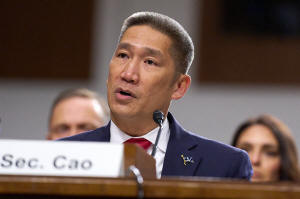
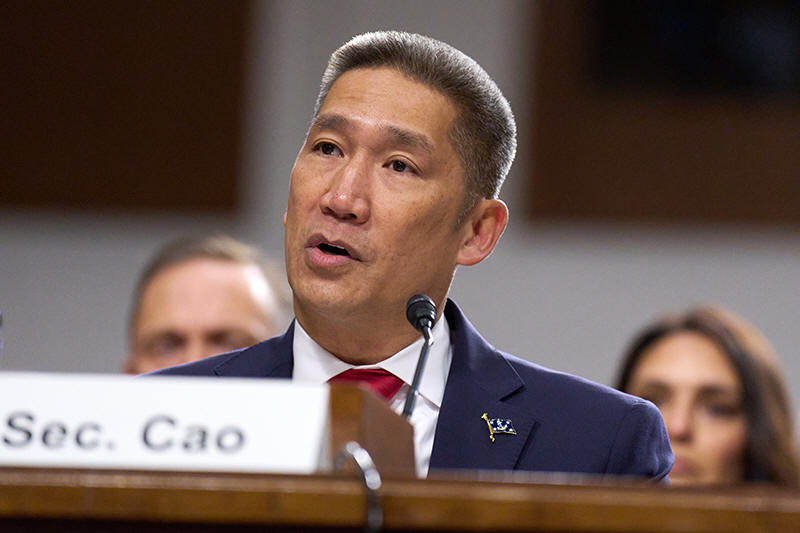
Acting Navy Secretary Hung Cao testifies before the Senate Armed
Services Committee on his nomination as Secretary of the Navy,
Tuesday, Nov. 17, 2026, on Capitol Hill in Washington. (AP
Photo/Jacquelyn Martin)

Sen. Jack Reed of Rhode Island, the committee’s ranking Democrat,
said in his opening remarks that “the munitions expended and damage
sustained from Operation Epic Fury alone will take years to
recover.”
When lawmakers raised concerns over munitions stocks, Cao said
there’s been a boost in production of Tomahawks and other weapons.
“When I was in uniform, we only produced 125 Tomahawks a year. Right
now we’re well above 60 every month,” Cao said.
He said efforts are also underway to boost the production of
interceptors that are used by Navy ships to shoot down incoming
missiles.
However, Cao also conceded that the Navy has taken to using expired
munitions, comparing it to adding water to expired bread and putting
it in the microwave. He didn't identify the specific munitions
involved.
“For some of these munitions, we recoded them. And so we’re able to
shoot off the expired munitions,” Cao said.
Democrats press Cao on recent Navy firings
Democratic lawmakers say the Navy failed to inform Congress that it
fired the entire leadership team of a nuclear-powered attack
submarine after an underwater collision. Separately, the sea service
fired the commander of a destroyer deployed to the Middle East.
Cao made the case against the Navy’s traditional policy of publicly
announcing the removal of commanders and instead argued that he
wants “to make sure that we don’t destroy their careers.”
“We relieve commanding officers for everything from negligence to
even just fraternization or, you know, harassment,” Cao said, “and I
want to make sure that we’re protecting their livelihood afterwards
as well.”
Trump nominated Cao for the permanent job in September. Cao has been
serving as acting Navy secretary since April after John Phelan’s
departure, which came with little public explanation. Before that,
Cao was serving as Navy undersecretary and had run an unsuccessful
Republican bid in 2024 to unseat Virginia Democratic Sen. Tim Kaine.
Cao fled Vietnam with his family as a child in the 1970s before
attending the U.S. Naval Academy. He was commissioned as a special
operations officer and went on to serve with SEAL teams and special
forces in Iraq, Afghanistan and Somalia, according to his Senate
campaign biography.

Cao left active duty in 2021. To take the secretary post, he needs a
waiver from a law that prohibits military officers from serving as a
service secretary until they have been retired for at least seven
years.
A similar law, which has been on the books since the end of World
War II, exists for the secretary of defense and is designed to
ensure truly civilian control of the military. Congress has only
granted exceptions three times for that post — twice in the past
decade, for retired Marine Gen. James Mattis during the first Trump
administration and retired Army Gen. Lloyd Austin under President
Joe Biden.
In each case, Republican and Democratic lawmakers expressed an
aversion to waiving the requirement and setting precedent for future
exceptions. They raised concerns about further erosion of the
already precarious concept of civilian control of the military.
___
Amiri reported from New York.
All contents © copyright 2026 Associated Press. All rights reserved |