Fed minutes: Higher interest rates needed in December as inflation
worries mount
[November 19, 2026] By
CHRISTOPHER RUGABER
WASHINGTON (AP) — Nearly all Federal Reserve officials expect the
central bank will lift its key interest rate by a quarter point in
December, minutes from a meeting last month showed, while some supported
a hike in October and two floated the possibility of a half-point
increase next month.
The minutes, released three weeks after the Oct. 27-28 meeting of the
Fed's rate-setting committee, also said a “vast majority” of the 19
members of the Fed's policymaking committee worried that inflation could
persist even if gas prices kept declining and the impact of tariffs and
the buildout of AI infrastructure faded.
The minutes will solidify expectations for a rate hike not only in
December but likely early next year as well. Wall Street investors
already see the odds of a December rate hike at nearly 95%, according to
CME Fedwatch. When the Fed lifts its key rate, over time it can also
raise borrowing costs for mortgages, auto loans and credit cards. Home
sales have withered as mortgage rates have topped 7% in recent months.
The Fed kept its key rate unchanged at 3.9% in October after raising it
for the first time in three years in September. Chairman Kevin Warsh at
a news conference Oct. 28 gave little guidance on the central bank's
next moves, but the statement issued after the Fed's meeting
acknowledged that “inflation remains elevated.”
The minutes said “some" policymakers supported lifting rates in October.
Two of them, Fed governor Lisa Cook and Beth Hammack, president of the
Federal Reserve Bank of Cleveland, formally dissented in favor of higher
rates. President Donald Trump has sought to fire Cook, but the Supreme
Court ruled in June she could keep her position while the case is
litigated.

Inflation has accelerated this fall and is showing signs of broadening
beyond industries directly affected by higher oil and gas prices or
tariffs, a trend that has raised alarm among many policymakers. Several
have spoken out in favor of more rate hikes in the past week.
Fed governor Christopher Waller said in an interview on CNBC early
Wednesday that inflation is “headed in the wrong direction and it’s
spreading out ″ into more goods and services. Waller is one of the Fed's
seven governors and a member of its rate-setting committee.
“If you really want to get it down, you’ve got to start taking more
aggressive actions,” Waller said. He reiterated his support for a
half-point rate increase at the Fed’s December meeting, double the usual
hike. He also said that several more hikes — not just the two that many
economists forecast — might be needed to tame inflation.
The minutes suggested that one other official also agreed that a
half-point increase should be considered in December, though it’s not
clear that the official is a voting member. Twelve of the 19 members of
the committee vote on rate decisions, though all participate in the
debates. The minutes don’t identify which officials took which
positions.
[to top of second column] |
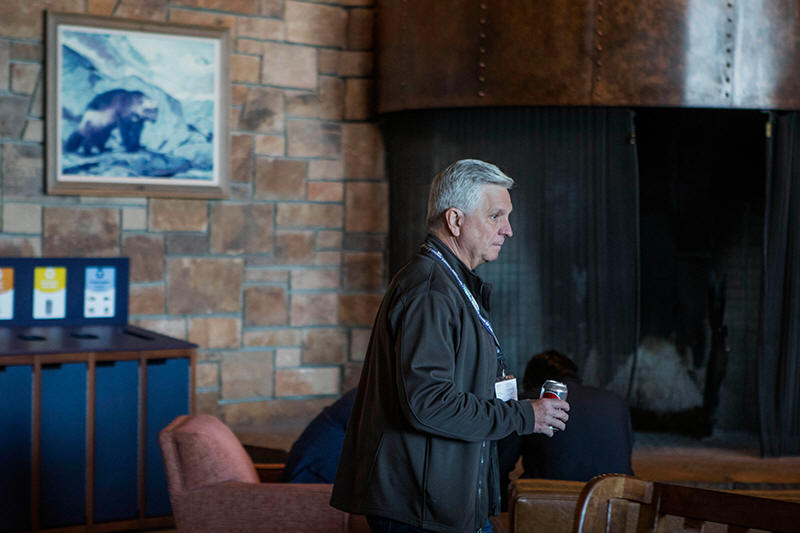
Member of the Federal Reserve Board of Governors Christopher Waller
walks through Jackson Lake Lodge during a break at the Jackson Hole
Economic Policy Symposium in Moran, Wyo., Aug. 22, 2025. (AP
Photo/Amber Baesler, File)
 Waller noted that in the past three
months, core inflation, which excludes the volatile food and energy
categories, has run at about a 3.5% annual rate, far above the Fed’s
target of 2%. Businesses increasingly appear willing to pass on
their own rising costs and also believe their customers can handle
price increases of about 3%, he added.
“That’s the kind of psychology I think we need to start breaking,”
Waller said.
Waller also took a shot at Warsh by arguing that one reason he
supported a half-point hike is that without greater communication,
financial markets won’t know whether a quarter-point increase in
December will be followed by a similar move in January. If investors
do have a sense of further hikes in the pipeline, they’ll push up
market rates in anticipation and help the Fed cool inflation, Waller
said.
Yet Warsh has steadily refrained from providing such guidance, which
he has said locks the Fed to a predetermined path.
Separately, John Williams, president of the New York Fed and vice
chair of the Fed's rate-setting committee, has pushed back against
the potential for a half-point increase. He told Axios Tuesday, “I
don’t think the situation calls for dramatic action.”
Other Fed officials have suggested many more hikes are likely
necessary. Alberto Musalem, president of the St. Louis Fed, said
Tuesday in a speech in Buenos Aires that “the economy will likely
require several interest rate increases before the spring of 2027”
to bring inflation down.
The economy is expanding at a healthy pace, he added, and interest
rates aren’t high enough to restrain borrowing and spending
sufficiently to cool inflation. Musalem does not have a vote on
rates this year.
Mary Daly, president of the San Francisco Fed, said last week that
she is leaning toward supporting further rate hikes, and added that
she also worries that companies are increasingly willing to pass on
higher costs to consumers.
“That’s the inflationary impulse that we want to avoid,” Daly said.
All contents © copyright 2026 Associated Press. All rights reserved
 |