Hannah Lillith Assadi’s 'Paradiso 17' wins the National Book Award for
fiction
[November 19, 2026]
By HILLEL ITALIE
NEW YORK (AP) — Hannah Lillith Assadi’s “Paradiso 17,” a loving,
melancholy and poetic account of a Palestinian exile’s worldwide
journey, won the National Book Award for fiction. Another story
originating from the Middle East, Egyptian author Abdelrahman ElGendy's
“Huna: A Memoir of Revolution, Prison, and Becoming,” was the nonfiction
winner.
Assadi, whose novel was inspired in part by the death of her father and
haunted further by the deaths of Palestinians in the Gaza war with
Israel, remembered the writing of her book as a time of pain, deep grief
and beauty, a cycle mirroring life itself.
“Isn’t that story all of ours?" she said.
Vicente Luis Mora’s “Centroeuropa,” translated from Spanish by Rahul
Bery, won for literature in translation. David Levithan's and Gabriel
Duckels' “The Fight of Our Lives: AIDS in America,” a book Levithan said
was inspired by how little kids knew about AIDS, won for young people's
literature.
Levithan, an editorial director at Scholastic, is among a handful of
book editors who also have successful writing careers. During his
remarks Wednesday, he noted the surge in book bans over the past few
years but added that “there are far, far, far more people who want our
voices to be heard, who want the truth of our lives to be shared, and
who want the queer generations that come after us to have it easier.”
Also Wednesday night, Brenda Hillman won in poetry for “Still House in
the Desert: An eco-contemplation,” an achievement echoing her husband
and fellow poet Robert Hass’ win in 2007.
“We have a matching set,” she said of her prize. “It’ll be nice to have
mine next to his.”
Winners in the five competitive categories each received $10,000.

Klass and Rushdie get honorary prizes
Honorary prizes were presented to the pediatrician-literacy advocate
Perri Klass for Outstanding Service to the American Literary Community
and to Salman Rushdie for Distinguished Contribution to American
Letters.
Klass brought to the stage emblems of her two passions — a stethoscope
and a copy of the children's classic “Goodnight Moon,” a book she
assured the audience that toddlers on up are able to quote from. Rushdie
noted that many previous winners of his award, from Don DeLillo to Saul
Bellow, were friends and influences and welcomed his own entry into the
“august” pantheon of American literature.
Actor-author Kyle MacLachlan hosted the dinner ceremony at Cipriani Wall
Street, boasting that he was such a book nerd growing up he took a class
in the Dewey Decimal system. Musical guest Michelle Zauner of Japanese
Breakfast sang “Be Sweet" and the suitably bookish “Magic Mountain,"
inspired in part by Thomas Mann's classic novel of the same name.
Some finalists faced visa denials
Not all of the finalists could attend. ElGendy, who is currently in
Europe after leaving the U.S. for fear he would be arrested by U.S.
Immigration and Customs Enforcement (ICE), and Samar Yazbek of Syria, a
finalist for books in translation, were denied visas to the U.S.,
according to the National Book Foundation, which presents the awards.
[to top of second column]
|
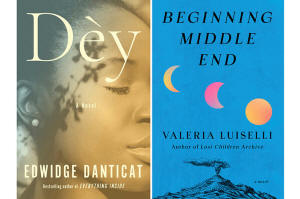
This combination of book cover images show "Dèy" by Edwidge Danticat,
left, and "Beginning Middle End" by Valeria Luiselli. (Knopf/Knopf
via AP)
 ElGendy is a onetime student
activist who as a teen was arrested in 2013 during protests in Cairo
and spent six years in prison. His editor, Helen Thomaides of the
Penguin Random House imprint Hogarth, read a brief statement on his
behalf in which he recalled his vow that someday he would turn the
suffering he endured into a story.
“A yearslong dream of mine has come true, and I'm not there to live
it with you,” his acceptance speech reads in part. “May all borders
be abolished; may all prisons fail.”
The State Department declined to comment on any specific cases, but
issued a statement saying that “The Trump Administration continues
to put America and its interests first by fully enforcing U.S.
immigration laws and ensuring lawful travel through our visa
process. As Secretary (of State Marco) Rubio said, ‘a visa is a
privilege, not a right’.”
At a pre-awards reading Tuesday, several finalists deplored the visa
denials. ElGendy’s fellow nonfiction nominees dedicated their
readings to him as he watched remotely, with novelist Omar El Akkad
appearing on ElGendy's behalf. The reading from Yazbek’s work was
done by her translator, Leri Price.
Publishers submitted 1,912 books in all, judged by panels of
authors, editors, booksellers and others in the literary community.
MacLachlan joked that his memoir “Fictional Selves” was somehow
snubbed for the National Book Awards. Others took their omission
more seriously. Author Marlon James, whose novel “The Disappearers”
was bypassed as a fiction finalist despite receiving high acclaim
and widespread coverage, has been critical of American awards in
general.
In a recent interview with Time magazine, the onetime Booker Prize
winner said that British judges were more open to bestsellers than
were American judges, who “feel this need to counterbalance
popularity.” He noted that such high-profile works as Ann Patchett's
"Whistler" and Tayari Jones' “Kin” also were left out.
“We complain that nobody is reading and they ignore it,” James said
of the judges. "And it seems the only crimes these books had was
that people read them."
___
Associated Press writer Jennifer Peltz contributed to this report.
All contents © copyright 2026 Associated Press. All rights reserved
 |