Soaking storms shift north to Florida's Space Coast and prompt water
rescues of humans and horses
[November 20, 2026]
By DAVE COLLINS, KATHY McCORMACK and JOHN RABY
Storms that brought record rains to South Florida this week shifted
north to the Space Coast on Thursday, sending rivers over their banks
and prompting water rescues of people and horses alike.
In California, rain continued to pound the coast, filling streets with
water, submerging cars and prompting hundreds of delayed flights.
This is supposed to be Florida’s dry season that runs from October to
May.
So far, it has been quite the opposite.
“Never seen such a thing like this in Florida,” said Jazmin Foster, who
has lived in her Melbourne home for eight years.
The storms have already dumped nearly 17 inches of rain over 48 hours in
the Fort Lauderdale area, according to preliminary totals from the
National Weather Service. Places like Fort Lauderdale, Melbourne and
West Palm Beach have already seen their wettest November on record, the
National Weather Service said.
This week’s storms have been fueled by persistent high pressure over
Virginia and a low-pressure system and an associated stationary front in
the Gulf, which together have pushed a steady onshore flow across the
Florida Peninsula. Heavy rains and flash flooding were expected to
persist through Friday, possibly moving north toward the Carolinas and
the mid-Atlantic into the weekend, the weather service said.

Dozens of horses and other animals caught in floodwaters at
equestrian center
On Thursday, the storms hit Brevard County directly. People with
trailers braved knee-deep water to rescue dozens of horses and other
animals at the Blue Lake Equestrian Center, an animal hospice and
boarding facility in Cocoa. The animals were taken to a dry pasture
elsewhere.
First responders conducted nearly 100 high-water rescues across the
county, and those numbers continued to climb, Sheriff Wayne Ivey said.
The city of Palm Bay conducted mandatory evacuations for some residents
of a mobile home community. Shelters were opened for residents forced
from their homes.
Water inundated Foster's home Thursday, two weeks after she endured a
previous round of flooding. She said an insurance claim filed for the
earlier flood was denied.
“Where is FEMA? Multiple people here in Brevard need help! I know other
people are worse than we are!” Foster told The Associated Press via
social media.
Nearly 200 Florida National Guard personnel with 50 high-water vehicles
have been deployed to help, the Division of Emergency Management said.
Other responding agencies included about 235 officers with the Florida
Fish and Wildlife Conservation Commission.
The St. Johns River near Cocoa rose above a record flood level set in
1953 and was forecast to stay at least 2 feet above flood stage through
early next week, according to the weather service.
Cyndy Paulin saw a fish swimming on her flooded street in Cocoa on
Thursday, and her adventurous 5-year-old granddaughter played in the
water. She brought a small body board and got on it, but it immediately
sank to the ground, and she got soaked.
“She had a blast,” Paulin said.
El Niño isn’t going away anytime soon
The storms are an offshoot of El Niño, the natural warming of the
Pacific near the equator that warps weather patterns worldwide.

[to top of second column]
|
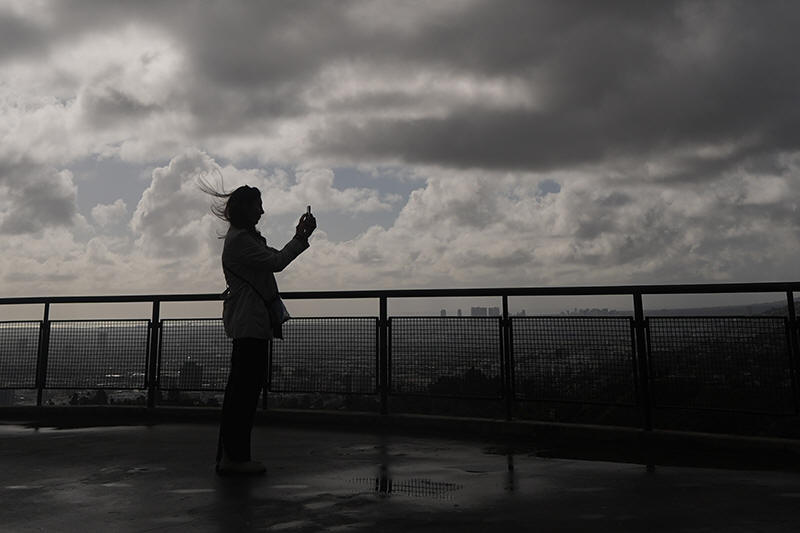
A visitor takes pictures as rain clouds hover over Griffith Park in
Los Angeles, Thursday, Nov. 19, 2026. (AP Photo/Jae C. Hong)

Forecasters said El Niño conditions are expected to persist through
the spring, meaning the soggy extreme weather in Florida and
California will likely continue through the winter.
“That’s what the forecast models are saying,” said Yale Climate
Connections meteorologist Jeff Masters. “Winter hasn’t even come yet
— we’re still in November. And things are likely to get even more
active. And with record-warm ocean temperatures both off the coast
of California and off the coast of Florida, we’re going to be seeing
some very heavy downpours.”
In July, United Nations officials warned that El Niño would add fuel
to the world’s accelerating climate crisis, powered by the burning
of coal, oil and natural gas.
Longtime Pompano Beach resident Ken Evans said he has seen heavier
rain and flooding worsen, especially over the past five years.
On Tuesday night, he was caught in his SUV on Interstate 95 north of
Miami during a heavy downpour with hail that left many roads under
water.
“This is absolutely a whole new cycle that’s going on, and a cycle
that we should be very concerned about,” Evans said.
California endures more flooding
Preliminary totals showed one area of Los Angeles received more than
3 inches of rain during a 12-hour period ending Thursday, the
weather service said. Some drivers were forced to abandon cars that
stalled in floodwaters.
More than 200 flights to and from Los Angeles International Airport
were delayed Thursday, about 12% of the total air traffic, but there
were only a handful of cancellations, according to Flightradar24.
South of the Monterey Peninsula, rock and mud slides in Big Sur
forced a more than 40-mile (64-kilometer) closure of Highway 1 along
the Pacific coast.
In West Oakland, Adriana Uchishiba woke up scared Wednesday after
finding her bed floating in her room with floodwaters inside her
house. A heater was still plugged in, and Uchishiba could feel the
electrical currents in the water.

A maintenance worker brought dehumidifiers and a water suction pump
to remove the water, and Uchishiba hopes they acted quickly enough
to avoid mold and mildew. Her friends have helped her clean up,
taking her clothes to their homes to wash, but she and her roommate
have to get new beds, blankets and books, she said.
“If it wasn’t for my friends coming out and showing up ... this
place would still be underwater,” she said.
Watching the skies — and surf — for Thanksgiving week
A nontropical low-pressure system expected to form Friday could
become a subtropical or tropical storm along the southeastern U.S.
coast, the National Hurricane Center in Miami said. The southeast
and mid-Atlantic coasts should expect strong winds, dangerous surf
and coastal flooding into early next week.
In Southern California, the weather service said extremely high
tides of more than 8 feet (2.4 meters) were expected to continue
through next week.
___
Associated Press writers Amy Taxin in Santa Ana, California, and
Jessica Hill in Las Vegas contributed to this report.
All contents © copyright 2026 Associated Press. All rights reserved |