At Dakar's Biennale, African artists explore how to turn fragility into
power
[November 21, 2026]
By MONIKA PRONCZUK
DAKAR, Senegal (AP) — As Senegal grapples with a deepening economic
crisis, the Biennale of Contemporary African Art opened in Dakar on
Friday with a theme of turning vulnerability into strength and
positioning art as a resource for navigating turbulent times.
The exhibition, founded in 1989 by the Senegalese government to promote
the continent’s thriving art scene, has over the decades become one of
the most important among African artists.
Every two years, Senegal’s picturesque capital puts on its best clothes
and welcomes hundreds of artists, curators and art lovers from across
the world who mingle, network and admire art against the backdrop of
palm trees and to the soundtrack of popping Champagne bottles.
This year's theme, “(Anti)fragility,” explores how to embrace
vulnerability and turn it into power for change, said Morad Montazami,
the event's artistic director.
“It's a paradoxical concept. We put ‘anti-’ in parentheses because, to
be ‘anti-fragile,’ you must first embrace or accept fragility,” he said.
“When something breaks or shatters, it’s considered fragile. When
something withstands shocks, we say it’s robust. But there’s a third
scenario: one where, as a result of a shock, you actually become
stronger.”
The theme resonates across the region, which is struggling with economic
shocks and identity crises, navigating its place in the new global
order. In Senegal, costs of living have skyrocketed as the government
wrestles with a massive debt, and thousands have undertaken the
treacherous, irregular route to Europe through the Atlantic Ocean,
making headlines over recent tragic shipwrecks.

That makes it even more vital for artists to create, gather and exhibit,
Montazami said.
“Crises give rise to new systems of thought,” he said. “So these are
also moments of rupture — moments where we can attempt to conceive
something new.”
The main exhibit displays works of 54 artists and 22 designers from
Africa and the African diaspora. Alongside the official program, over
450 pop up exhibitions are held in various venues, from suave five-star
hotels to low-key neighborhood galleries.
On Friday, the first day open to the public, international crowds of
tourists, academics, artists and curators roamed the halls of the
slightly decaying yet still majestic former courthouse in Dakar, which
hosts the flagship official selection.

[to top of second column]
|
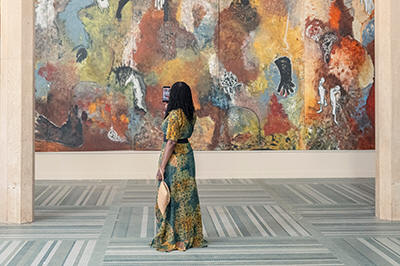
A visitor looks at "Naag 2" (2026), a six-panel mixed-media painting
by Senegalese artist Deb's, at the 16th Dakar Biennale of
Contemporary African Art in Dakar, Senegal, Friday, Nov. 20, 2026.
(AP Photo/Sylvain Cherkaoui)
 Claire Whitner and Samantha Cataldo,
curators at the Worcester Art Museum in Massachusetts, traveled to
Dakar to scout for new African artists.
“Our city has a lot of West African immigrants, and so we want our
collection to be able to respond to what our community looks like,"
said Cataldo.
“For now, the collection doesn’t have a strong representation of
African art. And at this moment in history, it feels unethical to
collect traditional African art — and there’s so much opportunity to
think about contemporary art in Africa.”
The art on display varied from an installation of thousands of
silkworm cocoons to intimate watercolor paintings representing the
fragility of human body, large canvases depicting joy and pain of
motherhood, and modern marblelike centaur statues.
Jean-David Nkot, an artist from Cameroon, reimagined the ancient
Greek monster Hydra, famous for regrowing new heads whenever one was
cut off, as gold miners in east Cameroon. Across West Africa,
governments are taking steps to reclaim control over their natural
resources — yet the working conditions of miners remain poor.
“I wanted to show the ability of bodies to overcome and to re-create
themselves in the context of confinement and suffering,” he said.
“The living conditions of these miners are so improbable that I want
to show the strength that they bring to society, and show how that
even in the most difficult times, they manage to surpass themselves
and rebuild themselves.”
The official exhibit also features work of patients from Senegal’s
psychiatric hospitals and marginalized groups, as well as a big
section dedicated to children, pushing the boundaries of who can
call themselves an artist.
Montazami, the artistic director, insisted that art was a necessary
resource, even more so in the times of crisis — not just for the
fortunate few, but for everyone.
“At its core, our struggle is about demonstrating that art is not an
accessory — that it is not a luxury,” he said. “Ultimately, it is a
common good and a resource.”
All contents © copyright 2026 Associated Press. All rights reserved |