Israeli settlers' move into a Palestinian neighborhood brings deadly
violence to Jericho's doorstep
[November 21, 2026]
By SAM METZ
JERICHO, West Bank (AP) — For years, this lush Palestinian city was an
oasis of calm in the occupied West Bank. Jericho's warm weather drew
tourists year-round and its perch low in the Jordan Valley kept it
somewhat isolated from the violence elsewhere in the territory.
But that relative peace was shattered this week when Palestinians said
Israeli settlers who had newly infiltrated the outskirts of Jericho shot
and killed a 72-year-old woman during clashes with local youth.
The killing late Monday of Fadda Fheidat came just days after the
settlers had seized a cluster of Palestinian homes they said they
purchased — a claim that rights groups and Palestinian residents
contest.
The takeover was the first time in decades that Israelis had settled
within a residential neighborhood around a major Palestinian city.
And now, as armed settlers patrol their streets, Palestinian residents
say the violence has raised fears that a new phase of settlement
expansion is reaching West Bank cities once considered safe from
encroaching settlers.
A new chapter for Israeli settlers
Israel has occupied the West Bank since it captured the territory, along
with east Jerusalem and the Gaza Strip, from Jordan and Egypt in the
1967 Mideast war. Since then, it has built a network of settlements for
more than half a million Israelis on land Palestinians seek for a future
independent state.

The international community overwhelmingly considers the settlements
illegal. But Prime Minister Benjamin Netanyahu's right-wing government
has approved more than 100 new settlements during its tenure. Settlers
have also erected unauthorized outposts, which they’ve used to attack
Palestinian shepherds, rampage through communities and drive people from
their homes.
The seizure of the homes in al-Duyuk al-Tahta followed a similar
pattern, residents and rights groups say, starting with the construction
of a new outpost nearby in 2024. The neighborhood lies just outside
Jericho’s city limits, near a prized archaeological site that Israel has
invested in developing as a tourist destination.
"We are writing a new chapter of Jewish life. We have returned home,"
Israel Ganz, who heads the local council governing Israeli settlements
in the area, declared on social media after the settlers moved in on
Nov. 4.
The Israeli rights group B’Tselem described the settlers' arrival as the
latest in a series of increasingly bold and largely unchallenged efforts
to drive Palestinians from their land. It warned of "a reality similar
to Hebron ” — the only city where Israeli settlers have for decades
lived under military protection in the heart of a built-up Palestinian
urban area.
The settlers' arrival introduces a permanent Israeli presence "with
increased military deployment, restrictions on Palestinian movement, and
settler militia violence and intimidation, which will affect the lives
of tens of thousands of Palestinians,” the group said in a statement.
A major turning point came in February when settlers from the nearby
outpost, emboldened by Israeli demolition orders for several houses on
the edge of al-Duyuk al-Tahta, drove trucks and tractors into the
community and spent nearly eight hours ransacking and bulldozing homes,
Palestinian residents said.
Soon after that, the Israeli government legalized the outpost. By
October, settlers had taken some of the Palestinian community's farmland
and began setting up new irrigation systems.
On Nov. 4, dozens of Israelis, some of them armed, moved into eight
Palestinian homes.

[to top of second column]
|
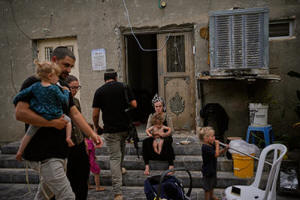
Israeli settlers gather at an eight-house compound that settlers
claim to have purchased on the outskirts of the Palestinian city of
Jericho in the occupied West Bank, Thursday, Nov. 5, 2026. (AP
Photo/Ohad Zwigenberg)

The settlers say they have proof-of-purchase documents for the
houses, but Palestinian residents say they don’t know how, when or
by whom the properties were sold.
Palestinian officials and Israeli human rights groups have
questioned the legality of the sales under both Israeli and
Palestinian laws. Most of the properties sit on farmland that
Palestinian shepherds have grazed for generations and that Israel
classifies as state land.
Under Israeli law, plots designated as state land generally cannot
be privately bought or sold. Under the Palestinian Authority, the
internationally backed body that administers semiautonomous parts of
the West Bank, including Jericho, selling land to Israelis is a
criminal offense.
A deadly clash after days of tension
Almost immediately after the settlers moved in, they began policing
the neighborhood, often with guns and in ATVs, Palestinian residents
said.
“They started to control our lives,” said Mustapha Fheidat, a farmer
whose extended family makes up much of the population in al-Duyuk
al-Tahta. “They stop us and ask for our IDs and what we’re doing
here. They prevent us getting from the main road to our farms.”
According to four members of the Fheidat family, it was one of these
settler patrols that set off Monday's deadly clash, after settlers
hurled insults at Palestinian residents, who responded by pelting
them with rocks.
Israel’s military said in a statement that the sequence of events
that led to Monday's shooting death were under investigation. Citing
testimony collected by soldiers at the scene, it said the clash
erupted after a Palestinian driver ”carried out an attack by
ramming" into an Israeli settler's vehicle as youths threw rocks at
the settlers.
Fadda Fheidat was “likely injured by fire from an Israeli civilian,"
the military said.
No arrests of Israelis were announced in connection with the
shooting. Two Palestinian men were arrested in connection with the
“ramming” incident, the military said.

Members of the Fheidat family who witnessed the violence denied the
collision was intentional, saying it happened when Fadda Fheidat's
son was rushing to the scene of his mother's shooting and skidded
into the settler's vehicle.
They said Fadda Fheidat and her daughter-in-law, Na'ima, were
driving a relative who had been shot to a nearby hospital but turned
back after Palestinians warned that more settlers were on the road
ahead.
The violence was still underway when the women returned home. As
they got out of the car, Na'ima Fheidat said she heard her children
scream: "'Grandma has been killed! Grandma has been killed!’”
Ahmed Fheidat was inside his home when he heard the shouting and
gunfire. He rushed outside and found his sister-in-law lying on the
ground with a gunshot to the head.
“Her skull was completely broken. My hand was full of blood,” he
said.
He carried her inside to wait for an ambulance, barely noticing that
he, too, had been shot in the leg.
All contents © copyright 2026 Associated Press. All rights reserved |