Why the failure to reach a major deal at UN climate talks matters as
extreme weather worsens
[November 23, 2026]
By SUZAN FRASER, SETH BORENSTEIN, ANTON L. DELGADO and
SIBI ARASU
ANTALYA, Turkey (AP) — United Nations climate talks fizzled out Sunday
without reaching an overarching agreement because of disputes over
whether to mention the fossil fuels that cause global warming.
Expectations had already been low heading into the two-week negotiations
in Turkey, but impasses over explicitly including fossil fuels and other
issues, including money, proved irreconcilable. Nations' negotiators,
activists and even organizers used the word “disappointing” to
characterize the discussions.
Though the talks, called COP31, failed to reach a main agreement, known
as a cover decision, the meeting had already made progress on smaller
issues. The two-week session ended Sunday night, after running more than
50 hours overtime at the resort town of Antalya.
This all happened as global warming accelerates with ever-worsening heat
waves, floods, storms and droughts. The U.N. said it is now inevitable
that the world will soon blow past the warming threshold established by
the 2015 Paris climate agreement. And there is also a global energy
shock due to the war in Iran. On top of that, a strong El Niño amplifies
human-caused warming and causes more weather disasters.
“I am deeply disappointed that COP31 has ended without consensus on an
overarching outcome,” United Nations Secretary-General Antonio Guterres
said. “Temperatures keep shattering records. Climate extremes keep
intensifying. Emissions remain far too high. And every delay makes our
task harder and more costly.”
Upset youth representative Oumnia Anfer told the negotiators “you have
let us down.”

Any pact approved at the talks requires near-unanimous consensus.
Several countries and the 27-nation European Union said they could not
accept the final proposal from the joint Turkish-Australian leadership,
which didn’t mention fossil fuels. A considerably larger number of
nations accepted the decision, often reluctantly, saying consensus on
something was more important, though it ultimately failed. Russia and
Saudi Arabia sought to keep fossil fuels out of the document.
“It’s unconscionable that we would have a climate act that makes no
reference to fossil fuels,” Darragh O’Brien, Ireland’s climate minister,
said on behalf of the EU at the climate talks.
Impasses over draft agreements
Previously, fossil fuels went unmentioned in COP final decisions for
more than 25 years, said Alden Meyer, with the think tank E3G. Then,
three years ago in the oil-rich United Arab Emirates, a groundbreaking
agreement called for “transitioning away from fossil fuels” but since
then there’s been no explicit mention of fossil fuels. The
Turkish-Australian proposal recalled the Dubai agreement in its
entirety, but that wasn’t enough for many nations and environmental
groups.
“Fossil fuels are driving the climate crisis,” said Guterres. “The
continued addiction to coal, oil and gas is fueling climate chaos,
exposing economies to price shocks and undermining energy security. We
can’t put out the fire while pouring fuel on it.”
Adding to the disagreement was the fact that the draft included explicit
language and a goal for carbon capture and storage for industrial
polluters, which many nations and activists said would undermine efforts
to reduce overall emissions.
“The failure of COP31 is an outrage — it is outrageous that a handful of
petrostates have veto power over any mention of fossil fuels," said
former U.S. Vice President Al Gore.
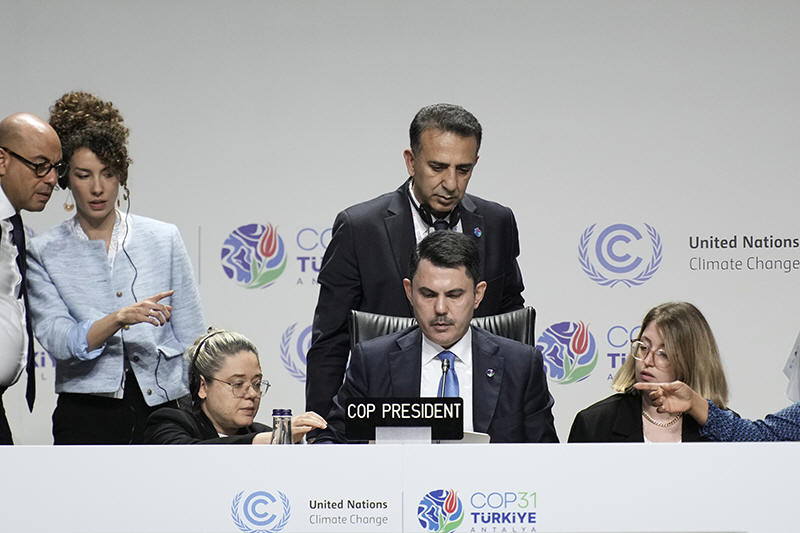
As the proposed deal fell apart in the plenary session, Turkish
Environment Minister Murat Kurum, the president of COP31, was absent,
leaving it to Elchin Allahverdiyev of Azerbaijan to announce the
failure.
“Unfortunately, we were unable to reach agreement on a cover decision.
And that’s disappointing, very disappointing,” said Australia’s Chris
Bowen, COP31's president of negotiations.
Bowen said the Dubai agreement's explicit call to wean away from coal,
oil and natural gas that cause climate change is still in force:
“Transition away from fossil fuels in the real world is happening. It’s
happening. It’s happening at speed and it’s irreversible.”

[to top of second column]
|
COP31 President Murat Kurum center, attends a closing plenary
session at the COP31 U.N. Climate Summit, Sunday, Nov. 22, 2026, in
Antalya, Turkey. (AP Photo/Khalil Hamra)

Other issues left unresolved
Other climate issues weren’t settled, and many were deferred to next
year’s negotiations in Ethiopia. They include details on
transitioning away from fossil fuels, financial help for poorer
nations to adapt to the warming world and action on gender and
climate.
For this year's negotiations, Turkey made global electrification its
signature issue. A proposal introduced separately from the main
agreement calls for countries to increase the share of electricity
in total final energy consumption from about 21% today to 35% by
2035. This would require nations to commit to measures such as
switching transportation — including cars, trucks and planes — from
fossil fuels to electricity and using electricity instead of coal to
make industrial products. Nearly 100 nations signed up for this goal
as part of the separate pledge.
Meyer, with E3G, also hailed progress on global adaptation goals and
on a program that helps countries achieve their emissions-cutting
goals fairly.
In negotiations over the main agreement, the final proposal was
distributed after 3 a.m. and negotiators had little time to register
their objections. Many observers and countries blamed the two-headed
leadership of Turkey and Australia for the failure to reach an
overarching agreement.
Speaking at the meeting, Antwi-Boasiako Amoah, chair of the African
Group of Negotiators, said, “With all due respect, Mr. President,
you have not shown respect to a group of 54 countries (from Africa)
and my country (Ghana) for that matter.” Kurum later publicly
apologized.
Confusion ensued at the meeting. Kurum was caught on a hot mic
telling U.N. climate chief Simon Stiell “to sit down,” as Stiell
tried to advise him on proceedings onstage.
Earlier this week, Panamanian Environment Minister Juan Carlos
Navarro said the talks were being held hostage by a “petroleum
mafia” and needed to be reformed.
Manuel Pulgar-Vidal, president of COP20 and now climate energy lead
at the World Wildlife Fund, said “COP31 left too much undone.”
“Too many once again shied away from the toughest decisions,
including how to turn their commitment to transition away from
fossil fuels into real action," he said. "The climate will not wait
for governments to find their courage.”

Earlier this year, the United Nations Environment Program announced
that the world will blow past the Paris Agreement temperature
threshold of limiting long-term warming to 1.5 degrees Celsius (2.7
degrees Fahrenheit) above preindustrial times. The goal should now
be to limit how much the world exceeds that threshold and then
somehow come back down using systems to suck carbon out of the air,
U.N. officials said.
The world is heading for between 2.7 C and 3 C (between 4.9 F and
5.4 F) of warming by the end of the century, scientists estimate.
October 2026 had the largest temperature increase above
preindustrial temperatures of any month on record at 1.8 C (3.2 F),
according to Berkeley Earth, which said there’s a 97% chance that
2026 will end up as the warmest year on record. Friday saw the most
above normal temperature on record, according to the European
climate monitor Copernicus.
“Mother Nature decided to comment on the collapse of #COP31 climate
negotiations in failure by setting a new record,” University of
Pennsylvania climate scientist Michael Mann said on X.
___
Borenstein reported from Kensington, Maryland; Delgado from Bangkok
and Arasu from Bengaluru, India.
All contents © copyright 2026 Associated Press. All rights reserved |