Pitchfork transformed music media. Founder Ryan Schreiber tells the
story in 'Weird Era'
[November 24, 2026]
By MARIA SHERMAN
NEW YORK (AP) — You could call it catching lightning in a bottle or
being in the right place at the right time. Or you could call it what it
really was: powering up the family computer and unexpectedly
transforming music media.
The year was 1996. In Minneapolis, a teenage music obsessive named Ryan
Schreiber had an idea. Why not launch an online music zine published for
and by enthusiasts with a strong point of view? Why not eventually call
it something sharp, like Pitchfork?
He had no need for the neutrality of other early 'net adopters, like
AllMusic, or legacy media like Rolling Stone's nascent online offerings.
He wanted to differentiate his site through snark and smarts — and he
had the youthful boldness to make it happen.
Or, to borrow a phrase from his memoir out Dec. 1, he understood that,
“If you don't do it, someone else will. So why shouldn't it be you?”
“I wanted it to be tougher than other critics, in part because it was a
white space that I could see was available,” Schreiber says of
Pitchfork's early ethos.
He calls it “unfiltered honesty,” the kind that naturally allows readers
to trust the judgments of the writer. “Recommendations mean that much
more,” he says, when they come from a place of “fearless criticism.”
In “Weird Era: How Pitchfork Changed Music Forever,” Schreiber
chronicles Pitchfork's evolution from bedroom passion project to
consequential music publication, one with the power to launch an indie
music career from obscurity to real fame. He also tells the story of his
own life, from precocious and confused teenager in the Midwest to
editor-in-chief and CEO of an influential publication in New York.
Simultaneously, he traces the trajectory of indie rock, once Pitchfork's
primary musical focus: the technological developments that created
musical movements, as well as the artists and writers who made it all
possible.

Telling Pitchfork's story
Pitchfork began in the era of CDs and — with discerning tastes and
unrivaled curation — shepherded voracious music fans into the MP3 and
peer-to-peer file-sharing age of Napster and then into the streaming era
beyond. While it continues to publish some of the internet's most
incisive music writing, Schreiber stepped away from the site in 2019, a
few years after it was acquired by media conglomerate Condé Nast.
Shortly thereafter, he started to organize his thoughts and what would
eventually become “Weird Era.”
Pitchfork “was my identity since I was 19 years old,” he says. Figuring
out “what would this story look like?” was no easy task, amplified by
the fact that he stopped writing for the site around 2005. But, he says,
part of him always knew he'd need to tell Pitchfork's story and, as a
result, he kept a robust personal archive.
“I did actually obsessively save everything the entire time,” he says.
“AOL Instant Messenger chats and all my emails and photos, I mean, all
the old reviews ... everything that’s not still online or is very old,
like original interviews ... I have all of that on hard drives.”
It meant not guessing which contributor he initially asked to review a
record or who came up with what idea. Debates over the site's infamous
decimal score rating — from 0.0 to 10 — were all there on the drives. He
had the proof.
It also meant facing the site's missteps with real detail. Those in the
book include an early confrontational interview with Lana Del Rey, a
too-high score for the ska band Save Ferris and an infamously fawning
review of Radiohead's “Kid A.”
There are also the triumphs: the artists it supported from day one
(think Arcade Fire, Bon Iver, Mac DeMarco, Grimes) and the rationale
behind the albums that received perfect 10 scores, like Wilco's “Yankee
Hotel Foxtrot” and Kanye West's “My Beautiful Dark Twisted Fantasy.”

[to top of second column]
|
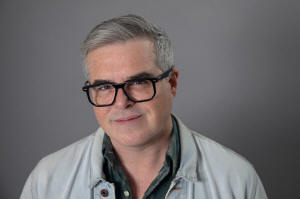
Ryan Schreiber poses for a portrait in New York on Nov. 10, 2026.
(Photo by Andy Kropa/Invision/AP)
 Stories from the internet's Wild
West
“Weird Era” is ripe with anecdotes from each stage of the
publication's trajectory, from its DIY origins to “the Kanye and
Beyoncé era” of the 2010s, as Schreiber describes the moment indie
rock and the site itself began to be co-signed by pop and hip-hop's
most influential innovators.
It's also a peek behind the curtain, exposing some of the site's
day-to-day operations: how Schreiber created its “Best New Music”
model, how scores are determined and discussed internally, how its
voice moved from sardonic to incisive (often both at once) and how
the scope of Pitchfork's independent editorial coverage adapted to
meet the current moment — all while maintaining its reputation as
“the most trusted voice in music,” as its tagline reads.
And, of course, it concludes with Condé Nast, which Schreiber sold
Pitchfork to in 2015. The decision — eulogized online as the end of
the site by fans and foes alike, for going corporate — was for
survival.
“Many of the advertisers that had supported Pitchfork were jumping
ship and doing social media marketing. ... It was dramatic, how
quickly it happened,” he says. “At the same time, we had also just
taken on a lot of new ventures to kind of help keep Pitchfork
growing, expanding.”
The subscription model hadn't fully taken hold of the internet, and
the site was at a crossroads. Joining Condé Nast, even with its
“outrageous promises that didn't necessarily seem outrageous at the
moment,” he says, felt like their only opportunity to “help secure
the future of Pitchfork in the long term and give us access to new
resources.”
“It was a decision that, at the time, felt like we had better do
this or else,” he says.
Then came a gut punch: In 2024, Condé Nast announced Pitchfork would
be folded into GQ, a men’s fashion and style magazine.
“Music is so much more than a ‘men’s interest’ or leisure pursuit,”
The Guardian’s deputy music editor Laura Snapes told The Associated
Press at the time. “Pitchfork paid close, longform critical
attention to so many different types of music, and so many different
niches. I’m not sure how that will live alongside ecommerce pieces
on stick vacuums.”
Schreiber says that in 2026, Pitchfork “may not have necessarily the
impact that it once had,” but it remains critically “important to a
lot of people and it still has a huge and very loyal readership.”

Pitchfork's legacy in music media
Schreiber continues to work as a journalist, media strategist and
public speaker. But now, a few years removed from the site he
founded, and in the exercise of writing a memoir, he's able to
theorize why Pitchfork became a cultural force.
“In-depth, insightful criticism,” he says, is its primary legacy —
along with being “the big torchbearer for music criticism, both in
terms of the music press’ role as a tastemaker and its
responsibility of bringing artists to light who might not have other
channels through which to gain an audience.”
That influence is still felt. “There was a period of time where if
Pitchfork said something was good, I thought it was good. And if
they panned something, I probably wouldn’t bother listening to it,”
says Gareth Paisey, singer of the Welsh indie band Los Campesinos!
“I think that speaks to its power — how it was able to push the
needle and single-handedly make something seem relevant.”
All contents © copyright 2026 Associated Press. All rights reserved |