Medicare for All was once a long shot. Now, steps toward it are part of
the Democratic agenda
[November 24, 2026]
By LISA MASCARO
WASHINGTON (AP) — What were once long-shot ideas around universal
healthcare — championed by Sen. Bernie Sanders' Medicare for All — have
suddenly been catapulted to the forefront of the Democratic agenda for
the new Congress in January.
The party in its first 100 days is planning swift action on legislation
to reverse recent Medicaid cuts that threaten to leave millions of
people without care and to revive tax breaks that help people who buy
insurance through the Affordable Care Act.
But it's also becoming clear that the Democrats have far more ambitious
healthcare goals as they prepare to take charge on Jan. 3, 2027.
Democratic leader Hakeem Jeffries of New York, on track to become House
speaker, announced his intentions to take steps toward Medicare for All
in a post-midterm election speech that stunned health advocates. He
listed proposals to lower the Medicare eligibility age below 65, add
dental, vision and hearing aid benefits, and open up healthcare to
children as part of the incoming majority's plans — all aspects of
Medicare for All.
Sanders, a Vermont independent who caucuses with Democrats, unveiled his
push for portions of Medicare for All as he takes over the chairmanship
of the Senate health committee.
And even former President Barack Obama encouraged newly elected
Democrats to go beyond the ACA, also known as Obamacare, which was among
his signature accomplishments in office.
“We got the ACA done, which was wonderful,” Obama said, according to a
transcript of his remarks to the incoming Democrats at the Capitol.
“But I was very explicit at the time. This is a starter home. It is not
the answer,” he said. “You should push further and get more.”

After a change election that ousted Republicans in a rebuke of President
Donald Trump's party, Democratic leaders are eager to use their incoming
wide majorities in the House and the Senate to deliver on their campaign
promises, particularly healthcare affordability.
The details are still taking shape, and there almost certainly will be
pushback from moderate and centrist Democrats who helped win the
majorities, especially regarding the costs of any healthcare expansion.
But Democratic leaders appear increasingly confident that proposals to
expand healthcare are no longer far-flung liberal ideas but are basics
that voters who sent them to Washington expect from their government.
“It's been an ongoing conversation over the last several months, about
how we acknowledge the urgency of the moment on healthcare and that it
can’t just be going back to restoring what was,” said Rep. Pramila
Jayapal, D-Wash., who has been in talks with Jeffries about moving the
legislation forward.
Voters want more government action on healthcare
About 6 in 10 voters nationally said the federal government should play
a bigger role in helping Americans get healthcare than it does now,
according to The AP Voter Poll, a survey of more than 100,000 midterm
voters.
The same number said they are “very concerned” about the cost of
healthcare, according to the survey.
Sanders, who has advocated for healthcare essentially since he arrived
in Congress more than 30 years ago, is now seen as an elder statesman on
the issue for a new generation of lawmakers, including Rep. Alexandria
Ocasio-Cortez, D-N.Y.
Jeffries, who had been an early co-sponsor of Medicare for All but
backed away once he became House Democratic leader after the 2022
election, recently namechecked Sanders as the “O.G.” whose committee
will be among those tackling the issue.
“We’re going to begin very early on in the new Congress by working to
reverse the Medicaid cuts and working to extend the Affordable Care Act
tax credits," Jeffries said at a post-election conference of Democrats
in Denver.
[to top of second column]
|
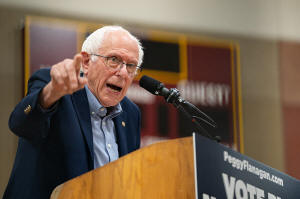
Sen. Bernie Sanders, I-Vt., speaks at a campaign rally in support of
Minnesota Lt. Gov. Peggy Flanagan, Oct. 24, 2026, at Lincoln Park
Middle School in Duluth, Minn. (AP Photo/Erica Dischino, File)

“And then we’ve got to go further to make sure that we don’t just fix
what’s broken but that we build upon what we need to do,” he said, as a
heckler tried to shout him down.
Jeffries went on, “I think we’ve got to lower the age of eligibility as
it relates to Medicare. I think we’ve got to make sure that we cover
hearing, vision and dental, and we got to make sure that every child in
America can be able to see a doctor with high-quality, affordable
healthcare."
Progressives were thrilled. Jeffries had essentially outlined the first
year of Medicare for All's multiyear phase-in plan.
“We had a sense that he was positively inclined,” said Jayapal, who is
also a past chair of the Congressional Progressive Caucus, “but he just
went ahead and did it.”
Trump has the power of veto but also a penchant for deals
Trump has promised to use the power of the presidential veto to swat
back the Democratic agenda.
But as Trump takes stock of his final two years in office with Democrats
in charge of Congress, he has also indicated the potential for
dealmaking with Jeffries and Senate Democratic leader Chuck Schumer.
"They’re all smart,” Trump said about the fellow New Yorkers at a news
conference on Friday, his first since the midterm election blowout.
“They’re going to send things my way, and I’m going to veto them,” he
said. “But I think after a month or so they’re going to send things and
I’m going to say, ‘I’m going to veto — unless you want to do this and
this and this.’”
Trump suggested that after years of his own Republican Party's efforts
on healthcare — largely attempts to repeal and replace Obamacare —
perhaps he could find something better with the Democrats.
"There’s a real possibility that we’ll get a lot of great things done,
especially on healthcare,” he said. “Now, can it be what they want? No,
but it can be a combination of what we all want. And we could end up
with great healthcare in our country.”
Democratic Sen.-elect Abdul El-Sayed of Michigan, who aligns with
Sanders on this and other issues, recently posted imagery of “TrumpCare,”
a golden insurance card, enticing the president to consider a universal
healthcare system.

Senate could prove an obstacle to their plans
With their large House majority, Democrats should be able to quickly
pass their initial bills to reverse the Medicaid cuts and restore the
ACA tax credits, but the outcome in the Senate is less certain.
Democrats will have a 56-seat majority in the 100-member Senate, but
most bills in the Senate require a 60-vote threshold to advance over a
filibuster, if Republicans try to block the legislation. And Trump's
veto threats loom.
But healthcare advocates are pushing Democrats to try anyway and see
what happens.
"Why bother? That’s what members of Congress are elected to do — to try
and try hard," said Brad Woodhouse, a seasoned strategist and executive
director of the advocacy group Protect Our Care, “and if they fail, to
try again.”
All contents © copyright 2026 Associated Press. All rights reserved |