Experts debunk Thanksgiving food myths, from turkey 'coma' to risky
leftovers
[November 24, 2026]
By HOLLY RAMER
CONCORD, N.H. (AP) — Was turkey on the table at the first Thanksgiving?
Probably. Did anyone take a nap afterward? Unclear.
Among the many myths associated with Thanksgiving is the notion that
today's traditional menu harkens back to what the Pilgrims and Wampanoag
people actually ate in November 1621.
While no oral history has been passed down by the Native people, Pilgrim
Edward Winslow briefly described the three-day feast in a letter to a
friend, said Malka Benjamin, director of colonial interpretation and
training at the Plimoth Patuxet Museums in Plymouth, Massachusetts.
According to Winslow’s letter — the only surviving record of the
celebration — the Wampanoag leader Massasoit provided five deer, while
the Pilgrims killed enough fowl in one day to feed the entire colony for
nearly a week. He didn’t mention turkey specifically, but it frequently
shows up in other firsthand accounts of the time period, Benjamin said.
“I feel very confident saying that it’s highly likely there was turkey
on the table, in addition to duck and goose and other kinds of birds,”
she said.
The menu also probably featured seafood, she said, along with squash and
nasaump, a porridge-like Wampanoag dish made with ground corn and
berries. Potatoes? Nope. And while cranberries were available, there was
no sugar to turn them into sauce.
Here are some other more modern myths about Thanksgiving food and what
experts have to say about them:

MYTH #1: Turkey makes you tired
Unless you’ve been asleep for the last few decades, you’ve probably
heard that tryptophan in turkey makes you sleepy. While the amino acid
does spur the creation of feel-good brain chemicals like serotonin and
melatonin, there’s not enough of it in turkey to make you nod off, said
Kimberly Dong, associate professor of public health at Tufts University
School of Medicine. Chicken and beef have similar levels; cheddar cheese
has even more.
“What’s happening is that people are eating a lot of carbohydrate-rich
foods that are really quickly absorbed into the bloodstream,” she said.
That causes a spike in blood glucose levels followed by a rapid drop.
It’s that roller coaster that contributes to fatigue, she said, not the
“turkey coma.”
Overeating in general also makes you sleepy because blood gets diverted
to the gastrointestinal tract to deal with digestion, leaving muscles
tired, said Susan Roberts, a professor and nutrition scientist at the
Geisel School of Medicine at Dartmouth.
“I’m not one of these punitive nutritionists. I think if you have
overeaten and you do feel tired, fine, take a nap,” she said. “Enjoy
it.”
[to top of second column]
|
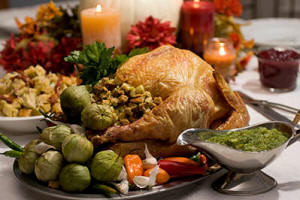
A grill-roasted brined turkey is presented on a table in Concord,
N.H., Oct. 19, 2008. (AP Photo/Larry Crowe, File)
 MYTH #2: Overeating is inevitable
That said, both Dong and Roberts take issue with the idea that
overeating is a given. Skipping breakfast on Thanksgiving might
sound smart, but trying to “save” calories for a big dinner usually
backfires, Dong said, “because you are so ravenous by the time the
food is served.”
Instead, she recommends eating a light breakfast
and staying hydrated early in the day. Roberts, meanwhile, suggests
a multi-day strategy: eating high fiber foods for two days before
Thanksgiving to keep hunger in check.
The experts disagree when it comes to leftovers, however. Dong says
setting aside leftovers can counteract the “this is my one chance to
eat this” mentality that leads to heaping helpings. But Roberts says
hosts should pare back from the start, and that guests who feel they
can’t decline leftovers should throw most, if not all, of them away
at home.
Willpower doesn’t work when a plate of food is in front of you, she
said, because the sights and smells activate the body to receive a
big meal.
“A better place to use your willpower is before it ever comes in the
house, when you’re still full from the Thanksgiving meal,” she said.
“You can throw half or three-quarters of it away now and it’s easy,
but if you put it in the fridge, it becomes a whole different
matter.”
MYTH #3: The sniff test works for leftovers
If you do end up with leftovers, be careful, says Anne Suelzer, a
registered dietitian and licensed dietitian with Health Loft.
Properly stored leftovers will be safe for three or four days, but
don’t rely on your senses to judge.
“The bacteria that make you sick usually don’t change how food looks
or smells,” she said.
Leftovers should be refrigerated within two hours, and the clock
starts when the food comes out of the oven, not when you’re done
eating.
“It helps to start packing things up while people are still at the
table,” she said.
All contents © copyright 2026 Associated Press. All rights reserved
 |