3 GOP states go to US Supreme Court to challenge 3 Democratic-led
states' abortion 'shield' laws
[October 01, 2026]
By GEOFF MULVIHILL and JOHN HANNA
Three Republican states went to the U.S. Supreme Court on Wednesday to
challenge abortion “shield laws” protecting providers in three
Democratic states, escalating the legal conflict over pills that account
for a majority of abortions.
The attorneys general of Alabama, Arkansas and Louisiana contend that
the laws in California, Massachusetts and New York undermine their
abortion bans and their states' sovereignty. Federal regulations allow
prescriptions for abortion pills to be made by telehealth and filled by
mail, and the three GOP states want to keep the pills out and punish
out-of-state providers for sending them.
“This is the first time we've seen a state or group of states suing
other states to challenge the validity of shield laws,” said Mary
Ziegler, a University of California, Davis, law professor and author of
seven books on abortion law and history.
The Supreme Court can hear disputes between states directly, though it
rarely does. If the top court weighs in, it could short-circuit existing
lawsuits.
Louisiana and anti-abortion activists have been frustrated with a lack
of federal action by President Donald Trump's administration against
medication abortion. Louisiana Attorney General Liz Murrill sued the
U.S. Food and Drug Administration over its rules allowing mail-order
prescriptions. The Supreme Court in May preserved access to abortion
medications as that case plays out.

“We need and deserve the opportunity to be able to enforce our laws
against those who have chosen, despite their knowledge of the
illegality, to continue to foster abortion in our state,” Alabama
Attorney General Steve Marshall said during a news conference with
Murrill and Arkansas Attorney General Tim Griffin.
Thirteen states ban abortion in all stages of pregnancy, which the
Supreme Court allowed in its 2022 decision overturning Roe v. Wade. Most
Democratic-controlled states adopted abortion protections, including
eight with laws intended to protect providers who prescribe abortion
pills for patients in states with bans.
Louisiana and Texas have pursued criminal charges and civil claims
against doctors based in New York and California. Officials in
California and New York have refused to cooperate, citing their shield
laws.
“Louisiana, Alabama, and Arkansas are asking the Supreme Court to let
them impose their abortion bans on New York and punish our doctors for
providing legal health care,” New York Attorney General Letitia James
said in a statement Wednesday.
[to top of second column]
|
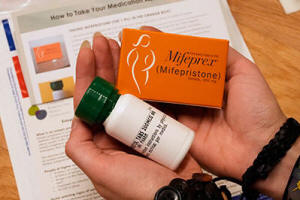
A coordinator shows the medications and care kit sent out the
clients at the Massachusetts Medication Abortion Access Project, May
13, 2025, in Somerville, Mass. (AP Photo/Charles Krupa, File)
 Ziegler said Alabama, Arkansas and
Louisiana would have a stronger case if they had first tried to get
the highest court in one of the three other states to force its
officials to cooperate. She also said the lawsuit's timing is odd —
six weeks before November congressional midterm elections that could
prove difficult for the GOP.
“This may be an example of the political incentives not being the
same for state-level Republicans versus federal Republicans,” she
said. “If you're running in a contested race, calling attention to
abortion is not a great idea, but if you're Louisiana attorney
general, you're not really in that position.”
But Rachel Rebouche, a University of Texas law professor, said suing
other states has been a potential legal strategy for GOP states
since the first shield laws were enacted.
“That it’s taken this long is kind of remarkable,” she said.
Even before Roe was overturned, abortion pills were the most common
means of ending pregnancies in the U.S., and telehealth makes
abortion available even where it's banned. The three GOP attorneys
general said hundreds of patients in their states use pills to end
pregnancies each month.
Also on Wednesday, Alabama, Arkansas and Louisiana filed a lawsuit
against 30 out-of-state abortion pill providers and their officers,
accusing them of false advertising and other misconduct harming
patients in states with abortion bans.
FDA scientists have repeatedly found the regimen safe and effective,
though the agency is now reviewing its rules.
All contents © copyright 2026 Associated Press. All rights reserved
 |