Confidence about the economy is in short supply despite a relatively
solid job market
[October 02, 2026] By
PAUL WISEMAN
WASHINGTON (AP) — The official numbers show that the U.S. job market has
proved sturdy in the face of one shock after another – President Donald
Trump’s trade wars, persistent inflation, high interest rates, and a
conflict with Iran that has sent gasoline prices rocketing higher,
squeezing family budgets.
When the Labor Department releases hiring and unemployment numbers for
September, they’re likely to be solid once again: Forecasters surveyed
by the data firm FactSet expect that employers – businesses, government
agencies and nonprofits – added 90,000 jobs last month and that
unemployment remained low at 4.1%.
Layoffs are rare, and most workers enjoy job security.
But ordinary Americans are not feeling it.
U.S. consumer confidence dropped this month to the lowest level in more
than a decade, according to an index published by the Conference Board.
One reason: More than 28% of the respondents told the business think
tank that they expect fewer jobs to be available in six months, double
the 14% who expect more.
The online jobs site Glassdoor reports that its employee confidence
index, based on how workers view prospects for their own companies,
dropped last month to the lowest level in records going back to the
beginning of 2016, a period that includes a global pandemic. It was the
index’s third record low this year.
“Employee confidence has been continuously grinding downwards over the
last year as workers grow increasingly anxious about everything from
layoffs to AI,’’ said Glassdoor chief economist Daniel Zhao.
The public discontent with the economy comes barely a month before
voters go to the polls for midterm elections that will determine whether
Trump's Republicans maintain full control over Congress. A Thursday poll
from The Associated Press-NORC Center for Public Affairs Research finds
that only 17% of U.S. adults approve of Trump's handling of the cost of
living. Just 26% approve of his handling of the economy overall, marking
a new low.

The public’s misgivings about jobs partly reflect an odd feature of the
current labor market: Employers aren’t laying off many workers, but they
aren’t hiring many either. A Labor Department measure of gross hiring –
before subtracting those who quit or lose their jobs – has been stuck in
a rut for more than two years.
So economists describe a “ low-hire, low-fire ’’ job market in which
those who have jobs are mostly secure, but jobseekers struggle to find
work. In August, the average unemployed person had been out of work for
more than six months, the longest average stretch of joblessness since
February 2022.
“People know that being laid off is unusually costly right now,” said
Glassdoor’s Zhao. “They hear from their friends how long they’ve been
out of work and had such a difficult time finding a job. That does make
layoffs even more scary than usual.’’
In that chilly environment, fewer workers are willing to quit their
jobs. “They often feel stuck,’’ Zhao said. “Workers aren’t finding
there’s opportunity on the open market to find a better job – one that
pays more or offers better work-life balance.’’

[to top of second column] |
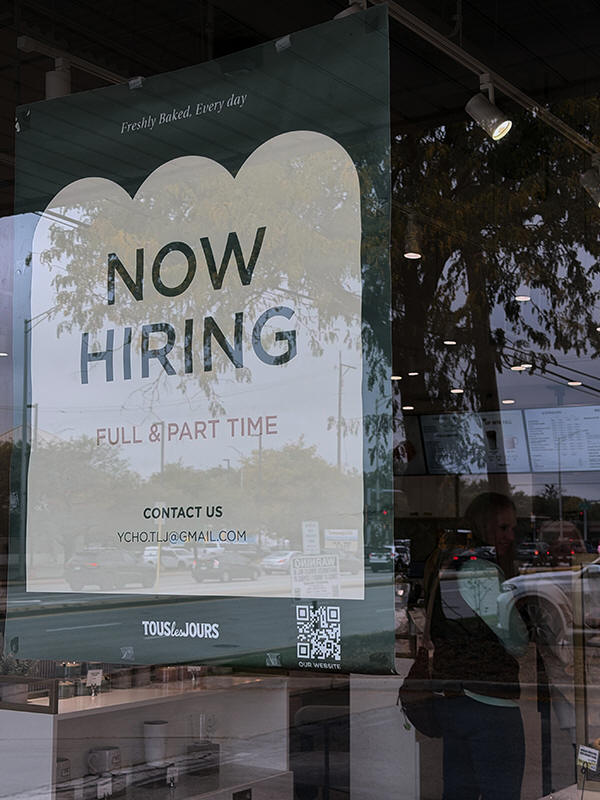
Hiring sign is displayed at a bakery in Arlington Heights, Ill.,
Wednesday, Sept. 30, 2026. (AP Photo/Nam Y. Huh)
 The weak hiring means more meager
wage gains, too. Average hourly pay rose just 3.1% in August from a
year earlier – the stingiest year-over-year increase since May 2021.
Researchers at the Federal Reserve Bank of San Francisco reported in
August that the job search has become tougher for two groups that
should be doing well this deep into an economic expansion.
Normally at this point – the last recession was six years ago --
employers would need workers so badly they’d be willing to take a
chance on applicants who are young or have little experience or
proven skills. But no: “Instead of being pulled in, the pipeline
into employment is shrinking such that the recovery is no longer
reaching workers at the margins,’’ the researchers noted.
Moreover, the unemployed people who normally get back to work the
fastest – those in their prime working years (25 to 54) and with
college educations – are struggling to find new jobs.
The San Francisco Fed researchers aren’t sure what’s making the job
search so tough. They suspect it might have to do with Trump’s
immigration crackdown, hiring slowdowns specifically at tech
companies and government contractors, “the early effects of
AI-related displacement in professional occupations,’’ uncertainty
over the direction of government policy or “early signals of broader
labor market deterioration.’’
Complicating the picture: The United States doesn’t need as many
jobs as it used to keep the unemployment rate stable. Baby boomer
retirements and Trump’s immigration crackdown mean fewer people are
competing for work. As a result, economists say, the so-called
“break-even’’ rate of hiring could be as low as zero jobs a month,
down from perhaps 150,000 a year or so ago.
So far this year, employers have been adding an average 80,000 jobs
a month, more than enough to keep the unemployment rate low, and a
big improvement on the 2025 average of just 9,700 jobs a month – the
feeblest hiring outside a recession since 2002.
Still, hiring remains well below the 166,000 monthly jobs created,
on average, in 2023 and 2024 and the 491,000 a month recorded during
the 2021-2022 hiring boom that followed pandemic lockdowns.
“We are seeing a modest improvement,’’ said Glassdoor’s Zhao.
“Whether that’s enough to really make workers feel good about the
job market is a different question. A modest improvement is not
really the same as opening up opportunities and really making people
feel like they can advance their careers.’’
All contents © copyright 2026 Associated Press. All rights reserved |